Monito del monte


Friends

 Submit your pet
for the cutest pet ever competition


StumbleUpon Toolbar Stumble this page!

Animal of the Day
Subscribe to the
animal of the day
Enter your Email


Powered by FeedBlitz

Top articles


Mammals and their maximum age

Mammals sorted by birth weight

The white rhino

Animals living in the water

Swim with manatees - harmful or helpful?

Picture has been licensed under a GFDL
Original source: Transferred from pl.wikipedia; Transfer was stated to be made by User:Aroche.
Author: Drawn by Dixi from pl.wikipedia
Permission: GNU Free Documentation License
Some facts about the
Monito del monte

Adult weight : 0.024 kg (0.0528 lbs)

Female maturity :730 days

Male maturity : 730 days

Litter size : 3

Interval between litters : 365 days

Source: AnAge, licensed under CC

Monito del monte

Order : Microbiotheria
Family : Microbiotheriidae
Species : Dromiciops gliroides


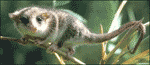
Monito del monte The Monito del monte (Dromiciops gliroides), meaning "little mountain monkey" is also know by the names "Colocolo" or "Chimaihuén". It lives in South America, mostly in Chile and Argentina. They are once believed to belong to the Didelphimorphia, but actually are in an order of their own. Monitos del Monte are mostly carnivorous, feeding on insects and intervertebrates, occasionaly some fruit. They are especially known for their ability to double their body weight in a week (!). They do this when it is time to hybernate. Native people with superstition are scared of the Monitos del monte and have even burnt down their houses when they saw one inside...

Picture copyright by Jaime E Jiménez

The Monito del monte is listed as Vulnerable (VU), considered to be facing a high risk of extinction in the wild, on the IUCN Red List of Threatened Species
Countries
Argentina and Chile

Facts about the monito del monte

Monito del Monte is believed to be primarily arboreal, though it (Full text)

The Monito del Monte is the only member of its family (Microbiotheriidae) and the only surviving member of an ancient order, the Microbiotheria, which is known from Oligocene and Miocene times in South America. (Full text)

The Monito del Monte is the only member of its family (Microbiotheriidae) and the only surviving member of an ancient order, the Microbiotheria, which is known from Oligocene and Miocene times in South America. (Full text)

The Monito del Monte is the only member of its family (Microbiotheriidae) and the only surviving member of an ancient order, the Microbiotheria, which is known from Oligocene and Miocene times in South America. (Full text)

The Monito del Monte is the only member of its family (Microbiotheriidae) and the only surviving member of an ancient order, the Microbiotheria, which is known from Oligocene and Miocene times in South America. (Full text)

The Monito del Monte is the only member of its family (Microbiotheriidae) and the only surviving member of an ancient order, the Microbiotheria, which is known from Oligocene and Miocene times in South America. (Full text)

The Monito del Monte is the only member of its family (Microbiotheriidae) and the only surviving member of an ancient order, the Microbiotheria, which is known from Oligocene and Miocene times in South America. (Full text)

The Monito del Monte is the only member of its family (Microbiotheriidae) and the only surviving member of an ancient order, the Microbiotheria, which is known from Oligocene and Miocene times in South America. (Full text)

The Monito del Monte is the only member of its family (Microbiotheriidae) and the only surviving member of an ancient order, the Microbiotheria, which is known from Oligocene and Miocene times in South America. (Full text)

Google
Contact Us | ©2008 TheWebsiteOfEverything.com | Privacy statement | Pictures and facts about the Monito del monte