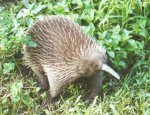
 The Western Long-beaked Echidna (Zaglossus bruijni) is one of four living species of Echidnas (The Cyclops Long-beaked Echidna was recently discovered). The Western Long-beaked Echidna species live in New Guinea, but earlier fossils indicate that they once also occurred in Australia. Echidnas are, together with platypuses, the only known mammals that lay eggs. Together, they are placed in the order Monotremata. The difference between the short-beaked echidna and the long-beaked echidna is that the short-beaked eats termites and ants, while the long-beaked echidna eats earthworms. The Western Long-beaked Echidna is listed as endangered by the IUCN. Their main threats are habitat destruction and hunting.
 Image licensed under GFDL
Keywords: claw
The Long-beaked echidna, long-nosed echidna, long-nosed spiny anteater, new guinea long-nosed echidna is listed as Endangered (EN), considered to be facing a very high risk of extinction in the wild, on the IUCN Red List of Threatened Species
Long-beaked echidna or New Guinean echidna habitats
Forest, Grassland, Subtropical / Tropical Dry forest and Subtropical / Tropical Dry GrasslandSome facts about the
Long-nosed echidna
Adult weight : 7.5 kg (16.5 lbs)
Maximum longevity : 41 years
Weaning : 152 days
Litter size : 1
Weight at weaning : 0.4 kg (0.88 lbs)
Basal metabolic rate : 6 W
Body mass : 11.849 kg (26.0678 lbs)
Temperature : 30.85 °C (87.53 °F)

Custom Search