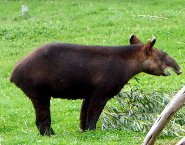
 The Mountain Tapir (Tapirus pinchaque) lives in South American cloud forests and wetlands high in the Andes mountains of Ecuador, Columbia and Peru. Since they live at altitudes up to 14,000 feet, they might get too cold if not for their woolly coats, which are longer than those of most tapir species. They sometimes migrate with the seasons to avoid the annoyance of certain insects. They are the smallest type of tapir.
Expectant mother Mountain Tapirs have a long wait: It can take 400 days before the baby tapir is born! When they are first born, Mountain Tapirs weigh about twenty-six to thirty kilograms (twelve to fourteen pounds)--that's lighter than a miniature poodle--and grow to be up to 250 kilograms (550 pounds). The adults are about 1.8 meters (six feet) in length, about .8 meters (2.5 to three feet) tall, and solid black or dark brown. The babies are brown with cream-colored spots and stripes over their bodies. They stay with their mothers for a year to eighteen months, and can live up to 30 years. When they are grown, they live alone.
Mountain Tapirs are nocturnal, sleeping during the day and foraging at night. They are well-suited to traversing mountainous terrain and are also excellent swimmers.
Sadly, the forests where Mountain Tapirs live are shrinking. The trees are being cut down for lumber and to make room for mining and farming. Experts of the International Union for Conservation of Nature (IUCN) believe that unless the situation changes drastically, the Mountain Tapir may be extinct in a few years. There are only about 2,500 Mountain Tapirs left in the wild, and very few zoos have breeding pairs in captivity.
Humans also threaten the Mountain Tapir more directly: Poachers hunt them for food and their woolly hides, and locals sometimes use various parts of the tapir in home remedies. In addition to poachers, Mountain Tapirs are hunted by mountain lions, spectacled bears and jaguars.
Ferns, grasses, leaves and other plants make up the Mountain Tapir's vegetarian diet. Plant seeds often pass undigested through their systems and grow where they fall. In this way, the tapirs help to renew their own food source.
Picture of the mountain tapir by Elissa Berver, licensed under Creative Commons Attribution-Share Alike 2.0 Generic license.
Keywords: white
Which zoos have them?
Los Angeles Zoo (United States)The Andean tapir, mountain tapir, woolly tapir is listed as Endangered (EN), considered to be facing a very high risk of extinction in the wild, on the IUCN Red List of Threatened Species
Namings for the mountain tapir
A young / baby of a mountain tapir is called a 'larva'. A mountain tapir group is called a 'colony'.Some facts about the
Mountain tapir
Adult weight : 148.95 kg (327.69 lbs)
Maximum longevity : 29 years
Gestation : 398 days
Litter size : 1
Weight at birth : 4.27 kg (9.394 lbs)

Custom Search