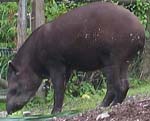
| Pictures of the Brazilian tapir or South American tapir are copyrighted by their owners |
|
Some facts about the
Brazilian tapir
Adult weight : 250 kg (550 lbs)
Maximum longevity : 37 years
Female maturity :1095 days
Male maturity : 1095 days
Gestation : 398 days
Weaning : 289 days
Litter size : 1
Weight at birth : 6 kg (13.2 lbs)
Weight at weaning : 86.26 kg (189.772 lbs)
Brazilian tapir or South American tapir
Order : Perissodactyla
Family : Tapiridae
Species : Tapirus terrestris
The Brazilian Tapir (Tapirus terrestris), also known as the Lowland Tapir, is considered endangered. Although its three relatives, the Mountain Tapir, the Malayan Tapir, and the Baird's Tapir are even more endangered. Males have a Flehmen response when they smell the urine of another male. "The Flehmen response is a particular type of curling of the lips in ungulates, felids, and many other mammals, which facilitates the transfer of chemicals into the vomeronasal organ. This behavior allows animals to smell the urine of others in order to determine several factors. These factors can be the presence or absence of estrus, the physiological state of the animal, and how long ago the animal passed by. This particular response is most recognizable in stallions when smelling the urine of a mare in heat." (source)
It is being hunted for meat, hide, and sport.
About the picture: photo taken by: de:User:Bradypus. Permission is granted to copy, distribute and/or modify this image under the terms of the GNU Free Documentation License
The Brazilian tapir, lowland tapir, south american tapir is listed as Vulnerable (VU), considered to be facing a high risk of extinction in the wild, on the IUCN Red List of Threatened Species
Countries
Argentina, Bolivia, Brazil, Colombia, Ecuador, French Guiana, Guyana, Paraguay, Peru, Suriname and Venezuela
Facts about the Brazilian tapir or South American tapir
© Chester Zoo The South American Tapir is a herbivore.
Brazilian Tapir or Tapirus terrestris is listed on the IUCN Red list (1996) as Vulnerable due to A2cd+3cd+4cd. (Full text)
Animal Description: The beautiful though unusual Brazilian Tapir is, sadly, disappearing from the wild. (Full text)
The beautiful though unusual Brazilian Tapir is, sadly, disappearing from the wild. (Full text)
Because of its widespread range, Tapirus terrestris is in the best shape of the four, being listed as 'vulnerable' to extinction by the 2002 IUCN red list. (Full text)
Tapirus terrestris is distinguished from other Recent tapir species by its enlarged sagittal crest, which appears to be related to a changed timing for expression of the temporalis musculature during the early stages of development (Holbrook, 2002). (Full text)
The South American tapir is dark gray or brown. (Full text)
Brazilian Tapir (Tapirus terrestris) The Brazilian tapir is related to the horse and the rhinoceros. (Full text)
Nearly always found near water, the Brazilian tapir is a good swimmer and diver (Full text)
The Brazilian Tapir is a [CITIES-listed Endangered Species] (Full text)
The proboscis of the lowland tapir (Tapirus terrestris) is flexible and used in foraging for Encyclopædia Britannica, Inc. (Full text)
Tapirus terrestris is one of four living tapir species. (Full text)
The South American tapir is found in wet tropical forests in Colombia, Venezuela, Brazil, Paraguay and northern Argentina. (Full text)
The Brazilian tapir is generally recognized as a endangered animal species, with the species being designated as endangered by the U. (Full text)
Anatomy: The Brazilian tapir is about 3 feet (91 cm) tall at the shoulder; it weighs up to 600 pounds (270 kg). (Full text)
The Malayan also has a distinctive "pig in a blanket" look, with a black head, shoulders and legs and a white body, while the South American tapir is brownish in colour. (Full text)
Virtually the only information available on the South American tapir is anecdotal or comes from observations in captivity, and little or nothing is known about the ecology of this species in the wild. (Full text)
Duncan) Physical Description* Tapirus terrestris is 77 to 108cm [30 to 43 in. (Full text)
The South American tapir is Tapirus terrestris . (Full text)
One of the most distinguishable characteristics of the Brazilian tapir is its proboscis, which is long, flexible, prehensile, and covered with sensory vibrissae. (Full text)
Tapirus terrestris is 77 to 108cm at the shoulder. (Full text)
The South American Tapir is a favourite food of the jaguar, and the flesh is considered palatable by hunters who have eaten it. (Full text)
Brazilian Tapir Skull - The Brazilian Tapier, Tapirus terrestris is generally solitary, and is found near rivers in mesic, transitional, and humid forest. (Full text)
The South American tapir is reported to be cleaned from ectoparasites by black caracaras and pale-winged trumpeters in Amazonian forests (Peres, 1996). (Full text)
It should say Central American tapir, but here is the actual text: Edne, a South American Tapir, is shown here with her day-old baby, born at the St. (Full text)
The lowland, Brazilian, or South American tapir (Tapirus terrestris) is indigenous to most of the rainforested areas of South America. (Full text)
The Brazilian or South American tapir is nearly always found close to water as, like other tapirs, it is a good swimmer. (Full text)
1. New World tapir, Tapirus terrestris -- (a tapir found in South and Central America)New World tapir
Tapirus terrestris
(Source WordNet)