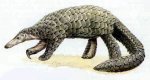
 The Giant Pangolin (Manis gigantea) is the largest of the scaly anteaters or 'pangolins'. It lives in Africa along the equator from west to east and its diet consists almost entirely on ants and termites. Because it eats only ants and termites, the giant pangolin has no teeth and cannot chew. Its main threats are habitat destruction, the bushmeat market, and the illegal medicine market. The giant pangolin, like other pangolins, is nocturnal. It is a good climber and a good digger with its strong claws, which they curl in their paws when walking around.
 Picture by mt.wiki, licensed under GFDL
The Giant ground pangolin, giant pangolin is listed as Least Concern (LR/lc), lowest risk. Does not qualify for a more at risk category. Widespread and abundant taxa are included in this category, on the IUCN Red List of Threatened Species
Countries
Angola, Benin, Burkina Faso, Cameroon, Chad, Congo, Democratic Republic of the, Congo, Republic of the, Equatorial Guinea, Gabon, Ghana, Kenya, Liberia, Niger, Nigeria, Rwanda, Senegal, Sierra Leone, Sudan and Uganda
Custom Search