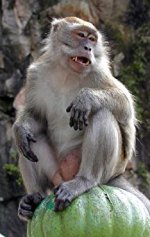
| Pictures of the long-tailed macaque are copyrighted by their owners |
|
Some facts about the
Long-tailed macaque
Adult weight : 6.363 kg (13.9986 lbs)
Maximum longevity : 39 years
Female maturity :1238 days
Male maturity : 1544 days
Gestation : 165 days
Weaning : 242 days
Litter size : 1
Litters per year : 1
Interval between litters : 431 days
Weight at birth : 0.32 kg (0.704 lbs)
Weight at weaning : 0.848 kg (1.8656 lbs)
Long-tailed macaque
Order : Primates
Family : Cercopithecidae
Subfamily : Cercopithecinae
Species : Macaca fascicularis
The Crab eating macaque (Macaca fascicularis) lives in South-east Asia. It is also known for the fact that it is one of the monkey species flown into space. Despite its name, it practically is an omnivore and eats anything it can get its hands to. Its diet is composed of fruits and seeds by 60 - 90%. Where crab-eating macaques live close to humans, this omnivorous behavior will become a problem and the macaque is seen as a crop-raider and a litterer, pushing over garbage cans to look into them for food. The Crab-eating Macaque's native range is the widest of any monkey. Partly because the wild harvest of macaques for medical testing has ended, because these are captive-bred now... Depending on the source, they are "near threatened" or "Lower Risk - Not Threatened". Image by Andrew Lih, licensed under ShareAlike 2.0.
The Crab-eating macaque, cynomolgus monkey, long-tailed macaque is listed as Near Threatened (Near Threatened (NT), is close to qualifying for or is likely to qualify for a threatened category in the near future, or LR/nt), is close to qualifying for or is likely to qualify for a threatened category in the near future, on the IUCN Red List of Threatened Species
Countries
Brunei, Burma, Cambodia, India, Indonesia, Malaysia, Palau, Philippines, Singapore, Thailand and VietnamHabitats
Forest, Subtropical / Tropical Dry forest, Subtropical / Tropical Mangrove Vegetation Above High Tide Level and Temperate forest
Facts about the long-tailed macaque
A stereotaxic brain atlas of the longtailed macaque (Macaca fascicularis) is presented in a format suitable for use as a template atlas of the macaque brain. It includes most of the brain segmented to show the boundaries of landmark structures such that every point in the brain can be represented by a unique set of coordinates in three-dimensional space and ascribed unambiguously to one and only one primary structure. More than 400 structures are represented, including 360 volumetric structures, which constitute the substance of the brain, and 50 superficial features. To facilitate use with ventriculography, magnetic resonance imaging, and other noninvasive imaging techniques, the stereotaxic space is referenced to internal landmarks, viz., the anterior commissure and posterior commissure; the center of the anterior commissure at the midline is the origin of the stereotaxic axes. Reference of stereotaxis to this bicommissural (Full text)
The long-tailed macaque is also called crab-eating macaque because it is common in coastal forests including mangrove and beach, and along rivers where it can easily catch and eat crabs, frogs, or insects. (Full text)
The long-tailed macaque is the monkey most commonly seen in Panaga. (Full text)
Long-tailed macaques are among the most commonly used laboratory animal, second only to the rhesus monkey. (Full text)
The long-tailed macaque is a forest-edge species, thriving in rural, and even urban, areas. (Full text)
- macaca fascicularis is financial report write (Full text)
Approximately 675 long-tailed macaques are housed at the (Full text)
Long-tailed macaques are common in a variety of habitats across southern Asia. (Full text)
long-tailed macaque, Macaca fascicularis, is also called (Full text)
Long-tailed macaques are hunted for food and as a pest on cultivated crops. (Full text)
Macaca fascicularis is the least shy of the forest dwellers; when (Full text)
Long-tailed Macaque is to be found in a wide range of habitats including (Full text)
The long-tailed macaque, Macaca fascicularis, is a major reservoir for the herpes B virus. (Full text)
Data on Barbary (Macaca sylvanus) and long-tailed macaques are (Full text)
- goat horny maca weed macaca fascicularis is financial dictionary (Full text)
the long-tailed macaque is a tropical species which particularly favours (Full text)
The new policy points out, for example, that the long tailed macaque is (Full text)
Bonnet macaque is found in the whole of South India, whereas long-tailed macaque is (Full text)
Long-tailed macaques are the most common primates in freshwater swamp forests. (Full text)
The cynomolgus macaque (Macaca fascicularis) is currently being used in our laboratory as a model to assess these risks. (Full text)
Long-tailed macaques are primarily frugivorous but also eat seeds, leaves, insects, frogs and crabs. (Full text)
The long-tailed macaques are allowed free rein in the town, parading down the main streets and deftly grabbing food from inattentive vendors and snacking tourists. (Full text)
Tantri Yuliandini, The Jakarta Post, JakartaA long-tailed macaque is suspended by the tail from the ceiling of what appears to be a workshop, while a man holds the primate's head to stop it struggling as he burns the animal with a blowtorch to seal in its internal juices. (Full text)
1. meter, metre, m -- (the basic unit of length adopted under the System International d'Unites (approximately 1.094 yards))meter
metre
m
2. molarity, molar concentration, M -- (concentration measured by the number of moles of solute per liter of solvent)
molarity
molar concentration
M
3. thousand, one thousand, 1000, M, K, chiliad, G, grand, thou, yard -- (the cardinal number that is the product of 10 and 100)
thousand
one thousand
1000
M
K
chiliad
G
grand
thou
yard
(Source WordNet)