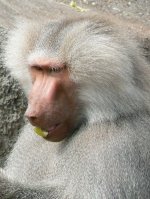
Hamadryas baboon


StumbleUpon Toolbar Stumble this page!

Animal of the Day
Subscribe to the
animal of the day
Enter your Email


Powered by FeedBlitz

Top articles


Animals living in the water
Swim with manatees - harmful or helpful?

Pictures of the hamadryas baboon are copyrighted
by their owners
Some facts about the
Hamadryas baboon

Adult weight : 18 kg (39.6 lbs)

Maximum longevity : 38 years

Female maturity :1514 days

Male maturity : 1762 days

Gestation : 171 days

Weaning : 300 days

Litter size : 1

Litters per year : 1

Interval between litters : 568 days

Weight at birth : 0.814 kg (1.7908 lbs)

Weight at weaning : 3.95 kg (8.69 lbs)

Mortality rate doubling time : 4 years

Basal metabolic rate : 21 W

Body mass : 12.671 kg (27.8762 lbs)

Source: AnAge, licensed under CC

Hamadryas baboon

Order : Primates
Family : Cercopithecidae
Subfamily : Cercopithecinae
Species : Papio hamadryas


Hamadryas baboonThe Hamadryas Baboon (Papio hamadryas) is an old world monkey, living in Africa in Eritrea, Egypt, Ethiopia, Somalia and the Arabian Peninsula (Saudi Arabia and Yemen). Like all other baboons, there is a big difference in size between male and females. Males tend to be twice as big as females. They live in 'harems' of which one male, the Alpha-male, is the leader and up to 15 females can follow him. Such a harem is called an 'OMU', or 'One Male Unit', and is a highly complex social structure. Its main threat is habitat loss, because of transformation into fields and pasture land. It faces almost no threat from leopards and lions because of the low numbers of these animals in the range of the Hamadryas Baboon.

Interesting fact: In old Egypt, the Hamadryas Baboon was a sacred animal, since it was the attendant to the deity Toth, hence it is also called the 'Sacred Baboon'.

The Hamadryas baboon, sacred baboon is listed as Near Threatened (Near Threatened (NT), is close to qualifying for or is likely to qualify for a threatened category in the near future, or LR/nt), is close to qualifying for or is likely to qualify for a threatened category in the near future, on the IUCN Red List of Threatened Species
Namings for the hamadryas baboon
A young / baby of a hamadryas baboon is called a 'infant'. A hamadryas baboon group is called a 'troop, congress, tribe or flange'.
Habitats
Desert and Hot Desert

Facts about the hamadryas baboon

This particular nomenclature has gained wide acceptance among socioecologists, probably because hamadryas baboons are the most distinctively different among the baboons ecologically and behaviorally. (Full text)

Characteristics: The male hamadryas baboon is gray,with a long shoulder cape; the female is olive brown, without a cape. (Full text)

Hamadryas baboons are the smallest of baboons. (Full text)

Our Hamadryas Baboon is built over a hand-made (Full text)

Male hamadryas baboons are grey with a long shoulder cape, and the females are olive brown without a cape. (Full text)

Hamadryas baboons are found in northeastern Sudan, eastern Ethiopia, (Full text)

The Hamadryas baboon is found in Ethiopia, Somalia, Saudi Arabia and Yemen. (Full text)

Hamadryas Baboons are large monkeys with elongated, dog-like snouts, small ears and well developed canine teeth. (Full text)

The social behavior of the Hamadryas Baboon is extremely complex. (Full text)

Hamadryas Baboons are omnivorous and are adapted to their relatively dry habitat. (Full text)

The Hamadryas Baboon (Papio hamadryas) is a baboon from the Old World monkey family. (Full text)

Both olive and Hamadryas baboons are native to northeast Africa. (Full text)

"Hamadryas Baboon" is a neurotic 8 selection collection of contrabass (upright classical bass) that clocks in at 70 minutes. (Full text)

"The hamadryas baboon is found in the countries of Ethiopia, Saudi Arabia, Somalia, and Yemen". (Full text)

Male Hamadryas baboons are grey in colour and have long shoulder cape; the (Full text)

The group assembled in Seattle felt strongly that the baboon (Papio hamadryas) is the (Full text)

The hamadryas baboon, Papio hamadryas, is 76 centimetres tall with a tail 61 centimetres long; the females have brown hair and the males have grey hair with a long mane. (Full text)

Both olive and Hamadryas baboons are native to (Full text)

The Hamadryas baboon is considered sacred in (Full text)

Listening to Hamadryas Baboon is like being invited into someone's subconscious and discovering an undulating mass of neurotic quirks. (Full text)

Papio hamadryas is closely related to other baboons of the (Full text)

The baboon is endangered but the Hamadryas baboon is extinct. (Full text)

Hamadryas baboons are found in the arid lands of the Horn of Africa, in parts of Ethiopia, Eritrea, Sudan (Full text)

1. Papio, genus Papio -- (baboons)
Papio
genus Papio
(Source WordNet)

Google
Contact Us | ©2008 TheWebsiteOfEverything.com | Pictures and facts about the Hamadryas baboon