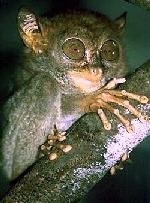
Philippine tarsier


Friends

 Submit your pet
for the cutest pet ever competition


StumbleUpon Toolbar Stumble this page!

Animal of the Day
Subscribe to the
animal of the day
Enter your Email


Powered by FeedBlitz

Top articles


Mammals and their maximum age

Mammals sorted by birth weight

The white rhino

Animals living in the water

Swim with manatees - harmful or helpful?

Picture has been licensed under a Creative Commons Attribution.
Original source: Tarsier Sanctuary, Corella, Bohol via AnimalPhotos.info
Author: Kok Leng Yeo
Permission: This file is licensed under Creative Commons Attribution 2.0 License
Some facts about the
Philippine tarsier

Adult weight : 0.119 kg (0.2618 lbs)

Maximum longevity : 16 years

Gestation : 179 days

Weaning : 83 days

Litter size : 1

Weight at birth : 0.026 kg (0.0572 lbs)

Body mass : 0.113 kg (0.2486 lbs)

Temperature : 33.85 °C (92.93 °F)

Source: AnAge, licensed under CC

Philippine tarsier

Order : Primates
Family : Tarsiidae
Species : Tarsius syrichta


Philippine tarsierThe Philippine Tarsier (Tarsius syrichta) is a nocturnal creature, which exists only on the Philippines. It has the largest eyes relative to its body and head. Other species of tarsier exist on Borneo and Sumatra. The tarsier is the only primate that can turn their heads 180 degrees in each direction along with the primates in the genus Galago. What appears pitch black to humans can be seen by nocturnal animals, the reason is the structure of their nocturnal eyes. Read it here. Tarsiers are known to injure or kill themselves when caged (source).

Permission is granted to copy, distribute and/or modify this image under the terms of the GNU Free Documentation License, Version 1.2 or any later version published by the Free Software Foundation; with no Invariant Sections, no Front-Cover Texts, and no Back-Cover Texts
Subject to disclaimers. Original copyright holder is LDC,Inc. Foundation. Now released with GFDL license.

The Philippine tarsier, phillipine tarsier is listed as Data Deficient (DD), inadequate information to make a direct, or indirect, assessment of its risk of extinction, on the IUCN Red List of Threatened Species
Countries
Philippines

Facts about the Philippine tarsier

Tarsius syrichta is found in the rainforests of the East Indies, from Sumatra to the Philippines and Sulawesi. (Full text)

The Philippine tarsier is found in areas of tall grasses, bushes, bamboo shoots, and small trees in tropical rainforests. (Full text)

The Philippine Tarsier, scientific name Tarsius syrichta is a threatened and endangered species, like that of the Philippine eagle. (Full text)

Philippine Tarsier (Tarsius syrichta) is a tarsier that was, for a (Full text)

Tarsius syrichta is a threatened and endangered species. (Full text)

Spearheading the campaign to save the Philippine tarsier is the Philippine Tarsier Foundation, a nonstock, non-profit organization based in Tagbilaran City, the capital of Bohol. (Full text)

Tarsius syrichta is made possible. (Full text)

WHEREAS, the preservation of the Philippine Tarsier is a matter (Full text)

Spearheading the campaign to save the Philippine tarsier is the Philippine Tarsier Foundation, a nons. (Full text)

Philippine Tarsier (Tarsius syrichta) is a tarsier that was, for a very long time, believed to exist only in the provinces of Samar, Leyte, and Bohol, Philippines. (Full text)

According to the IUCN "Redlist", the Philippine tarsiers are a threatened species (listed (Full text)

The Philippine Tarsier, Tarsius syrichta, is a unique animal (Full text)

(Biologists say Philippine tarsiers are actually a species of (Full text)

In fact, some brochures claim Philippine tarsiers are found only in (Full text)

In many respects, the Philippine tarsier is different (Full text)

The Philippine Tarsier is most commonly found on the islands of Bohol, Samar, Leyte, and Mindanao. (Full text)

1. Tarsius syrichta -- (a variety of tarsier)
Tarsius syrichta
(Source WordNet)

Google
Contact Us | ©2008 TheWebsiteOfEverything.com | Privacy statement | Pictures and facts about the Philippine tarsier