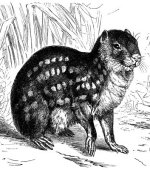
| Pictures of the paca are copyrighted by their owners |
|
Some facts about the
Paca
Adult weight : 9 kg (19.8 lbs)
Maximum longevity : 16 years
Female maturity :365 days
Male maturity : 365 days
Gestation : 116 days
Weaning : 78 days
Litter size : 1
Litters per year : 2
Interval between litters : 191 days
Weight at birth : 0.68 kg (1.496 lbs)
Basal metabolic rate : 15 W
Body mass : 9.156 kg (20.1432 lbs)
Temperature : 36.85 °C (98.33 °F)
Paca
Order : Rodentia
Suborder : Hystricognathi
Family : Agoutidae
Species : Agouti paca
The Paca (Agouti paca) is a solitary, nocturnal animal which can be found from Mexico to Paraguay. It lives in the rainforests near water and can dig burrows that can be two meters in length, with usually one exit, and Pacas have usually more than one burrow. To escape danger, Pacas usually flee to the water, they are good swimmers. Pacas have three to five spots on the sides of their bodies and can weigh between 6 and 12 kilos. They use their urine and anal glands to mark their territories. The Paca is considered a pest by the formers as they eat their food crops like yams, cassavas, sugar canes and corns. While they are not endangered, their numbers decline due to habitat destruction and hunting.
The Spotted paca is listed as Least Concern (LR/lc), lowest risk. Does not qualify for a more at risk category. Widespread and abundant taxa are included in this category, on the IUCN Red List of Threatened Species
Countries
Argentina, Belize, Bolivia, Brazil, Colombia, Costa Rica, El Salvador, French Guiana, Guatemala, Guyana, Honduras, Mexico, Nicaragua, Panama, Paraguay, Suriname, Trinidad and Tobago and Venezuela
Facts about the paca
Behavior Pacas are solitary and little interaction occurs between individuals. (Full text)
(Linnaeus, 1766) The Paca (Agouti paca) is a large rodent found in tropical and sub-tropical America, from East-Central Mexico to Paraguay. (Full text)
The Paca (Agouti paca) is a large rodent found in tropical and sub-tropical America, from East-Central Mexico to Paraguay. (Full text)
Agouti paca (Linnaeus, 1766) The Paca (Agouti paca) is a large rodent found in tropical and sub-tropical America, from East-Central Mexico to Paraguay. (Full text)
Because Hush Pacas are all-natural, we use natural preservatives only; no artificial preservatives. (Full text)
Pacas are sexually mature at about 1year. (Full text)
The Paca (Agouti paca) is a large rodent found in tropical (Full text)
"Created by Breeders for Breeders,"© PACA+™ is without a doubt, the (Full text)
Paca PacaStatus Lower Risk image here--> Scientific classification Kingdom:Animalia Phylum:Chordata Class:Mammalia Order:Rodentia Family:Dasyproctidae Genus:Agouti Species:paca Binomial name Agouti paca (Linnaeus, 1766) The Paca (Agouti paca) is a large rodent found in tropical and sub-tropical America, from East-Central Mexico to Paraguay. (Full text)
PACA is the Philadelphia Area Coaches Alliance, a non-profit organization of personal and professional coaches in the Philadelphia region. (Full text)
Pacas are reddish brown with three or four rows of white spots that may form stripes along the sides of their bodies. (Full text)
Cristobal Galindo-Galindo [*] The agouti (Agouti paca) is a widespread Latin American species, ranging from southwestern Brazil (Perez 1992; Woods 1992) to Tamaulipas, Mexico (Moreno-Valdez et al. (Full text)
Paca Paca :Animalia :Chordata :Mammalia :Rodentia :Dasyproctidae :Agouti :paca Binomial name Agouti paca (Linnaeus, 1766) The Paca (Agouti paca) is a large rodent found in tropical and sub-tropical America, from East-Central Mexico to Paraguay. (Full text)
dasyproctid Pacas are sometimes considered agricultural pests, as they may destroy yams, cassava, sugar cane, corn, and other crops. (Full text)
Agouti: Pacas Pacas are sometimes considered agricultural pests, as they may destroy yams, cassava, sugar cane, corn, and other crops. (Full text)
PACA is a subsidiary of DHB Industries Inc. (Full text)
The Preservation and Conservation Association (PACA) is a non-profit, 501(c)3 organization dedicated to preserving buildings and open spaces in Champaign County, Illinois. (Full text)
William Paca is actively seeking volunteers. (Full text)
The intent of PACA is to encourage fairness and feedback as a method of working with shows to produce events to suit their audiences. (Full text)
1. agouti, Dasyprocta aguti -- (agile long-legged rabbit-sized rodent of Central and South America and West Indies; valued as food)agouti
Dasyprocta aguti
(Source WordNet)