
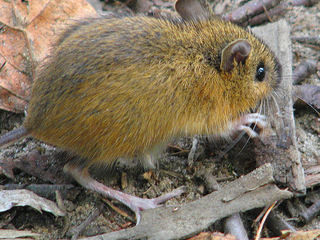
Author: D Gordon E. Robertson
Permission: GNU Free Documentation License
Woodland jumping mouse
Order : Rodentia
Suborder : Sciurognathi
Family : Dipodidae
Subfamily : Zapodinae
Species : Napaeozapus insignis
Keywords: tail
The Woodland jumping mouse is listed as Least Concern (LR/lc), lowest risk. Does not qualify for a more at risk category. Widespread and abundant taxa are included in this category, on the IUCN Red List of Threatened Species
Namings for the woodland jumping mouse
A young / baby of a woodland jumping mouse is called a 'pinkie, kitten or pup'. The females are called 'doe' and males 'buck'. A woodland jumping mouse group is called a 'nest, colony, harvest, horde or mischief'.Some facts about the
Woodland jumping mouse
Adult weight : 0.025 kg (0.055 lbs)
Female maturity :256 days
Gestation : 29 days
Weaning : 36 days
Litter size : 4
Litters per year : 1
Weight at birth : 0.001 kg (0.0022 lbs)
Weight at weaning : 0.009 kg (0.0198 lbs)
Body mass : 0.022 kg (0.0484 lbs)
Temperature : 36.85 °C (98.33 °F)
Facts about the woodland jumping mouse
The Woodland Jumping Mouse is from the order Rodentia. (Full text)
The woodland jumping mouse is found from Labrador, Quebec, and New Brunswick west to southeastern Manitoba, Canada, and south in the Appalachian Mountains to eastern Kentucky and northern Georgia. (Full text)
Food Habits The woodland jumping mouse is omnivorous; the diet includes seeds, fungi, insects, fruit, nuts and other plant matter.
The woodland jumping mouse is a common resident of coniferous, deciduous, and mixed forests in the Adirondacks to elevations of 1189 m (3900 ft). (Full text)
The woodland jumping mouse is primarily nocturnal and is active only during the warmer months.
The woodland jumping mouse is the champion jumper of all North American rodents. (Full text)
The Woodland jumping mouse is mostly brown with a black back.
Habitat Preferences: The distribution of the woodland jumping mouse is closely related to distributions of the spruce-fir and hemlock-hardwood forest types of northeastern North America.
Woodland jumping mouse by SamThe Woodland jumping mouse is brightly
More animals beginning with W