
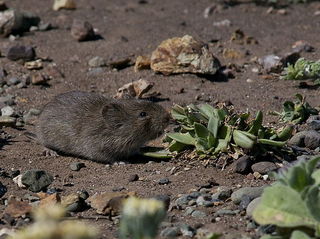
Original source: originally posted to Flickr as Vole (Microtus)
Author: Jerry Kirkhart
California vole
Order : Rodentia
Suborder : Sciurognathi
Family : Muridae
Subfamily : Arvicolinae
Species : Microtus californicus
The California vole is listed as Least Concern (LR/lc), lowest risk. Does not qualify for a more at risk category. Widespread and abundant taxa are included in this category, on the IUCN Red List of Threatened Species
Facts about the California vole
Niche: The California vole is a widespread and common herbivore in California.
California Vole is a 'pest' (an unwanted organism) that can be controlled through the use of pesticides.
California voles are dark black in color and have a faintly bicolored tail.
com Endangered Status The Amargosa Vole, a subspecies of the California Vole, is on the U.
description The California Vole is covered with grayish-brown fur.
REPRODUCTIVE CHARACTERISTICS: The gestation period in Microtus californicus is approximately three weeks, and litter size ranges from 1 to 9, with a mean of about 4 (20).
The California vole (Microtus californicus) is generally found in dense grass, beneath plant residues, in brush piles, beneath logs, and in underground burrows.
Meadow mice and Voles (Subfamily Arvicolinae) The California vole (Microtus californicus) is a coarse brownish above and gray-brown to whitish below. (Full text)
Endangered Status The Amargosa Vole, a subspecies of the California Vole, is on the U. (Full text)
Like most voles, the California Vole is a burrower, but it also forms surface runways. (Full text)
(Left: Like humans, the California vole is both polygamous and monogamous. (Full text)
The California vole (Microtus californicus) is the most widespread vole in the state, found in the Owens and Central valleys and nearly the entire length of the coast range. (Full text)
The California Vole, Microtus californicus, is an herbivorous rodent that goes through boom and bust cycles somewhat asynchronously in the different populations that occur throughout the Southland. (Full text)
California Voles are the preferred prey of White-tailed Kite, pairs of which use the West Mesa and the Cieneguitas Creek Grasslands. (Full text)
More animals beginning with C