
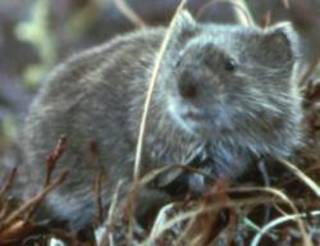
Tundra vole
Order : Rodentia
Suborder : Sciurognathi
Family : Muridae
Subfamily : Arvicolinae
Species : Microtus oeconomus
Keywords: tail , brown , white
The Root vole, tundra vole is listed as Least Concern. Does not qualify for a more at risk category. Widespread and abundant taxa are included in this category, on the IUCN Red List of Threatened Species
Countries
Austria, Belarus, Canada, Czech Republic, Finland, Germany, Hungary, Kazakhstan, Mongolia, Netherlands, Norway, Poland, Russia, Slovakia, Sweden, Ukraine and United StatesSome facts about the
Tundra vole
Adult weight : 0.058 kg (0.1276 lbs)
Female maturity :30 days
Male maturity : 48 days
Gestation : 22 days
Weaning : 19 days
Litter size : 7
Litters per year : 4
Interval between litters : 29 days
Weight at birth : 0.002 kg (0.0044 lbs)
Weight at weaning : 0.018 kg (0.0396 lbs)
Basal metabolic rate : 1 W
Body mass : 0.033 kg (0.0726 lbs)
Temperature : 38.85 °C (101.93 °F)
Facts about the tundra vole
Least weasels are usually found near grassy areas where meadow and tundra voles are common, but they would be adept at catching red-backed voles -- the most common vole -- in our area.
On some islands Microtus oeconomus is out-competed by Microtus arvalis.
The major type of habitats for Microtus oeconomus (tundra vole) is floodplain forests and moist shrub areas.
The root vole (Microtus oeconomus) is a rodent with Holarctic distribution.
Tundra Vole Microtus oeconomus The tundra vole is another holarctic Canadian species.
Tundra Vole or Microtus oeconomus is listed on the IUCN Red list (1996) as Least Concern .
The Tundra Vole is from the order Rodentia. (Full text)
Tundra Vole is yellower. (Full text)
More animals beginning with T