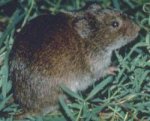
| Pictures of the meadow vole are copyrighted by their owners |
|
Some facts about the
Meadow vole
Adult weight : 0.049 kg (0.1078 lbs)
Female maturity :29 days
Male maturity : 37 days
Gestation : 21 days
Weaning : 14 days
Litter size : 6
Litters per year : 3
Interval between litters : 21 days
Weight at birth : 0.002 kg (0.0044 lbs)
Weight at weaning : 0.012 kg (0.0264 lbs)
Body mass : 0.038 kg (0.0836 lbs)
Temperature : 38.85 °C (101.93 °F)
Meadow vole
Order : Rodentia
Suborder : Sciurognathi
Family : Muridae
Subfamily : Arvicolinae
Species : Microtus pennsylvanicus
The Meadow Vole (Microtus pennsylvanicus) is also called Field Mouse or Meadow Mouse. It is a member of the order Rodentia (rodents) and resembles a mouse, but with a stouter body, a shorter hairy tail, and smaller ears and eyes. The Meadow vole is the most widespread vole in the United States. They are hunted on by snakes, owls, hawks, falcons and various carnivores. Its size ranges from 12,8 to 19,5 centimeters. They are active all day, but most active during the night. They dig burrows to store food and give birth (litter size ranges from 2 to 9, with 6 / 7 on average). Meadow voles can be kept as pets.
The Meadow vole is listed as Least Concern (LR/lc), lowest risk. Does not qualify for a more at risk category. Widespread and abundant taxa are included in this category, on the IUCN Red List of Threatened Species
Facts about the meadow vole
Abstract Abstract The meadow vole, Microtus pennsylvanicus, is the most widely distributed Microtus species in North America.
In regions where Microtus pennsylvanicus is absent, the prairie vole may occupy a variety of open habitats, but in the Upper Midwest it is largely restricted to grasslands that are relatively dry and relatively undisturbed.
Meadow Vole is a 'pest' (an unwanted organism) that can be controlled through the use of pesticides.
Meadow vole: Microtus pennsylvanicus Description: The meadow vole is a small, short-tailed rodent with small eyes,
Meadow voles are listed as feeding on grasses, sedges, seeds, grain, bark, and some insect parts.
Meadow voles are most active above the ground, as evidenced by surface trails often littered with droppings and grass cuttings in the ground vegetation where they live (fig.
Meadow Voles are most active at night during the Summer, and during the day if its Winter.
Only one subspecies of Microtus pennsylvanicus is confirmed in New Mexico, M.
The meadow vole is a plump mammal with short ears and beady eyes and a body that measures seven inches plus a two-inch-long tail.
The meadow vole is found throughout Ohio.
Meadow Vole or Microtus pennsylvanicus is listed on the IUCN Red list (1996) as Lower Risk/Least Concern . (Full text)
Because Microtus pennsylvanicus is intermediate between these two species in distribution and over-water dispersal ability, we predict that it will have more genetic structure than Oryzomys palustris, but less than Peromyscus leucopus. (Full text)
The arrow points to the entrance to underground runway system Damage identification Signs of prairie and meadow voles are found mostly above ground (see above). (Full text)
Ondatra zibethicus Ondatra nebrascensis no other species of Ondatra is present: see Voorhies and Corner 1988 status unclear Microtus pennsylvanicus is an intrusive: KA 1980 Canis sp. (Full text)
richardsonii Ondatra zibethicus Ondatra nebrascensis no other species of Ondatra is present: see Voorhies and Corner 1988 status unclear Microtus pennsylvanicus is an intrusive: KA 1980 Canis sp. (Full text)
The increased food intake and small changes to gastrointestinal morphology during times of increased energy demands suggest that meadow voles are able to meet their energy needs primarily through increased food intake, and therefore more energetically expensive gastrointestinal changes are minimized. (Full text)
The Meadow Vole is from the order Rodentia. (Full text)
Meadow voles are usually seen running and can reach speeds up to 5 to 6 miles per hour! (Full text)
Our interviewee, a meadow vole, is revealed in all its minuscule glory. (Full text)
The meadow vole is common across North America and can be found statewide in North Dakota. (Full text)
Meadow voles are most active above the ground, as evidenced by surface trails often littered with droppings and grass cuttings in the ground vegetation where they live. (Full text)
Description Meadow voles are brown, herbivorous rodents that are 5 to 7 inches long. (Full text)
Meadow Vole: The meadow vole is the most widely distributed species in the United States. (Full text)
Area of Distribution The meadow vole is the most widely distributed vole species in the United States, and is found in the northern United States and Canada. (Full text)
1. meadow vole, meadow mouse, Microtus pennsylvaticus -- (widely distributed in grasslands of northern United States and Canada)meadow vole
meadow mouse
Microtus pennsylvaticus
(Source WordNet)