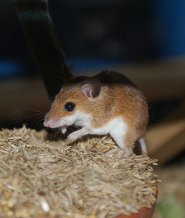
 The African Pygmy Mouse (Mus minutoides) is a very close relative to the common house mouse. This small mammal is also sometimes known as just the Pygmy Mouse. There are a few characteristics that set the African Pygmy Mouse apart from other rodents.
The African Pygmy Mouse is found south of the Sahara in Africa. These animals are native to South Africa, Swaziland, Malawi, Angola, Zambia, Zimbabwe, and Mozambique, although they may sometimes be found in the surrounding countries as well. Within this range they are most often found in grassy areas near a water source.
These animals are best known for their small size. African pygmy mice can be five to seven centimeters, two to two-point-eight inches, long including their tail, which is usually as long if not longer than the body of the mouse. The bodies of these mice are typically two to two and a half centimeters, about an inch, long. They can weigh from three to twelve grams, or eleven hundredths to forty-two hundredths of an ounce. Females are usually a little larger that the males. African pygmy mice have a mostly reddish brown coat with a white underside.
African Pygmy Mice are predominately nocturnal but are sometimes active during the day as well. These animals are extremely active and are known to consume a relatively large amount of water for their size.
These mice are very social and prefer living in groups. They are also very quick breeders with a gestation period of about twenty days and litters of one to six young. At seven days the young begin growing hair, at twelve days they open their eyes, and at about seventeen days they begin exploring outside the nest. These animals reach sexual maturity at four to six weeks of age and live an average of one to three years. One interesting fact about the African Pygmy Mouse is that its sex is determined by the X chromosome rather than the Y unlike most mammals.
The African Pygmy mouse is a unique and interesting species. Despite its prey status this animal is listed as Least Concern by the IUCN Red List. This fascinating species will hopefully continue to have a stable population in the future.
Sources:
Monadjem, A. 2008. Mus minutoides. In: IUCN 2010. IUCN Red List of Threatened Species. Version 2010.1. <www.iucnredlist.org>. Downloaded on 07 May 2010.
CNRS (Délégation Paris Michel-Ange). "African Pygmy Mice: Females Are XY ... Researchers Find out Why." ScienceDaily 25 February 2010. 7 May 2010 http://www.sciencedaily.com /releases/2010/02/100224134147.htm
Brooks, Kevin. "African Pygmy Mouse- Mus minutoides." Exotic Keepers Forum. N.p., n.d. Web. 7 May 2010. http://exotickeepersforum.co.uk/upload/African_Pygmy_Mouse.pdf
Which zoos have them?
Artis (Netherlands)The Pygmy mouse is listed as Least Concern. Does not qualify for a more at risk category. Widespread and abundant taxa are included in this category, on the IUCN Red List of Threatened Species
Namings for the pygmy mouse
A young / baby of a pygmy mouse is called a 'pinkie, kitten or pup'. The females are called 'doe' and males 'buck'. A pygmy mouse group is called a 'nest, colony, harvest, horde or mischief'.Countries
Benin, Burkina Faso, Burundi, Cameroon, Central African Republic, Congo, Democratic Republic of the, Congo, Republic of the, Cote d'Ivoire, Equatorial Guinea, Gabon, Ghana, Guinea, GuineaBissau, Kenya, Liberia, Malawi, Mali, Mozambique, Namibia, Nigeria, Rwanda, Senegal, Sierra Leone, South Africa, Sudan, Swaziland, Tanzania, Togo, Uganda, Zambia and ZimbabwePygmy mouse habitats
Arable Land, Artificial / Aquatic & Marine, Artificial / Aquatic - Irrigated Land (includes irrigation channels), Artificial / Terrestrial, Dry savanna, Forest, Grassland, Mediterranean-type Shrubby Vegetation, Moist savanna, Pastureland, Plantations, Rural Gardens, Savanna, Shrubland, Subtropical / Tropical Dry forest, Subtropical / Tropical Dry Grassland, Subtropical / Tropical Dry Shrubland, Subtropical / Tropical High Altitude Grassland, Subtropical / Tropical Moist Lowland, Subtropical / Tropical Moist Montane, Subtropical / Tropical Moist Shrubland and Urban AreasSome facts about the
Mouse
Adult weight : 0.007 kg (0.0154 lbs)
Maximum longevity : 4 years
Female maturity :60 days
Male maturity : 77 days
Gestation : 20 days
Weaning : 21 days
Litter size : 4
Litters per year : 4
Interval between litters : 31 days
Weight at birth : 0.001 kg (0.0022 lbs)
Weight at weaning : 0.003 kg (0.0066 lbs)
Body mass : 0.008 kg (0.0176 lbs)
Temperature : 35.85 °C (96.53 °F)

Custom Search