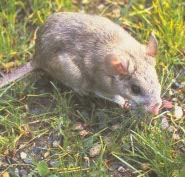
Bushy-tailed woodrat


StumbleUpon Toolbar Stumble this page!

Animal of the Day
Subscribe to the
animal of the day
Enter your Email


Powered by FeedBlitz

Top articles


Animals living in the water
Swim with manatees - harmful or helpful?

Pictures of the bushy-tailed woodrat are copyrighted
by their owners
Some facts about the
Bushy-tailed woodrat

Adult weight : 0.336 kg (0.7392 lbs)

Female maturity :353 days

Gestation : 30 days

Weaning : 27 days

Litter size : 4

Litters per year : 2

Weight at birth : 0.014 kg (0.0308 lbs)

Weight at weaning : 0.107 kg (0.2354 lbs)

Basal metabolic rate : 1 W

Body mass : 0.257 kg (0.5654 lbs)

Source: AnAge, licensed under CC

Bushy-tailed woodrat

Order : Rodentia
Suborder : Sciurognathi
Family : Muridae
Subfamily : Sigmodontinae
Species : Neotoma cinerea


Bush tailed woodratA Bushy-tailed Woodrat (Neotoma cinerea) can be found in North America, ranging from arctic Canada down to northern Arizona and New Mexico, and as far east as the western portions of Nebraska and the Dakotas. The Woodrats can be recognized by their big ears and its bushy tail. Its back is pale gray with a mix of brown, with white underneath.

They are also called as packrats and Bushy-tailed Woodrats are known to be capable of building stick homes within caves and crevices. If you are wondering where the "packrat" came from, a Bushy-tailed Woodrat's house holds items brought in from the outside, such as glass, pine cones, cardboards, plastic odds and ends, wire...you name it.

These woodrats territory is small, and a long time back, it was thought by experts that they would not go away farther than 60m from their nests. However, recent studies assert that the female of its kind could go as far as 500m. Basically, a typical woodrat is solitary, nocturnal and strongly protective of its own territories. Most facets of its behavior is thought to be a by-product of predation, and they have a lot to escape from. Weasels, black bears, bobcats, hawks and so many others, of course...that includes man.

Their diet consists of a variety of ingredients. In dry locations, they could survive on succulents, but in woody habitats, they consume a lot of woody vegetation. A Bushy-tailed Woodrat gets all of the water it needs from the foods it consumes. As prey, they are the main food source for Spotted Owls, and that is an endangered species.

Interesting fact: These woodrats get enticed to shiny things, they often get them from camps and other establishments. So, if you are camping in one of their territories, watch out!

The Bushy-talied woodrat, packrat, woodrat is listed as Least Concern (LR/lc), lowest risk. Does not qualify for a more at risk category. Widespread and abundant taxa are included in this category, on the IUCN Red List of Threatened Species
Namings for the bushytailed woodrat
A young / baby of a bushytailed woodrat is called a 'kitten, nestling, pinkie or pup'. The females are called 'doe' and males 'buck'. A bushytailed woodrat group is called a 'colony, horde, pack, plague or swarm'.
Countries
Canada and United States

Facts about the bushy-tailed woodrat

Bushy-tailed woodrats are currently found at elevations up to at least 3700 m.

In the Jemez, San Juan, and Sangre de Cristo mountains bushy-tailed woodrats are centered in spruce-fir forest, extending somewhat above and somewhat below this zone.

Neotoma cinerea is a species with a somewhat disjunct habitat in New Mexico.

Neotoma cinerea is the largest and most cold-tolerant species of woodrat, and the largest and most sexually dimorphic individuals of this species are found in the northern parts of its range.

Description: The bushy-tailed woodrat is large and has a bushy tail. (Full text)

woodrat (Neotoma cinerea) is attested from 1885, from pack (v. (Full text)

The bushy-tailed woodrat is a large soft-furred rat with a distinctive well-furred tail. (Full text)

Bushy-tailed woodrats are found in early successional through climax stages of succession. (Full text)

Habits - Bushy-tailed woodrats are primarily nocturnal and are most active during the half hour after sunset and at dawn, year-round [1,9,30]. (Full text)

woodrat TAXONOMY : The currently accepted scientific name for the bushy-tailed woodrat is (Full text)

Bushy-tailed woodrats are a solitary species that defend territories (Banfield 1974). (Full text)

Because their middens preserve plant macrofossils and bones, bushy-tailed woodrats are important to paleoscientists as a valuable source of information. (Full text)

The Bushy-tailed Woodrat is from the order Rodentia. (Full text)

Discussion The Bushy-tailed Woodrat is the original "pack rat," the species in which the trading habit is most pronounced. (Full text)

bushytailed woodrat (Neotoma cinerea) is attested from 1885, from pack (v. (Full text)

In the southern Oregon Coast Range, bushy-tailed woodrats are more common in mixed-conifer forests along streams than in Douglas-fir forests [3,4]. (Full text)

The bushy-tailed woodrat is the original "pack rat," the species in which the trading habit is most pronounced. (Full text)

Well, this Bushy Tailed Woodrat is not exactly Bushy Tailed Woodrat a pleasure trip. (Full text)

The bushy-tailed woodrat is mostly a species of the western mountains but can be found in the badlands of southwestern North Dakota in areas of rock and sandstone outcroppings. (Full text)

Both eastern and bushy-tailed woodrats are solitary, mostly nocturnal rodents that are active throughout the year. (Full text)

– A case study involving the discovery of plague-killed woodrats (Neotoma cinerea) is described. (Full text)

bushy-tailed woodrats are light greyish or tawny brown, with black streaks or markings on top and pale undersides (Full text)

Neotoma cinerea is usually distinguishable from N. (Full text)

1. packrat, pack rat, trade rat, bushytail woodrat, Neotoma cinerea -- (any of several bushy-tailed rodents of the genus Neotoma of western North America; hoards food and other objects)
packrat
pack rat
trade rat
bushytail woodrat
Neotoma cinerea
(Source WordNet)

Google
Contact Us | ©2008 TheWebsiteOfEverything.com | Pictures and facts about the Bushy-tailed woodrat