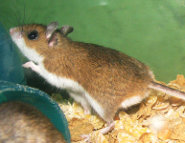
 The deer mouse (Peromyscus maniculatus), is found in North America. This species can also be the cause of dangerous diseases as lyme and hantaviruses. It comes in the same genus, Peromyscus, as Peromyscus leucopus, the white-footed mouse.
 Physical Description:
If the tail of the deer mouse is not considered, then the animal is hardly 7.5 - 11 cm (3-4 inches) long. Its weight is around 15-32 g (0.52-1.12 oz). They have good eyesight and hearing power because of their large eyes and ears. The soft fur of the mouse may vary in color from black to white but all the deer mice are white from underside and have white feet.
Behavior:
Deer mice are known to be nocturnal creatures that generally spend time playing in areas where there are trees. They also like inhabiting a place where there are burrows having nests made from plant materials. The litters of the deer mice are taken care of by the female mother in an individual home. The mouse does not like its litters to get mixed in the group. When the litters grow, the mouse interacts only with its own kind of litter but not with other litters. The homes of the deer mice, although individual, generally overlap. When such overlapping occurs, the probability of mixing of opposite sexes is more than mixing with the same sex.
Life Span and Reproduction:
When a detailed study was conducted, it was found that less than 50% of the total population of male and female deer mice left home to reproduce. This led to a conclusion that they usually mate within the same family and so the overall flow of genes is limited among this species. Reproduction can be done by female mice throughout the year. This is the main reason why deer mice reproduce intensely and rank among the most frequently reproducing animals in their species, even more than the reproduction frequency of mammals. The female mice grant permission to the male mice to keep the litter together and keep them warm, which is very essential for their survival. Although their life expectancy is lesser than 96 months, the average life expectancy of the deer mouse is 45.5 months among the females and it is 47.5 as far as the males are concerned.
Habitat:
The deer mice are generally found in regions like Canada, Alaska, and in some parts of South America. Most of these generally live in hollows that are created at a higher height in a tree. It is common among deer mice to house alone but they may stay along with the mouse of the opposite sex. They have a huge population in the wooden areas or in the mountainous areas. The deer mice are considered to be nocturnal creatures.
Diet:
The deer mice generally like seeds, arthropods, leaves, fruits, fungi etc. Their food habit is not the same throughout the year, since the diet keeps changing according to the season and availability of the type of food. During winters, arthropods form 20% of their diet. These arthropods generally include heteropterans, caterpillars, and spiders. Seeds become the main part of their diet during the spring season as their availability increases along with other types of insects. Deer mice also consume tree leaves in a good quantity during spring. They like thriving on fruits and seeds during the summer season. The deer mice will gradually change their food habit in the fall season as per their usual winter diet.
p.s. The deer mouse is not to be confused with the "mouse deer".
Picture of the deer mouse by 6th Happiness, licensed under Creative Commons Attribution ShareAlike 3.0
Keywords: white
The Deer mouse is listed as Least Concern (LR/lc), lowest risk. Does not qualify for a more at risk category. Widespread and abundant taxa are included in this category, on the IUCN Red List of Threatened Species
Namings for the deer mouse
A young / baby of a deer mouse is called a 'pinkie, kitten or pup'. The females are called 'doe' and males 'buck'. A deer mouse group is called a 'nest, colony, harvest, horde or mischief'.Some facts about the
Deer mouse
Adult weight : 0.021 kg (0.0462 lbs)
Maximum longevity : 8 years
Female maturity :49 days
Gestation : 24 days
Weaning : 22 days
Litter size : 5
Litters per year : 3
Interval between litters : 27 days
Weight at birth : 0.002 kg (0.0044 lbs)
Weight at weaning : 0.009 kg (0.0198 lbs)
Body mass : 0.021 kg (0.0462 lbs)
Temperature : 36.85 °C (98.33 °F)

Custom Search