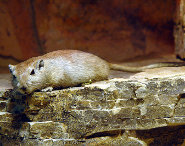
 The fat sand rat (Psammomys obesus), is a relatively small sized rat, with a slightly rotund body. This rodent actually belongs to the gerbil family, and looks very similar to the common gerbil sold in pet stores. Found mostly in North Africa and the Middle East, particularly throughout Egypt, Libya, Palestine, the Sudan coast, and Saudi Arabia, this creature prefers sandy areas, where there is little vegetation and little water. The food that they do eat tends to be low calorie, providing low energy.
The heat of their environment, coupled with their low calorie food, makes them somewhat less active than normal rats. This results in their larger body mass, compared to length. Adult fat sand rats grow to weigh about 212 grams (.4664 lbs). At a length of 85-130 mm, or 3-5 inches, that makes this rat a bit chubby, though not quite as large as the name implies.
While many rats are nocturnal (alert and active mostly at night), the sand rat tends to be more diurnal (more active during the day), though often the high temperatures force the rat to be more active during the cooler times of dusk and dawn. The sand rat’s extra weight results in frequent development of type 2 diabetes. This makes the sand rat a great choice for diabetes research, however, they usually do not do well in captivity.
A forager by nature, this little rat rarely drinks water. Instead, it takes in its liquid nourishment through the vegetation it eats, and by licking morning dew off of plant leaves. The fat sand rat has very efficient kidneys, which are able to remove waste using very little water, while still keeping the rat healthy. The main predator of this rat are the desert lizards, snakes, and birds of prey.
Picture of the fat sand rat by Tino Strauss, licensed under Creative Commons Attribution-Share Alike 2.5 Generic
The Fat sand rat is listed as Least Concern. Does not qualify for a more at risk category. Widespread and abundant taxa are included in this category, on the IUCN Red List of Threatened Species
Namings for the fat sand rat
A young / baby of a fat sand rat is called a 'kitten, nestling, pinkie or pup'. The females are called 'doe' and males 'buck'. A fat sand rat group is called a 'colony, horde, pack, plague or swarm'.Countries
Algeria, Egypt, Israel, Jordan, Libya, Mauritania, Morocco, Saudi Arabia, Sudan, Syria and TunisiaFat sand rat habitats
Seasonal / Intermittent Saline, Brackish or Alkaline Lakes and Flats, Shrubland, Subtropical / Tropical Dry Shrubland and Wetlands (inland)Some facts about the
Fat sand rat
Adult weight : 0.212 kg (0.4664 lbs)
Maximum longevity : 3 years
Female maturity :100 days
Gestation : 24 days
Weaning : 28 days
Litter size : 4
Interval between litters : 38 days
Weight at birth : 0.006 kg (0.0132 lbs)
Weight at weaning : 0.04 kg (0.088 lbs)

Custom Search