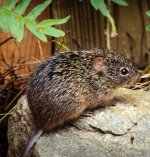
| Pictures of the hispid cotton rat are copyrighted by their owners |
|
Some facts about the
Hispid cotton rat
Adult weight : 0.185 kg (0.407 lbs)
Maximum longevity : 5 years
Female maturity :40 days
Male maturity : 40 days
Gestation : 27 days
Weaning : 15 days
Litter size : 5
Litters per year : 7
Weight at birth : 0.006 kg (0.0132 lbs)
Weight at weaning : 0.02 kg (0.044 lbs)
Basal metabolic rate : 1 W
Body mass : 0.16 kg (0.352 lbs)
Temperature : 37.85 °C (100.13 °F)
Hispid cotton rat
Order : Rodentia
Suborder : Sciurognathi
Family : Muridae
Subfamily : Sigmodontinae
Species : Sigmodon hispidus
The Hispid Cotton Rats (Sigmodon Hispidus), are a kind of rodent considered to be prevalent in North America, South America and Central America. Still, from recent DNA sequence information, experts in the field are asserting that they could be subdivided further into three subspecies. A Hispid Cotton Rat has a gray-enhanced coat of deep-brown hair. It has a dark tail, 5 sets of nipples but it has been known that it could have 6 sets. A typical Hispid Cotton Rat resides in grasslands and of course it is to be expected, as grass is its typical food for survival. They move about in both nighttime and daytime, and you may not believe this, but these Hispid Cotton Rats could swim (a fascinating datum). Its underparts go in colors of gray or white. It has small ears and ordinarily, covered by the fur...and...going back to the tail, it is thinly covered.
As far as breeding is concerned, these rats go on all throughout the year, and gestation time frame is close to a month. Size of the litter can go from 1 up to 15, with the Northern-living rats capable of still bigger sets. A young Hispid Cotton Rat is already well-formed right at birth, and its eyes would be functional within 36 hours (upon birth), the weaning period is approximately 2 weeks (in terms of days, that's 10 to 15).
Interesting fact: Right now, they are not yet endangered, but two of the subspecies have been labelled as Near Threatened, which means it is just a matter of time.
The Hispid cotton rat is listed as Least Concern (LR/lc), lowest risk. Does not qualify for a more at risk category. Widespread and abundant taxa are included in this category, on the IUCN Red List of Threatened Species
Namings for the hispid cotton rat
A young / baby of a hispid cotton rat is called a 'kitten, nestling, pinkie or pup'. The females are called 'doe' and males 'buck'. A hispid cotton rat group is called a 'colony, horde, pack, plague or swarm'.Countries
Belize, Colombia, El Salvador, Guatemala, Honduras, Mexico, Nicaragua, Panama, United States and Venezuela
Facts about the hispid cotton rat
Comments on Species Association Comments on Wildlife Diseases 2000: The full species Sigmodon hispidus is known to transmit the plague.
Food Habits Although hispid cotton rats are omnivorous, they mainly feed upon green vegetation.
hispid cotton rat (Sigmodon hispidus) is a common, omnivorous rodent in the Southeastern U.
HISPID COTTON RAT The hispid cotton rat is a mammal of the southern United
Hispid cotton rats are at home on land and on floating vegetation, and can readily cross gaps between clumps of emergent vegetation, but likely do not use the underwater medium.
Sigmodon hispidus is distributed in 41.
Summary: Identification The hispid cotton rat (Sigmodon hispidus) is a moderately large, robust rodent with a scaly, sparsely haired tail that is shorter than the combined head and body.
URBAN: VEGETATEDYr-RndCasual Use49 Comments on Gap Analysis Habitat Associations Hispid cotton rats are typical of Plains-Mesa Grasslands in New Mexico (Frey and Yates, 1996) *42*.
The cotton rat (Sigmodon hispidus) is a well-documented model for infection by a number of human respiratory pathogens (41), suggesting that this animal's respiratory tract is similar to that of humans. (Full text)
Hispid cotton rats are considered pests in agricultural regions. (Full text)
The Florida rice See Also: RICE (Greek 6p6 a, Latin oryza, French riz, Italian riso, Spanish arroz, derived from the Arabic)RICE, EDMUND IGNATIUS (1762-1844)RICE, JAMES (1843-1882)-rat (Sigmodon hispidus) is another well-known representative of the group. (Full text)
Diurnal and Annual Activity: Some studies have suggested that hispid cotton rats are mainly nocturnal, but activity has been observed at all hours. (Full text)
In southeastern loblolly pine-shortleaf pine stands hispid cotton rats are the dominant herbivorous rodent the first and second years after fire. (Full text)
MANAGEMENT CONSIDERATIONS : The hispid cotton rat is an economic pest in the Southeast where it causes damage to sweet potato, corn, peanut, tomato, sugar cane, squash, (Full text)
TAXONOMY : The currently accepted scientific name for the hispid cotton rat is Sigmodon hispidus Say and Ord. (Full text)
htm The hispid cotton rat (: The hispid cotton rat (Sigmodon hispidus) is a common, omnivorous rodent in the Southeastern US This species is found in a wide variety of habitats including . (Full text)
The grizzled appearance of the hispid cotton rat is the result of a mixture of tan, brown, and black hairs. (Full text)
(112 - 225 g) Physical Characteristics: The grizzled appearance of the hispid cotton rat is the result of a mixture of tan, brown, and black hairs. (Full text)
The Hispid Cotton Rat is one of the most prolific of mammals, breeding as early as six weeks of age. (Full text)
Description: The hispid cotton rat is a relatively large rodent with hispid pelage--that is, dorsal hairs are a mixture of black or dark brown and buffy or gray hairs. (Full text)
Hispid cotton rats are very prolific and in the absence of predators their populations can increase rapidly. (Full text)
1. cotton rat, Sigmodon hispidus -- (destructive long-haired burrowing rat of southern North America and Central America)cotton rat
Sigmodon hispidus
(Source WordNet)