
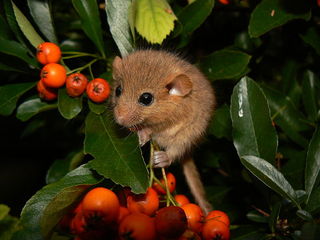
Hazel dormouse
Order : Rodentia
Suborder : Sciurognathi
Family : Myoxidae
Subfamily : Myoxinae
Species : Muscardinus avellanarius
The Common dormouse, hazel dormouse is listed as Near Threatened (LR/nt), is close to qualifying for or is likely to qualify for a threatened category in the near future, on the IUCN Red List of Threatened Species
Countries
Albania, Austria, Belarus, Belgium, Bosnia and Herzegovina, Bulgaria, Croatia, Czech Republic, Denmark, France, Germany, Greece, Hungary, Italy, Latvia, Lithuania, Macedonia, Netherlands, Poland, Romania, Russia, Serbia and Montenegro, Slovakia, Slovenia, Sweden, Switzerland, Turkey, Ukraine and United KingdomSome facts about the
Hazel dormouse
Adult weight : 0.027 kg (0.0594 lbs)
Maximum longevity : 5 years
Female maturity :335 days
Male maturity : 335 days
Gestation : 23 days
Weaning : 39 days
Litter size : 4
Litters per year : 2
Interval between litters : 50 days
Weight at birth : 0.001 kg (0.0022 lbs)
Body mass : 0.024 kg (0.0528 lbs)
Facts about the hazel dormouse
CAPTIVE BRED ANIMALS DIVORCE AND DIE, BUT REINTRODUCTIONS STILL SUCCEED: LESSONS FROM DORMICE The hazel dormouse, Muscardinus avellanarius, is a European protected species indicative of diverse ancient woodlands, a habitat that has greatly declined.
Common dormouse ( Muscardinus avellanarius) is also found in the wetland.
Hazel Dormouse / : is tawny with yellowish tummy.
Hazel Dormouse or Muscardinus avellanarius is listed on the IUCN Red list (1996) as Lower Risk/Near Threatened .
opendocument Woodland wildlife: The once common hazel dormouse Muscardinus avellanarius, is patchily distributed throughout Surrey and has declined greatly due to the cessation of traditional .
The common dormouse (sometimes called the “hazel†dormouse) is strictly protected under UK and European legislation.
The common or hazel dormouse (Muscardinus avellanarius) is no longer as widespread or abundant as its name suggests.
There are two species of dormouse found in Britain, but the hazel dormouse is the only native species.
This rodent, Muscardinus avellanarius, is the sole representative of its genus, but belongs to a familythe Gliridae, or Myoxidaecontaining a small number of Old World species.
KarwinMuscardinus avellanarius is one of Britain's most endangered mammals. (Full text)
Muscardinus avellanarius is one of Britain's most endangered mammals. (Full text)
The Rise of the Dormouse - Britain's endearingly sleepy hazel dormouse is the focus of energetic rescue efforts The dormouse in Patrick James' hand is not living up to its reputation. (Full text)
The fourth dormice species - the common dormouse (Muscardinus avellanarius) - is quite common and widespread in Lithuania. (Full text)
By Tara Mack Britain's endearingly sleepy hazel dormouse is the focus of energetic rescue efforts (Full text)
The hazel dormouse is classified as care-demanding on the national Red List in Sweden. (Full text)
More animals beginning with H