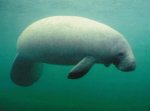
 The West Indian Manatee (Trichechus manatus) is the largest member of the order of Sirenia and can weigh up to 1500 kilograms, although usually somewhere between 400 and 800 kilos. All manatees have a split upper lip. They use both parts of the lip to help put food in their mouths.Because grasses aren't very nutritious they feed on huge quantities. This has also given them a very slow metabolism. Some taxonomies differ two subspecies, the Florida Manatee and the Antillean Manatee. All the three species of manatee are listed as 'vulnerable to extinction' by the IUCN. Although they do not have any natural predators, the increase in human activity has reduced its habitat in the coastal marsh areas and manatees are often injured or killed by collisions with powerboats. Manatees like warm, shallow, coastal estuarine waters, and because of that they often congregate near power plants, where the water is warmer. Some manatees have become reliant on this source of heating and have stopped to migrate to warmer waters. Recently, a couple of power plants have been shut down and the U.S. Fish and Wildlife Service is trying to find a new way to heat the water for these manatees. In Florida, swimming with manatees is a tourist attraction.
The American manatee, antillean manatee, caribbean manatee, north american manatee, sea cow, west indian manatee is listed as Vulnerable (VU), considered to be facing a high risk of extinction in the wild, on the IUCN Red List of Threatened Species
Namings for the West Indian manatee
A young / baby of a West Indian manatee is called a 'calf'. The females are called 'cow' and males 'bull'. A West Indian manatee group is called a 'herd'.Countries
Anguilla, Antigua and Barbuda, Aruba, Barbados, Belize, Brazil, Colombia, Costa Rica, Dominican Republic, French Guiana, Grenada, Guadeloupe, Guatemala, Guyana, Haiti, Honduras, Jamaica, Martinique, Mexico, Montserrat, Nicaragua, Panama, Puerto Rico, Saint Kitts and Nevis, Saint Lucia, Saint Vincent and the Grenadines, Suriname, Trinidad and Tobago, Turks and Caicos Islands, United States and VenezuelaWest Indian manatee habitats
Artificial / Aquatic & Marine, Artificial / Aquatic - Aquaculture Ponds, Artificial / Aquatic - Ponds (below 8ha), Coastal Brackish / Saline Lagoons / Marine Lakes, Coastal Freshwater Lakes, Coral Reef, Epipelagic (0-200m), Estuaries, Freshwater Springs and Oases, Marine Coastal / Supratidal, Marine Intertidal, Marine Neritic, Marine Oceanic, Permanent Freshwater Lakes (over 8ha), Permanent Freshwater Marshes / Pools (under 8ha), Permanent Rivers / Streams / Creeks (includes waterfalls), Salt Marshes (Emergent Grasses), Seagrass (Submerged), Seasonal / Intermittent Freshwater Lakes (over 8ha), Seasonal / Intermittent Freshwater Marshes / Pools (under 8ha), Seasonal / Intermittent / Irregular Rivers / Streams / Creeks and Wetlands (inland)Some facts about the
Caribbean manatee
Adult weight : 322 kg (708.4 lbs)
Maximum longevity : 56 years
Female maturity :1278 days
Male maturity : 913 days
Gestation : 335 days
Weaning : 456 days
Litter size : 1
Interval between litters : 1187 days
Weight at birth : 32 kg (70.4 lbs)
Basal metabolic rate : 70 W
Body mass : 450 kg (990 lbs)

Custom Search