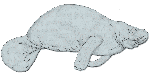
 The African Manatee (Trichechus senegalensis) is a big, roundly-shaped mammal, whose forelimbs could serve as flippers...and whose rear is horizontal and flat. Its flexible flippers are for touching, embracing (other manatees of course) and in moving their food. The upper lip has a bristly layer, and it is segregated. It may interest you to know that they do not have canine teeth/incisors, so what do they have? Only molars, and these are for crushing their vegetation intake. Older ones (molars, not the Manatee) fall out, and a new set materializes.
Another name for it is the 'West African Manatee'. It weighs below five hundred kg. African Manatees are known to reside in lagoons, coastal territories and big rivers- from brackish all the way to freshwater. An African Manatee is dependent on hanging vegetation, as opposed to those submerged. A typical member of this breed is capable of journeying from 30 to 40 km per day through various waters.
The African Manatee's population runs from Mauritania up to Angola, but their numbers are on the way down. This has been caused by hunting, captures, among lesser reasons. There has been legal mandates set to protect the African Manatee, but it is still targetted by humans. Every so often, they are killed in control gates(dams) and turbines. If the locus is significantly damaged, a breed that thrivesin it is also affected.
Although the occasional shark or croccodile kills a manatee, the main threat for these animals are human related, habitat loss, poaching and other environmental influences.
Interesting fact: The Manatee has the unusual capability of moving each side of its lips independently.
Picture of the West african manatee by Sharon Mooney, licensed under GFDL
The African manatee, seacow, west african manatee is listed as Vulnerable (VU), considered to be facing a high risk of extinction in the wild, on the IUCN Red List of Threatened Species
Namings for the African manatee
A young / baby of a African manatee is called a 'calf'. The females are called 'cow' and males 'bull'. A African manatee group is called a 'herd'.Countries
Angola, Benin, Cameroon, Chad, Congo, Democratic Republic of the, Congo, Republic of the, Cote d'Ivoire, Equatorial Guinea, Gabon, Gambia, The, Ghana, Guinea, GuineaBissau, Liberia, Mali, Mauritania, Niger, Nigeria, Senegal, Sierra Leone and TogoAfrican manatee habitats
Artificial / Aquatic & Marine, Artificial / Aquatic - Canals and Drainage Channels, Ditches, Artificial / Aquatic - Irrigated Land (includes irrigation channels), Artificial / Aquatic - Ponds (below 8ha), Artificial / Aquatic - Seasonally Flooded Agricultural Land, Artificial / Aquatic - Water Storage Areas (over 8ha), Coastal Brackish / Saline Lagoons / Marine Lakes, Coastal Freshwater Lakes, Coral Reef, Epipelagic (0-200m), Estuaries, Freshwater Springs and Oases, Marine Coastal / Supratidal, Marine Intertidal, Marine Neritic, Marine Oceanic, Mud Flats and Salt Flats, Pelagic, Permanent Freshwater Lakes (over 8ha), Permanent Freshwater Marshes / Pools (under 8ha), Permanent Inland Deltas, Permanent Rivers / Streams / Creeks (includes waterfalls), Permanent Saline, Brackish or Alkaline Lakes, Salt Marshes (Emergent Grasses), Seagrass (Submerged), Seasonal / Intermittent Freshwater Lakes (over 8ha), Seasonal / Intermittent Freshwater Marshes / Pools (under 8ha), Seasonal / Intermittent / Irregular Rivers / Streams / Creeks and Wetlands (inland)
Custom Search