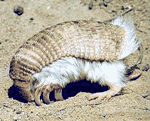
| Pictures of the pink fairy armadillo are copyrighted by their owners |
|
Pink fairy armadillo
Order : Xenarthra
Family : Dasypodidae
Subfamily : Chlamyphorinae
Species : Chlamyphorus truncatus
The smallest of the family of the armadillos, the Pink Fairy Armadillo (Chlamyphorus truncatus), is an endangered species. It exists in parts of Argentina in South America and is threatened by the destruction of its habitat and domestic dogs. It can be distinguished from the other members in the family, because it is the only armadillo with the dorsal shell almost completely separated from the body. This little digger can bury so fast that it can bury itself in a matter of seconds when it feels threatened. The armor plate functions as a cork to close the entrance to its burrow. They feed primarily on ants.
The Lesser fairy armadillo, lesser pichi ciego, pink fairy armadillo is listed as Near Threatened (NT), is close to qualifying for or is likely to qualify for a threatened category in the near future, on the IUCN Red List of Threatened Species
Namings for the pink fairy armadillo
A young / baby of a pink fairy armadillo is called a 'pup'. The females are called 'zed' and males 'lister'. A pink fairy armadillo group is called a 'fez'.Countries
ArgentinaHabitats
Desert, Dry savanna, Grassland, Savanna, Shrubland, Temperate Desert, Temperate Grassland and Temperate Shrubland
Facts about the pink fairy armadillo
Conservation Status The pink fairy armadillos are declining in number due to the spread of human civilization, and they are considered quite rare.
Physical Description The pink fairy armadillo is the smallest member of the armadillo family, measuring only about
The pink fairy armadillo is omnivorous.
The pink fairy armadillo is the smallest of the armadillos (about 3-1/2" to 4-1/2" long excluding the tail) and pale rose or pink in color.
2 lbs) The distinguishing characteristic of Chlamyphorus retusus (along with its congeneric, Chlamyphorus truncatus) is its pelvic armor, which is firmly attached to the spine and pelvic bones, unlike other members of the family Dasypodidae. (Full text)
The pink fairy armadillo is the smallest of the armadillos (about 3-1/2" to 4-1/2" long excluding the tail) and pale rose or pink in color. (Full text)
(Yes, pink fairy armadillos are real animals, they are native to Argentina and endangered. (Full text)
Oh, all that and Chlamyphorus truncatus is the single most wondeful mammal since, like, ever. (Full text)
The smallest armadillos are the fairy armadillos, or pichiagos; the smaller of the two pichiago species (Chlamyphorus truncatus) is about 6 in. (Full text)
The smallest armadillos are the fairy armadillos, or pichiagos; the smaller of the two pichiago species ( Chlamyphorus truncatus ) is about 6 in. (Full text)
The smallest armadillos are the fairy armadillos, or pichiagos; the smaller of the two pichiago species (Chlamyphorus truncatus) is about 6 in. (Full text)
The tiny pink fairy armadillo is threatened by the plowing of fields for agriculture, and predation by domestic dogs. (Full text)
The Pink Fairy Armadillo is perhaps the second most fantastic animal ever next to the dodo bird of course. (Full text)
The pink fairy armadillo is the smallest- 6 inches from head to tail. (Full text)
There are fanciful juxtapositions: The pink fairy armadillo is not far from the walrus. (Full text)
1. Chlamyphorus, genus Chlamyphorus -- (pichiciago)Chlamyphorus
genus Chlamyphorus
(Source WordNet)