Some facts about the
Silky anteater
Adult weight : 0.266 kg (0.5852 lbs)
Gestation : 135 days
Weaning : 152 days
Litter size : 1
Basal metabolic rate : 1 W
Body mass : 0.24 kg (0.528 lbs)
Temperature : 32.85 °C (91.13 °F)
Silky anteater
Order : Xenarthra
Family : Myrmecophagidae
Species : Cyclopes didactylus
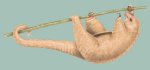
The Silky Anteater or Pygmy Anteater (Cyclopes didactylus) is the smallest of the anteaters. Its total length is between 36 and 45 centimeters. Its other distinguishing features are its short snout, soft golden brown fur, prehensile tail and two very enlarged claws in each forepaw. It is nocturnal and arboreal, and feeds on large amounts of ant in the trees, between 100 and 8000 ants a day. If the Silky Anteater feels threatened, it stands in a defensive posture, standing on their hind legs, holding its forefeet close to its face so they can strike, with its sharp claws, any animal that tries to get closer to it. Nice pictures of the silky anteater can be seen here, here and here.
The Pygmy anteater, silky anteater is listed as Least Concern. Does not qualify for a more at risk category. Widespread and abundant taxa are included in this category, on the IUCN Red List of Threatened Species
Namings for the silky anteater
A young / baby of a silky anteater is called a 'pup'.Countries
Belize, Bolivia, Brazil, Colombia, Costa Rica, Ecuador, French Guiana, Guatemala, Guyana, Honduras, Mexico, Nicaragua, Panama, Peru, Suriname, Trinidad and Tobago and VenezuelaHabitats
Forest, Moist savanna, Savanna, Subtropical / Tropical Moist Lowland and Subtropical / Tropical Moist Montane
Facts about the silky anteater
Silky anteaters are related to sloths, but much smaller.
htm The Pygmy Anteater (also called the dwarf, or silky, anteater), Cyclopes didactylus, is much smaller - about the size of a squirrel
The Silky Anteater (Cyclopes didactylus) is a native of the hottest parts of South and Central America, and about the size of a rat, of a general yellowish color, and exclusively tree-dwelling.
The silky anteater is arboreal and very rarely descends to the ground. (Full text)
The Silky Anteater (Cyclopes didactylus) is a native of the hottest parts of South and Central America, and about the size of a rat, of a general yellowish color, and exclusively tree-dwelling. (Full text)
The silky anteater is about 13 inches from head to tail and weighs about 1 pound. (Full text)
The Silky Anteater (Cyclopes didactylus) is a native of the hottest parts of South and Central America, and about the size of a rat, of a general yellowish color, and exclusively tree-dwelling. (Full text)
Well, Carlos's excitement knew no bounds - though, again, not that rare, silky anteaters are creatures of the night that spend their waking hours walking tightrope on pencil-thin branches in search of, yes, ants, and are rarely seen. (Full text)
Unlike the Giant Anteater and the Tamanduas the Silky Anteater is completely aboreal. (Full text)
Silky anteaters are found from southern Mexico . (Full text)
Classification from the anteater articleThe giant anteater and tamanduas constitute the family Myrmecophagidae, which means ant-eating in Latin, whereas the silky anteater is classified in a family of its own, Cyclopedidae. (Full text)
DIET: Zoo: Tamanduas and silky anteaters are seldom seen in captivity because of their specialized diet. (Full text)
The silky anteater is nocturnal and almost never descends to the ground. (Full text)
There are three anteater species, of which the tamandua is the most commonly seen by visitors, while the giant and silky anteaters are only seen occasionally. (Full text)
The Silky Anteater (Cyclopes didactylus) is a native of the hottest parts of South and Central America, and about the size of a rat, of a general yellowish color, and exclusively tree-dwelling. (Full text)
Silky anteaters are usually a soft golden colour; tamanduas are tan to brown, with black markings on the chest. (Full text)
The giant anteater is wholly terrestrial, the lesser anteater species are both terrestrial and arboreal, and the silky anteater is completely arboreal. (Full text)
Arboreal and nocturnal, the Silky tamandua (also known as the Silky anteater) is difficult to see when active but occasionally can be spotted sleeping in the daytime, curled up into a tight furball, usually in a tangle of vines or in a cohune plant. (Full text)
The Silky Anteater (Cyclopes didactylus) is a native of the hottest parts of South and Central America, and about the size of a rat, of a general yellowish color, and exclusively tree-dwelling. (Full text)
Silky anteaters are a very rarely observed, but probably common inhabitant of Amazon rainforests. (Full text)
This silky anteater is hanging in a defensive posture. (Full text)
” · Silky anteaters are the smallest anteaters. (Full text)
· The silky anteater is also known as the “pygmy anteater,” “dwarf anteater,” or “two-toed anteater. (Full text)
1. silky anteater, two-toed anteater, Cyclopes didactylus -- (squirrel-sized South American toothless anteater with long silky golden fur)silky anteater
two-toed anteater
Cyclopes didactylus
(Source WordNet)
Submit your pet