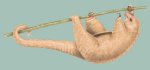
 The Silky Anteater or Pygmy Anteater (Cyclopes didactylus) is the smallest of the anteaters. Its total length is between 36 and 45 centimeters. Its other distinguishing features are its short snout, soft golden brown fur, prehensile tail and two very enlarged claws in each forepaw. It is nocturnal and arboreal, and feeds on large amounts of ant in the trees, between 100 and 8000 ants a day. If the Silky Anteater feels threatened, it stands in a defensive posture, standing on their hind legs, holding its forefeet close to its face so they can strike, with its sharp claws, any animal that tries to get closer to it.
 Nice pictures of the silky anteater can be seen here, here and here.


Keywords: brown , prehensile tail , claw
The Pygmy anteater, silky anteater is listed as Least Concern. Does not qualify for a more at risk category. Widespread and abundant taxa are included in this category, on the IUCN Red List of Threatened Species
Namings for the silky anteater
A young / baby of a silky anteater is called a 'pup'.Countries
Belize, Bolivia, Brazil, Colombia, Costa Rica, Ecuador, French Guiana, Guatemala, Guyana, Honduras, Mexico, Nicaragua, Panama, Peru, Suriname, Trinidad and Tobago and VenezuelaSilky anteater habitats
Forest, Moist savanna, Savanna, Subtropical / Tropical Moist Lowland and Subtropical / Tropical Moist MontaneSome facts about the
Silky anteater
Adult weight : 0.266 kg (0.5852 lbs)
Gestation : 135 days
Weaning : 152 days
Litter size : 1
Basal metabolic rate : 1 W
Body mass : 0.24 kg (0.528 lbs)
Temperature : 32.85 °C (91.13 °F)

Custom Search