
Even-toed ungulates
Order : Artiodactyla
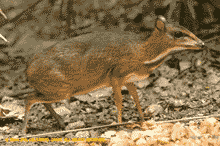 Smallest animal: lesser Malay mouse deer (see picture, 40 cm long)
Largest animal: Giraffe (5.8 meter)
Heaviest animal: hippopotamus (reports vary from 3,600 to 4,500 kg)
Most of the world's species of large land mammals are artiodactyls. The order of Artiodactyla, containing cattle, pigs, goats, and sheep, has helped humans through evolution. Humans domesticated them for their meat, milk, and leather, farmers to help them on the land.
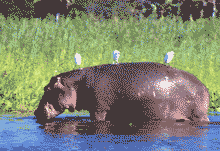 The order is native to all continents, except the continents of Antarctica and Australia. The giant hippopotamus is the only aquatic artiodactyl, spending most of its time in water. They live their lives in herds of up to 40 animals. They may forage several kilometers distant from where they pass the day, and some farmers see considerable damage to their crops and rangelands due to their foraging and their travel to foraging areas. Pygmy hippos are less social and are usually found in and near forests.
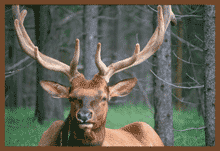 Many members of the order of artiodactyla have huge horns, usually used in conflicts with members of the same species, often in ritualized combats between males at mating time. These horns may become targets of sexual selection: if females find males with larger horns more attractive, they will mate with them and large horns will be favored evolutionarily. This can result into the enormous antlers in species such as the Irish elk. Still the favourite weapon of artiodactyl is their speed to outrun their predators, sight, smell and hearing.
Distinctive features:
"Artiodactyls are paraxonic, that is, the plane of symmetry of each foot passes between the third and fourth digits. In all species the number of digits is reduced at least by the loss of the first digit, and the second and fifth digits are small in many. The third and fourth digits, however, remain large and bear weight in all artiodactyls. This pattern has earned them their name, Artiodactyla, which means "even-toed." Artiodactyls stand in contrast to the "odd-toed ungulates," the Perissodactyla, in which the plane of symmetry runs down the third toe. The most extreme toe reduction seen in any artiodactyls (living or extinct) is in forms such as antelopes and deer, which have just two functional (weight-bearing) digits on each foot. In such forms the third and fourth metapodials fuse, partially or completely, to form a single bone called a cannon bone. In the hind limb of these species, the bones of the ankle are also reduced in number, and the astragalus becomes the main weight-bearing bone. These traits are probably adaptations for running fast and efficiently."
(source: Myers, P. 2001. "Artiodactyla" (On-line), Animal Diversity Web. Accessed July 07, 2005)
