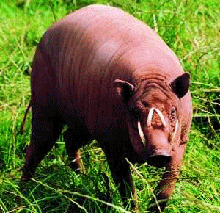
 The Babirusa (Babyrousa babyrussa) is a very special member of the pig family. Up until now the relationship between the Babirusa and the other pig species hasn't been resolved completely. There are pieces of research, which suggest the conclusion, that it is closely related to Hippopotamuses, close relatives of pigs themselves. With its cylindrical body, its bristly skin, the small ears and the long snout, the Babirusa can be easily identified as a typical pig relative at least on the face of it, although its legs are extraordinarily long and thin. Babirusas reach lengths of about one metre and weigths of 100 kg - much less than the size of Wild boars.
They have a very special marking, which distinguishes them from all other pigs and which is unique in the animal kingdom: It is the curious growth of the upper canine teeth of the males. The fact that they are extremely long isn't very special among pigs and even the fact that the canine teeth are worn outside the mouth is shared by other animals too. But very special is the fact that the canine teeth are growing through the snout from the inside to the outside. Together with the canine teeth of the lower jaw, which are also very long, they resemble antlers. The canine teeth of the upper jaw seem to be completely without function at first glance. They neither can be used for foraging because of their position nor can they be used as weapons because of their fragility. The only function they might have is that of a rank or status symbol. The bizarre teeth of the males are growing in an arched way to the back and might grow into the snout from the outside again. The females wear either upper canine teeth of normal lengths or none at all.
Babirusas live on the national territory of Indonesia, which consists of many islands and archipelagos. They inhabit the island of Sulawesi, the Togian Islands and the Moluccan Islands. The populations of the three distribution ranges differ from each other in several markings, allowing researchers to establish three subspecies of the Babirusa - the Sulawesi babirusa, the Togian babirusa and the Moluccan babirusa. The prefered habitat of all subspecies is the rainforest. Here they live solitary or in small groups, moving mostly on firm trails within their territories. Like all pigs Babirusas like wallowing to get rid of skin parasites. Their diet consists of fruits and nuts. Very sought-after are mangos, but also mushrooms and leaves are taken. Babirusas get animal protein in the form of insects, which they often flush in rotten wood. In contrast to Wild boars, Babirusas avoid farmland and thus conflicts with farmers. Nevertheless they are hunted for their meat - in spite of laws protecting them. In addition the conversion of forests into areas used for agriculture contributes to the decline of the populations. Babirusas have always been scarce, but today they are very endangered. The few zoos, which are keeping Babirusas, try to breed them in coordinated breeding programs. The one to three piglets are born after a pregnancy of about five months. They take solid food, when just a few days old, are weaned at an age of six to eight months and become sexually mature after one to two years. Babirusas reach an maximum age of 24 years.
This article was originally published at magazine.naturspot.de. Link to the original article
Keywords: brown
Which zoos have them?
Los Angeles Zoo (United States) and Saint Louis Zoological Park (United States)The Babiroussa, babirusa, deer hog is listed as Vulnerable (VU), considered to be facing a high risk of extinction in the wild, on the IUCN Red List of Threatened Species
Countries
IndonesiaSome facts about the
Babirusa
Adult weight : 71.5 kg (157.3 lbs)
Maximum longevity : 23 years
Female maturity :548 days
Male maturity : 548 days
Gestation : 153 days
Weaning : 213 days
Litter size : 1
Litters per year : 2
Weight at birth : 0.715 kg (1.573 lbs)
Links
Babirusa links on the web
Great article on the babirusa at indonesianfauna.com
Balizones.com Bali Hotel & Villas Bargain Rates - Land, Villas, Hotel for Sale in Bali!
