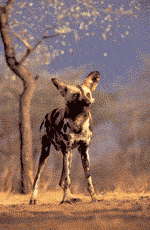
 Reaching a length of up to 100 cm and a weight of 35 kg, the African hunting dog (Lycaon pictus), which is also simply called Wild dog, is about the size of a small Wolf. Its fur is of dark colour, which is softened by yellowish, brownish and white spots. Its ears are etraordinarily large. At first glance there is a certain resemblance between African hunting dogs and Hyenas concerning the appearance. But they are not closely related to Hyenas except the fact that both are carnivores; African hunting dogs are "real" dogs, whereas the closest relatives of Hyenas are Viverrids.
Many horror stories about African hunting dogs have been spread: It was said that they kill much more prey than they are able to eat, drive all antilopes out of large areas and are even dangerous to man. In this context the African hunting dog could be called the "African wolf", since many negative myths have grown up around the Wolf too. Most of this is pure fiction or grossly exaggerated. Not only concerning there negative image there are similarities between African hunting dogs and Wolves: Both canids live and hunt in packs. In African hunting dogs as well as in Wolves there are distinct gender specific hierarchies. This means that the males as well as the females have there own dominance relations. But those are not as obvious in African hunting dogs as in Wolves. There is much harmony among the members of an African hunting dog pack and each member seems to be able to play different roles within the pack.
Fostering of good social relations is of great importance for the survival of each member of an African hunting dog pack. Only a harmonizing pack is able to hunt successfully and defend its prey against Hyenas. The size of the pack seems to be decisive concerning its success; packs with just a few members lose a larger portion of their prey to Hyenas than packs with many members. Cubs and pack members, which are not able to hunt, are supplied with meat by the other members. Raising the cubs - there may be 16 in a single litter - demands all available help. Also the males make a contribution to that job and are able to raise older cubs without female help in cases of emergency.
African hunting dogs are very skilled hunters. Mostly the hunting is lead by a single or a few dogs, whereas the rest of the pack follows in a certain distance. If the potential prey tries to break out, a dog from the background blocks off its way. African hunting dogs are hunting with much perseverance; a hunting can be expanded over several kilometres and the dogs hunt at an average speed of about 50 km/h. The prefered prey are medium sized Antilopes but African hunting dogs are also able to kill larger Antilopes and even Zebras. But they hunt for those animals just if no other prey is available, since their risk of being injured themselves is quite large.
African hunting dogs inhabit the African savannas. The packs roam through large areas without claiming a certain territory. The fact that the dogs need such large areas with a lot of game to meet their food demands, makes them very vulnerable towards human originated changes of landscapes. Outside the national parks large areas become more and more rare. African hunting dogs are regarded to be very endangered nowadays.
This article was originally published at magazine.naturspot.de. Link to the original article
Keywords: white
Which zoos have them?
Artis (Netherlands), Brookfield Zoo (United States), Dublin Zoo (Ireland) and Los Angeles Zoo (United States)The African wild dog, cape hunting dog, painted hunting dog, wild dog is listed as Endangered (EN), considered to be facing a very high risk of extinction in the wild, on the IUCN Red List of Threatened Species
Namings for the African wild dog
A young / baby of a African wild dog is called a 'pup'. A African wild dog group is called a 'pack'.Countries
Angola, Benin, Botswana, Burkina Faso, Burundi, Cameroon, Central African Republic, Chad, Congo, Democratic Republic of the, Cote d'Ivoire, Eritrea, Ethiopia, Gabon, Gambia, The, Ghana, Guinea, GuineaBissau, Kenya, Malawi, Mali, Mozambique, Namibia, Niger, Nigeria, Rwanda, Senegal, Sierra Leone, South Africa, Sudan, Tanzania, Togo, Uganda, Zambia and ZimbabweAfrican wild dog habitats
Dry savanna, Forest, Grassland, Savanna, Shrubland, Subtropical / Tropical Dry forest, Subtropical / Tropical Dry Grassland, Subtropical / Tropical Dry Shrubland and Subtropical / Tropical Moist MontaneSome facts about the
African wild dog
Adult weight : 26.5 kg (58.3 lbs)
Maximum longevity : 17 years
Female maturity :639 days
Male maturity : 639 days
Gestation : 72 days
Weaning : 91 days
Litter size : 8
Litters per year : 1
Interval between litters : 362 days
Weight at birth : 0.318 kg (0.6996 lbs)
Basal metabolic rate : 33 W
Body mass : 8.75 kg (19.25 lbs)
Links
Hunting dog names - African hunting dogs have their domestic counterparts... If you are looking for a cool name for your dog? Try this website, especially for hunting dogs.Links
