 The Fin Whale (Balaenoptera physalus) is a Baleen whale and is the second largest whale and also the second largest animal currently living in the world. The blue whale is the largest. The Fin whale can grow up to 26 meters in length. There are two groups of Fin Whales in the world, north and south. The two groups do not interbreed and never meet. Species from the Southern group can become larger (up to 26 meters) than the Northern group (21 - 23 meters). Can you guess the weight of a 26 meter long Fin whale? Its weight is around 120,000 kilograms! Apart from its gigantic size it is distinguishable by a white patch on its right jaw (not the left) as you can see from this picture. In the early days of whaling, the Fin whale was too fast for the whalers to catch them. This changed with the coming of steam-powered boats. The Fin whale soon became the most hunted Cetacean of the world (at its peak there were 30,000 killed annually) and is listed as endangered now (now they are only hunted by humans on the coast of Greenland, killing about 10 Fin whales a year).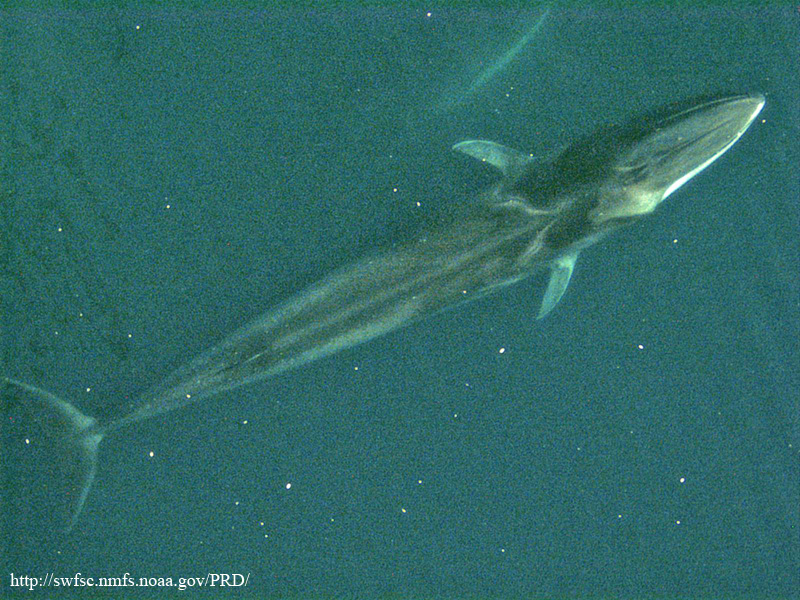
Keywords: blue
The Common rorqual, fin whale, fin-backed whale, finback, finner, herring whale, razorback is listed as Endangered (EN), considered to be facing a very high risk of extinction in the wild, on the IUCN Red List of Threatened Species
Namings for the fin whale
A young / baby of a fin whale is called a 'calf'. The females are called 'cow' and males 'bull'. A fin whale group is called a 'gam, pod or herd'.Countries
Angola, Argentina, Australia, Brazil, Burma, Canada, Ecuador, Faroe Islands, French Polynesia, French Southern and Antarctic Lands, Greenland, Hong Kong, Iceland, India, Indonesia, Italy, Japan, Kenya, Korea, North, Korea, South, Madagascar, Mexico, Namibia, New Zealand, Norway, Pakistan, Poland, Portugal, Russia, South Africa, South Georgia and the South Sandwich Islands, Spain, Sri Lanka, Suriname, Svalbard, Taiwan, Tanzania, Tunisia, United Arab Emirates, United Kingdom and United StatesSome facts about the
Fin whale
Adult weight : 70000 kg (154000 lbs)
Maximum longevity : 114 years
Female maturity :2701 days
Male maturity : 2864 days
Gestation : 342 days
Weaning : 183 days
Litter size : 1
Interval between litters : 608 days
Weight at birth : 1800 kg (3960 lbs)

Custom Search