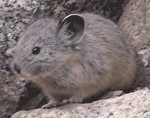
Some facts about the
North American pika
Adult weight : 0.1 kg (0.22 lbs)
Maximum longevity : 7 years
Female maturity :347 days
Gestation : 30 days
Weaning : 28 days
Litter size : 3
Litters per year : 2
Interval between litters : 30 days
Weight at birth : 0.009 kg (0.0198 lbs)
Weight at weaning : 0.081 kg (0.1782 lbs)
Basal metabolic rate : 1 W
Body mass : 0.109 kg (0.2398 lbs)
Temperature : 39.85 °C (103.73 °F)
American pika
Order : Lagomorpha
Family : Ochotonidae
Species : Ochotona princeps
The pika (Ochotona princeps), a cousin of the rabbit may look like a hamster, but it isn't. It sometimes is known as "whistling hare" because when it dives into its burrow, it emits a high-pitched warning cry. Donald Grayson reports in the current issue of the Journal of Biogeograph that 7 out of 25 historically described American Pika populations in the Great Basin -- the area between the Sierra Nevada and Rocky Mountains, have become extinct at the end of the 20th century. Reasons described are the grazing of livestock and the increase of roads. According to Grayson, the pika populations are totally isolated from each other so they cannot reach other populations. Pikas are also considered to be one of the best early warning systems for detecting global warming. CNN article on the extinction of the American Pika
NatureWorks on the American Pika
The American pika is listed as Least Concern (LR/lc), lowest risk. Does not qualify for a more at risk category. Widespread and abundant taxa are included in this category, on the IUCN Red List of Threatened Species
Facts about the American pika
The two North American pikas are also rock dwellers.
ABSTRACT- The North American pika (Ochotona princeps) is a small alpine mammal found in naturally fragmented habitat, and as such it represents a model system for examining the relationship between habitat spatial structure and gene flow. (Full text)
Merideth, Susan*,1, Peacock, Mary1, Brussard, Peter1, 1 University of Nevada, Reno, Reno, NV ABSTRACT- The North American pika (Ochotona princeps) is an alpine mammal that is confined to talus habitat, which is naturally fragmented at both local and regional scales. (Full text)
American Pika or Ochotona princeps is listed on the IUCN Red list (1996) as Lower Risk/Least Concern . (Full text)
Pika particularsAlso referred to as a "cony" or "rock rabbit," the American Pika is a cute little critter of only about six or seven inches in length and weighs-in at a plump three or four ounces. (Full text)
The American pika is an herbivore that eats grasses, sedges, and other types of vegetation. (Full text)
Taxonomy: Kingdom Animalia; Phylum Chordata; Subphylum Vertebrata; Class Mammalia; Order Lagomorpha; Family Ochotonidae; Genus Ochotona; Species Ochotona princeps Status: The American pika is common and is divided into about 36 subspecies, which all have slight variations and are found in individual locations. (Full text)
The opus of the day is in, and the American pika is now online. (Full text)
^ Geographic Range Nearctic: American pikas are found in mountain habitats from central British Columbia to South-Central California and east to Colorado. (Full text)
Ochotona princeps is the high altitude species investigated in this study. (Full text)
The American pika, or Ochotona princeps, is native to the western mountains of America. (Full text)
^ Physical Characteristics Mass: 121 to 176 g Ochotona princeps is a moderate sized pika with buffy (as opposed to white in O. (Full text)
The North American pika is a buff colour. (Full text)
Research shows that American pikas are particularly vulnerable to global warming because they live in areas with a cool, fairly moist climate. (Full text)
At home on boulder-covered hillsides across western North America, especially at higher elevations, the American Pika is an agrarian wonder. (Full text)
Similar Species American Pika is brownish, lacks collar. (Full text)
Ochotona princeps is a moderate sized pika with buffy underparts. (Full text)
NEW MEXICO Tundra is the biotic zone with which the American pika is particularly associated in New Mexico (Frey and Yates, 1996) *57*. (Full text)
Hiker's Note:Ochotona princeps is a moderate sized pika with buffy underparts. (Full text)
American pikas are diurnal, or active in the day. (Full text)
Diet The American pika is a plant eater. (Full text)
Research results show that American pikas are particularly vulnerable to global warming because they reside in areas with cool, relatively moist climates like those normally found in their mountaintop habitat. (Full text)
^ Physical Characteristics Ochotona princeps is a moderate sized pika with buffy (as opposed to white in O. (Full text)
The north american Pika is a small mammal related to rabbits and hares which lives in talus slopes at high elevation in the western mountains: This particular pika was just east of Tioga Pass, outside Yosemite National Park. (Full text)
American pikas are smaller relatives of hares and rabbits, but have short, round ears. (Full text)
Enlarge Map Previous research results suggested that American pikas are particularly vulnerable to global warming because they reside in areas with cool, relatively moist climates like those normally found in mountaintop habitats. (Full text)
American pikas are typically found in rocky areas, called talus, within alpine regions of the western United States and southwestern Canada. (Full text)
1. Ochotona, genus Ochotona -- (type genus of the Ochotonidae)Ochotona
genus Ochotona
(Source WordNet)
Submit your pet