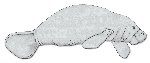
Some facts about the
Amazonian manatee
Adult weight : 480 kg (1056 lbs)
Maximum longevity : 40 years
Female maturity :1096 days
Male maturity : 1096 days
Gestation : 328 days
Weaning : 548 days
Litter size : 1
Litters per year : 1
Weight at birth : 12.5 kg (27.5 lbs)
Weight at weaning : 67.5 kg (148.5 lbs)
Basal metabolic rate : 55 W
Body mass : 167.594 kg (368.7068 lbs)
Amazonian manatee
Order : Sirenia
Family : Trichechidae
Species : Trichechus inunguis
The Amazonian manatee (Trichechus inunguis) is the smallest of the manatees and lives, as its name suggests in the Amazon river and its river branches and the Amazon River Basin, they never go out into the sea, or salt water. It is one of three species of manatee, 'lamantine' or 'sea cows', they are part of the order of Sirenia. They are both diurnal as nocturnal, feeding on aquatic vegetation, as much as 8 percent of their body weight. Amazonian manatee numbers have greatly declined because of hunting and habitat degradation. Interesting fact: Like all manatees, the Amazonian manatee molar teeth grow constantly, and old teeth are replaced with new ones, which enter at the back of the jaw.
Other manatees are: West Indian manatee, African manatee
Image created by Sharon Mooney, for Sirenian Evolution and based on Manatees of the World, image may be redistributed on condition original credits remain intact. Licensed under Attribution ShareAlike 2.5
The Amazonian manatee, south american manatee is listed as Vulnerable (VU), considered to be facing a high risk of extinction in the wild, on the IUCN Red List of Threatened Species
Namings for the Amazonian manatee
A young / baby of a Amazonian manatee is called a 'calf'. The females are called 'cow' and males 'bull'. A Amazonian manatee group is called a 'herd'.Habitats
Coastal Brackish / Saline Lagoons / Marine Lakes, Coastal Freshwater Lakes, Estuaries, Marine Coastal / Supratidal, Marine Neritic, Permanent Freshwater Lakes (over 8ha), Permanent Rivers / Streams / Creeks (includes waterfalls), Seasonal / Intermittent / Irregular Rivers / Streams / Creeks and Wetlands (inland)
Facts about the Amazonian manatee
The Amazonian manatees are the smallest of the three species and are shorter too.
Which, there are certain things in life you never need see—and a dolphin snorting coke while being orally pleasured by a pair of topless Trichechus inunguis is definitely one of them.
Amazonian Manatee Trichechus inunguis Amazonian manatees are found in the waters of the Amazon River and its tributaries in South America.
Amazonian Manatees are smaller than all other manatees.
Most Amazonian manatees are born in February and May.
The Amazon manatee (Trichechus inunguis) is the only manatee that lives exclusively in freshwater.
The Amazonian Manatee is grey with a white spot on stomach and has several markings on rest of body.
Trichechus inunguis/Trichechus manatus/Trichechus senegalensis Trichechus inunguis is more commonly known as the Amazonian manatee, with Trichechus senegalensis as the (West) African manatee, and Trichechus manatus as the West Indies manatee.
Conservation Status Trichechus inunguis is listed as Cites-Appendix I, as U. (Full text)
Amazonian Manatees are the smallest of the three species. (Full text)
The Amazonian Manatee is a [CITIES-listed Endangered Species] (Full text)
The Amazonian manatee is a herbivore that feeds on aquatic vegetation near lake edges, such as aquatic grasses, and floating vegetation such as water lilies. (Full text)
Description The Amazonian manatee is a most bizarre-looking aquatic mammal, and was first described as a curious combination of a hippopotamus and a seal. (Full text)
The Amazonian manatee is found in the lagoons and rivers that flow off of the Amazon River though such countries as Brazil, Colombia, Peru, Guyana, and Ecuador. (Full text)
They can live in Fresh, Salt, and brackish waters; the Amazonian manatees are the only restricted to the fresh waters. (Full text)
In the Amazon basin, the manatee (Trichechus inunguis) is traditionally very important in the diet as is Trichechus manatus in coastal Caribbean areas and in the Orinoco basin (160, 311, 337, 563). (Full text)
The closely related Amazonian manatee (Trichechus inunguis) is found in the River Amazon and its tributaries in northern Brazil. (Full text)
click on picture to return to gallery The Manatee (Trichechus inunguis) is (Full text)
Amazonian Manatee The Amazonian Manatee is one of the largest creatures of the Amazon watershed. (Full text)
Amazonian manatees are the only species of manatee confined to fresh water. (Full text)
Amazonian manatees are the smallest of the three species. (Full text)
Many Amazonian manatees are found in Brazil where limited funding is available for research, but their habitat also reaches into Colombia, Ecuador, and Peru where more research is needed. (Full text)
Yara, our Amazonian Manatee Ambassador (scientific name Trichechus inunguis), is named after a Brazilian Indian word that means "Lady of the Water". (Full text)
(c) 2000 Sirenian International Yara, our Amazonian Manatee Ambassador (scientific name Trichechus inunguis), is named after a Brazilian Indian word that means "Lady of the Water". (Full text)
1. Trichechus, genus Trichecus -- (type and sole genus of the Trichechidae)Trichechus
genus Trichecus
(Source WordNet)
Submit your pet