Friday 30 December 2005
Zoo does not give up hope for stolen penguin Toga
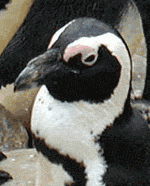
It has been almost two weeks since Toga, a jackass penguin, was stolen from the Amazon World zoo on the Isle of Wight in Southern England. This
news article states that after a tip-off that the rare bird had been dumped in Portsmouth docks in a plastic bag, which failed to turn up anything, the zoo doesn't give up. It goes on with what it has been doing all christmas, following every lead they get. A spokeswoman of the Amazon World zoo says that Toga's parents, Oscar and Kyala (or Oscar and Layana, depending on the
source), seem to be preparing to lay more eggs... The reward for the safe return of Toga, the stolen jackass penguin, has been increased to £31,000.
You can help spreading the word about this animal by liking it on facebook
Permanent Link
Thursday 29 December 2005
Bengal tigers in India - next to become extinct ?
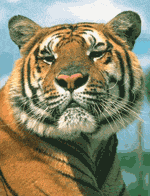
The largest of all cats, the
tigers are declining fast in India. According to this
news article on onlypunjab.com, the tiger population in India is declining so fast that the whole population may be extinct in India in 10 years. Officially, the tiger population is at 3,500. The Wildlife Trust of India says 1,500 may be more accurate. Ashok Kumar of the Wildlife Trust of India says that "A villager can earn as much in one night from poisoning and skinning a tiger as he could earn from farming in five years". "Eventually, that skin can sell for up to $6,000 dollars in Lhasa". The
Balinese Tiger (
Panthera tigris balica) became extinct in 1937. The
Javan Tiger (
Panthera tigris sondaica) became extinct in 1979 and the
Caspian Tiger or Persian Tiger (
Panthera tigris virgata) became extinct in 1968. The subspecies of tiger that exist in India is the Bengal tiger. Is the Bengal tiger in India next to become extinct ?
You can help spreading the word about this animal by liking it on facebook
Permanent Link
Wednesday 21 December 2005
In the news: Snatched penquin may be christmas gift
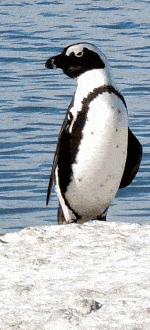 Toga
Toga, a 3 month old African Penquin (
Spheniscus demersus), or Jackass Penquin, has been stolen from Amazon World on the Isle of Wight in Southern England last saturday and does not stand a chance to survive without the proper care and nutrition according to the zoo manager."Toga is very, very vulnerable. The penguin is still being fed by his parents and we don't believe it could survive more than five days," she told The Associated Press. She also said "We can't understand what may have been going through the thief's head, but we are worried someone decided a penguin would make the perfect Christmas gift. There has been a lot of attention because of the film '
March of the Penguins'. Perhaps someone saw the film and thought their wife or girlfriend would be thrilled to have one as a present." In the wild, penquins exist on the south-western coast of Africa.
Updated: Read entry of 30 december here.
You can help spreading the word about this animal by liking it on facebook
Permanent Link
Tuesday 06 December 2005
Bats - the only true flying mammals
Bats are the cause of many myths and have always appealed to our imagination. Be it in a good way, like Batman, or in the form of Dracula. Bats are mammals that can
fly because they adapted their forelimbs into wings. Their wings are, unlike birds, skin supported by four fingers. Bats are the only mammals that can fly. Most feed on insects, some have the ability to feed on fruits. Vampire bats really do exist, but only three species in Central and South America are known. Vampire bats feed on large birds, cows, horses and pigs.
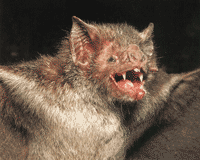
All of the members of chiroptera (bats) are active during the night or during the twilight. Instead of relying on their sight, bats have excellent senses of smell and hearing. By emitting high-pitched sounds and listening to the echoes, the bats sense prey and other nearby objects. This is called echolocation. Echolocation is also common among
dolphins and
whales.
References
Bat on Wikipedia
Chiroptera on Animal Diversity Web
The Wild ones
You can help spreading the word about this animal by liking it on facebook
Permanent Link