Thursday 29 September 2005
Giant squid - Japanese scientists take the first images of a living specimen
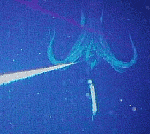
Japanese scientists discovered the giant squid by following Sperm whales, which hunt for the giant squids. It is believed to reach lengths of 60 ft (18 meters) long and has two tentacles that can stretch up to two thirds of its length. Tracking the
Sperm whales and dangling bait and their camera at 450 fathoms (800 meters) they managed to catch the attention of a 25 ft (7.62 m) long giant squid and some pictures.
A researcher from New Zealand has captured the first live images from a "giant" squid earlier, although you can leave "giant" out, they were only half an inch long larvae.
In 2003, a giant squid attacked a french boat, which was taking part in the round-the-world (talk about coincedence!) Jules Verne Trophy. (Jules Verne is the author of 20,000 Leagues Under the Sea, in which is described how giant squid attacked Capt Nemo's submarine Nautilus).
Links
news.telegraph
news.yahoo
20,000 Leagues Under the Sea (public domain version)
You can help spreading the word about this animal by stumbling it by pressing
this link 
or discuss things in our
Animal Forum
- Permanent Link
Tuesday 20 September 2005
Kea (Nestor notabilis) - New Zealand's playful birds

Why do animals play? A theory says that playing exercises abilities,
which are important for survival. That's certainly correct; a lot of
young animals practice their abilities to hunt and fight by playing.
But also adult animals do play and sometimes it seems that besides
exercising courses of motion and behaviour flows, pure fun might be the
deciding cause. But there is a restriction concerning the occurrence of
playing; animals do only play when there are no other important demands
of life, which have to be fulfilled, like escaping from predators,
finding food and so on. Most mammals show a more or less well-developed
playing behaviour. But playing birds are rather unusual. One of the
best-known exceptions is the Kea. And Keas really enjoy playing;
everything arousing their interest is examined very closely and romping
around in the snow is one of their favourites. While playing they move
with clownish clumsiness and communicate using all kinds of sounds.
Their best-known call, which also gave them their name, is a squawking
"keeaah" while flying. Keas are also very curious and tame towards man;
they approach hikers and mountaineers almost without any timidity.
(more)
You can help spreading the word about this animal by stumbling it by pressing
this link 
or discuss things in our
Animal Forum
- Permanent Link
Saturday 17 September 2005
Day geckos (genus Phelsuma) - Beauties from Madagascar
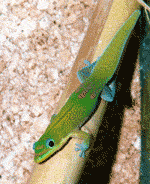
Most members of the family Geckonidae are nocturnal animals. But there are some exceptions too. Among these are the members of the genus Phelsuma, the so called Day geckos. They inhabit the island of Madagascar, which lies off South-East Africa. But Day geckos are also distributed on some "nearby" islands like the Comores, the Seychelles, Nossi B�, Aldabra, Assumption and Sainte Marie. Some species also can be found in some coastal regions of South-East Africa.
(more)
You can help spreading the word about this animal by stumbling it by pressing
this link 
or discuss things in our
Animal Forum
- Permanent Link
Tuesday 13 September 2005
Swim with manatees - harmful or helpful?

I just love these bulky creatures... Swimming with manatees is possible in Florida in the United States. You can hire a boat or book a tour to see these cute giants. Manatees consume 10-15% of their body weight every day, they pretty much eat all day... You can swim with a manatee as long as you don't "intentionally or negligently, to annoy, molest, harass, or disturb any manatee". This includes feeding the manatees.
Conservation status
To ensure the survival of the manatees in Florida, they are listed as a threatened species. This means a population reduction of at least 50%(!) projected or suspected to be met within the next ten years or three generations, whichever is longer. Researchers have found that Manatee bones have no marrow cavity, which makes their bones fragile. Although manatees can hold their breath for as long as 20 minutes, the slow-moving mammals must come to the surface to breathe air periodically, and are thus vulnerable to being struck by propellers and hulls of powerboats. To save the manatees, there are speed limits in the Florida waters, avoiding fatal accidents, but still wounding the manatees.
Tourism to the rescue?
In the winter, manatees migrate to the warm waters of springs and power plants in Florida. Swimming with manatees is booming business, you can rent a boat and snorkeling equipment, take a tour, and they even put in a giant fishbowl in the Homosassa river. Some argue that any contact with manatees is harmful, because the manatees will lose their natural fear for humans, and no longer avoid dangers. Most manatees die because of boats travelling at high speeds, which they cannot avoid. Speed limits are enforced and discussions about propeller guards are ongoing. As long as you follow the rules of engagement, you can swim with manatees without helping their decline...
Read more about manatees
You can help spreading the word about this animal by stumbling it by pressing
this link 
or discuss things in our
Animal Forum
- Permanent Link
Monday 12 September 2005
Colugos - Flying lemurs are not lemurs and cannot fly!

Colugo's are also called flying lemurs. Strangely enough, they are not lemurs and can't even fly! There are just two species:
Malayan colugo
Philippine colugo
They are nocturnal, shy creatures that live in the tropical rainforests of Southeast Asia. Colugo's are in a separate order called Dermoptera. Their most distinctive feature is the skin between their limbs which gives the ability to glide between trees. The skin is much like the skin used by bats to fly. They are endangered by the deforestation of the rainforest and are being hunted by the Philippine Eagle, becoming an easier prey with more and more trees gone. To make things worse, they are hunted for their meat and fur by humans. Recent studies show that they are related to Tree shrews and primates. Some researchers believe they are also related to Bats.
You can help spreading the word about this animal by stumbling it by pressing
this link 
or discuss things in our
Animal Forum
- Permanent Link
Friday 09 September 2005
Tiger - Largest cat killed by Chinese medicine?
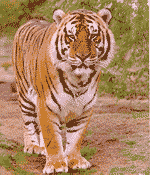
The largest of all cats killed by traditional Chinese medicine? There are different opinions among scientists, whether to call the Tiger
Panthera tigris (
Panthera tigris) and leave it in the genus Panthera together with the Lion and the other so-called Great cats or to call it Neofelis tigris and have it in the genus Neofelis together with the much smaller Clouded leopard (Neofelis nebulosa). But the following is not disputed: Tigers are the largest living cats. They reach a length up to 280 cm and a weight of almost 300 kg. Remarkable are the dark stripes on orange- or ochre- coloured ground. There are various subspecies, which partly differ widely in size. The largest subspecies is the Siberian tiger.
(more)
You can help spreading the word about this animal by stumbling it by pressing
this link 
or discuss things in our
Animal Forum
- Permanent Link
Wednesday 07 September 2005
Order Dasyuromorphia - ranging from mouse to dog shaped carnivorous marsupials

All of the members of the order of dasyoroids live (or lived) in Australia. The marsupial order of dasyomorphia contains three families, namely:
Dasyuridae, containing 61 carnivorous and insectivorous species
Myrmecobiidae, the numbat, the marsupial anteater
Thylacinidae, the recently extinct Tasmanian wolf
Picture of the Tasmanian devil taken with Nikon D100 on Tasman Peninsula at Tasmanain Devil Park by Wayne McLean (jgritz)
You can help spreading the word about this animal by stumbling it by pressing
this link 
or discuss things in our
Animal Forum
- Permanent Link
Sunday 04 September 2005
Puma - America's allrounder

Many animal species are adapted to quite narrow habitats providing certain living conditions. This is not different concerning cats: cheetahs, eg., are animals which are able to survive only in savannas and semi-deserts, while
tigers are "forest creatures", which prefer habitats with a lot of trees and much water. But on the other hand there are also species, which are real allrounders, inhabiting all kinds of habitats in many subspecies. The most prominent examples are the
Leopard in Africa and Asia and its American counterpart - the
Puma (
Puma concolor) .
(more)
You can help spreading the word about this animal by stumbling it by pressing
this link 
or discuss things in our
Animal Forum
- Permanent Link
Saturday 03 September 2005
Proboscis monkey - The swimming star with the giant nose

Everyone who has the opportunity to see a
Proboscis monkey (
Nasalis larvatus) is struck by its giant nose. But there is a second feature which is very typical for Proboscis monkeys and their relatives, the so called Leaf-monkeys - it's their large belly. Indicated by the name of that group of apes, they almost exclusively feed on leaves - and leaves are not easy to digest. Moreover leaves are not very rich in energy-content. So Proboscis monkeys have to eat a lot of leaves and spend most of their time on feeding. In order to obtain enough energy from their meagre nourishment, Proboscis monkeys have got a complicated stomach divided into several parts. Their stomach is quite similar to that of ruminants, which have to face the same problems. Adult Proboscis monkeys are large animals. Males reach a length of about 70 cm and a weight up to 24 kg. Females are significantly smaller, reaching lengths of 60 cm and weights of just 12 kg. The tails of Proboscis monkeys are about as long as their bodies. Their fur is brick-red, the front and the cheeks are of brighter colour and the arms and legs are more greyish. The most obvious feature of Proboscis monkeys is the male's extremely long nose, shaped like a cucumber. Noses of females and young are not small either but don't reach the sizes of the noses of males by far.
(more)
You can help spreading the word about this animal by stumbling it by pressing
this link 
or discuss things in our
Animal Forum
- Permanent Link