Monday 30 October 2006
Pudu - smallest deer in the world
The
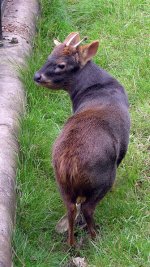
pudu (
Pudu puda) is the smallest deer in the world, ranging from 60 to 85 centimeters in length. They can be found in Chile and Argentina from sea level to 3200 meters high. They are very cautious animals, checking the wind every now and then by standing on their hind legs when feeding on twigs and bark, fruits, leaves and seeds. Its predators are eagle owls, the
cougar, foxes and small cats. When the pudu feels threatened, it flees usually in a zig-zag pattern and have the unique ability, for deers, to be able to climb trees when threatened. It is listed as endangered by the IUCN and its main threats are habitat destruction, roe and fallow deer introduced from Europe, and domestic dogs.
You can help spreading the word about this animal by liking it on facebook
Permanent Link
Thursday 26 October 2006
Giant anteater
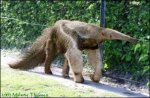
The
Giant Anteater (
Myrmecophaga tridactyla) is the largest of the anteaters and lives Central and South America. Its diet consists mainly of ants and termites. Sometimes it feeds on up to 30,000 in a single day, moving from one anthill or temitehill to another. They do not have any teeth, even when reaching adulthood. The only mammals that has no teeth too, when mature, are the
Pangolins. The middle three digits on their forefeet have longer claws, which they use to break open mounds of ants and termites. Actually they have five digits, despite their name
'tridactyla', which means 'three fingers' in Greek, the two outer digits are much smaller. The Giant anteater is the mammal with the longest tongue in relation to its body and can extend it as much as 150 times per minute and as long as 61 centimeters. They do not use their claws to digg burrows, yet they sleep in dense vegetation, abandoned burrows, or a hole in the ground. They are hunted on by
jaguars and
pumas, but their primary threat is habitat destruction. Giant anteaters are listed as 'vulnerable' by the
IUCN.
Picture of the giant eater by Malene Thyssen, www.mtfoto.dk/malene/, licensed under Creative Commons Attribution ShareAlike 2.5
You can help spreading the word about this animal by liking it on facebook
Permanent Link
Monday 23 October 2006
Gray Fox - only canid to climb trees
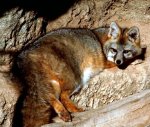
The
Gray Fox (
Urocyon cinereoargenteus) ranges from lower Canada all the way to Venezuela, excluding the Great Plains, northwestern United States, and eastern Central America. It has a gray back, light brown to brownish orange on the sides, neck and legs, and a black stripe along its back and tail and a white belly. It is very agile and can climb up and down trees easily with their powerful, hooked claws and are they only member of the canid family to climb trees. It preys on cottontail rabbits, birds, voles,
field mice, shrews and insects. It also eats fruits, berries and vegetable material. Gray foxes can weigh between 3.6 to 6.8 kilograms and can become 6 to 10 years in the wild.
You can help spreading the word about this animal by liking it on facebook
Permanent Link
Saturday 21 October 2006
Lion
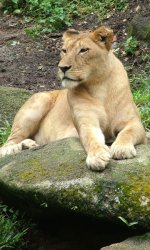
The
lion (Panthera leo) is one of the four 'big cats' in the genus Panthera. The
tiger is the largest of the big cats and the second place is for the lion. They can become 10 to 14 years in the wild and the male can weigh as much as 225 kilograms. Their main threats are inbreeding, because remaining populations became isolated. Lions usually hunt at night and dawn, hunting on
antelopes, gazelles,
warthogs, wildebeest, buffalos and
zebras, but also carrion from hyenas or
African wild dogs. Lions can run as fast as 60 kilometers per hour, but cannot maintain that speed fo a very long time. Lions can either be 'nomads', or 'residents'. When lions are in groups (prides) of related females, their young and 1 to 4 males (a 'coalition'), they are said to be 'residents'. When one or two lions
migrate over great distances, they are said to be 'nomads'. Lions spend about 20 hours per day resting. Did you know a lion can be crossbred to produce a
liger or
tigon (ligers (male lion and a tigress) and tigons (male tiger and a lioness) are crossbreeds of a lion and a tiger), leopons (crossbreed a lion and a leopard), and a jaglion (jaglions are crosbreeds between a jaguar and a lion).
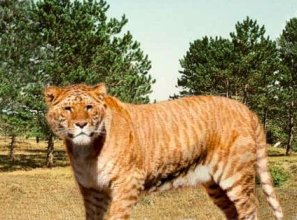
Bertram the liger
You can help spreading the word about this animal by liking it on facebook
Permanent Link
Wednesday 18 October 2006
Northern ghost bat
The
Northern Ghost Bat (Diclidurus albus) is also called Jumbie or Jumby bat or white bat and belongs to the Emballonuridae family of bats. Although relatively rare, it is widespread as it is found in eastern Brazil, North Peru, and Mexico and also in the Caribbean, especially in Trinidad. They roost at daytime in rock crevices, old mines and caves in colonies, and alone under leaves of palm trees from lowland regions up to the mountain areas of about 1500 meters high.
The length of the bat's head and body ranges from 86 to 103 millimeters, and its forearm is from 60 to 70 millimeters. It weighs about 17 to 24 grams. Obviously, the white bat's color is white and has short rounded yellowish ears and hair bases that may be visibly grayish. Its pelage is white, and its patagia is translucent and pinkish. It has a short tail, about 18 to 22 millimeters, which is perhaps one-third of the length of the bat's uropatagium. Its face is almost naked, and its eyes are big. The white bat does not have wing sacs unlike the other members of Emballonuridae family. Its uropatagium has a unique triangular gland instead with two valves. Its function is unknown, but the male has a larger gland that becomes bigger and more prominent when breeding season comes. The Northern Ghost Bat also has vestigial thumbs.
Northern ghost bats like to stay in humid habitats such as tropical and riparian rainforests. However they have wandered to human settlements, too. They roost underneath palm fronds, like coconut, coquito, and chocho palms. Some are seen in evergreen and deciduous forests. They migrate within the Neotropics.
These bats are insectivores feeding mainly on moths. They are attracted occasionally to insects near street lamps. They also produce echolocation sounds that vary from 22 to 25 kHz while hunting.
You can help spreading the word about this animal by liking it on facebook
Permanent Link
Wednesday 18 October 2006
Coatimundi
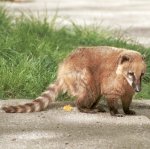
The
Coatimundi (Nasua nasua) is a member of the raccoons. It lives in South, Central and south-western North America. Coatimundis live in loosely grouped bands of 4 to 25 females and juveniles and usually only one man. With its long snout and bear-like paws they live in the forests and feed on small birds, fruit, leaves, roots, insects, amphibians, fish, nuts,
reptiles and eggs. They descend head-first from trees. Coatimundis are hunted by
jaguars, boas,
pumas, foxes, tayras, ocelots, hawks and eagles. With their strong muscles and strong paws and jaws, they are a difficult catch for them. They can become 8 years of age in the wild.
You can help spreading the word about this animal by liking it on facebook
Permanent Link
Tuesday 17 October 2006
The Dromedary Camel
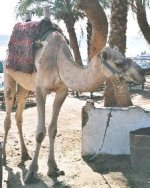
The
Dromedary Camel (Camelus dromedarius) has, as you might know, only one hump, in contrast to the
Bactrian camel which has two humps. There no longer are any wild dromedaries in their original range, but there does exist a feral population in Australia of about 300,000 animals. The dromedary is taller and faster than the Bactrian camel and is used for its milk, meat, wool, leather and is used as a beast of burden. Dromedaries weigh about 360 to 600 kilograms and can become 1.8 to 2 meters at shoulder height. Dromedaries have adapted to the life in the desert by evolving two eyelashes to protect them from the blowing sand and they can also close their nostrils in case of a sandstorm. Their lump is not used for storing water, contrary to popular believe, but is composed of fat and acts as a food storage. Dromedaries can drink an amount of 100 liters of water in 10 minutes. They can become 50 years of age.
Picture of the dromedary taken by Hajor, December 2002. Licensed under Creative Commons Attribution ShareAlike 1.0
You can help spreading the word about this animal by liking it on facebook
Permanent Link
Thursday 12 October 2006
Mountain Beaver
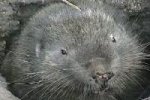
The
Mountain Beaver (Aplodontia rufa) is, despite their name, actually not related to beavers. They are located in the Pacific northwest of North America and they can weigh up to 1 kilo and about 50 centimeters in length. They build extensive burrow systems with seperate chambers for storing food or droppings. They are not very social and seldom go out more than a few meters from their burrow. Their diet mainly consists of grasses and ferns and are strictly vegetarian. A range of other animals are known to live in burrow systems of the mountain beaver, among them are the
Long-tailed Weasel,
Ermines, Minks,
Fishers, American Badgers, and
Raccoons. They are hunted on by
Cougars,
Bobcats,
Coyotes, Golden Eagles, and Owls. Because they have an effect on a lot of animals, researchers consider them to be a key species.
You can help spreading the word about this animal by liking it on facebook
Permanent Link
Thursday 05 October 2006
Pronghorn antelopes - fastest land animal of North America
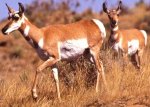
The
pronghorn antelope (
Antilocapra americana) is the fastest land animal of North America and is capable of running approximately 54 mph (90 km/h)! They are not true antelopes, their horns are made of a hairy substance, only the very inner core is made of bone. They primarily feed on grasses and even eat cacti. Male pronghorns have horns that can grow 30 cm long. Females can also have horns but this happens only in 1 out of 8 times. The pronghorn finishes second, standing defeated by the cheetah which holds the world speed record of the fastest land mammal on earth.
You can help spreading the word about this animal by liking it on facebook
Permanent Link
Wednesday 04 October 2006
West Indian Manatee
The
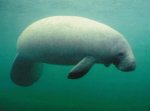
West Indian Manatee (Trichechus manatus) is the largest member of the order of
Sirenia and can weigh up to 1500 kilograms, although usually somewhere between 400 and 800 kilos. All manatees have a split upper lip. They use both parts of the lip to help put food in their mouths.Because grasses aren't very nutritious they feed on huge quantities. This has also given them a very slow metabolism. Some taxonomies differ two subspecies, the Florida Manatee and the Antillean Manatee. All the three species of manatee are listed as 'vulnerable to extinction' by the IUCN. Although they do not have any natural predators, the increase in human activity has reduced its habitat in the coastal marsh areas and manatees are often injured or killed by collisions with powerboats. Manatees like warm, shallow, coastal estuarine waters, and because of that they often congregate near power plants, where the water is warmer. Some manatees have become reliant on this source of heating and have stopped to migrate to warmer waters. Recently, a couple of power plants have been shut down and the U.S. Fish and Wildlife Service is trying to find a new way to heat the water for these manatees. In Florida,
swimming with manatees is a tourist attraction.
The oldest living manatee is Snooty, living in the South Florida Museum and was born July 21, 1948, which makes him 56 years of age!
You can help spreading the word about this animal by liking it on facebook
Permanent Link
Sunday 01 October 2006
Pyrenean desman
The
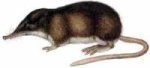
Pyrenean Desman (Galemys pyrenaicus) has a waterproof fur and a long flat tail which can act as a rudder or propeller in the water. Pyrenean desmans live in the Pyrenees Mountains of France, northern and Central Spain and northern Portugal. It lives along the fast-flowing mountain streams. The Pyrenean Desman forages mainly at night on crustaceans and insect larvae. It is threatened by construction of hydro-electric plants and water pollution. It is thought that Pyrenean desmans slap the surface of the water to produce noises helpful in echolocation, although this is mere speculation.
You can help spreading the word about this animal by liking it on facebook
Permanent Link