new - Animal forum

Subscribe to
"Animal of the day"

AddThis Feed Button
Or subscribe by e-mail

Enter your Email


Powered by FeedBlitz

We hope that reader will gain an increased appreciation of the need for more conservation measure in order to protect the beautiful creatures that inhabit the earth. Our philosophy is that the more we learn about animals, the more we respect them and take better care of them. That is why we update this blog with new animals, We encourage you to syndicate our content by adding "animal of the day" to your own blog! (read more)

About us

Our mission is to get people excited about animals and their welfare by writing articles on these animals. We encourage people to comment on posts and share with others. Don't forget to subscribe to our feed.

Contact us
Copyright notice

Funny animal videos and pictures

Swimming with manatees - harmful or helpful

Last Comments

janicka (Ribbon seal): i love the ribbon seal i …
bob (Fattest cat in th…): DUUUUUUUUUUUUUUUUUUUUUUUU…
P.L. Frederick (Ribbon seal): This seal is new to me — …
kenneth maldonado… (Ribbon seal): unbelievably cute.Why hav…
jenny (Impala - don't sh…): i totally luv imppalas th…
coco (Impala - don't sh…): i luv impalas they are my…
cicimici (Ribbon seal): me also did`t heard about…
Doriesmom (Ribbon seal): What an interesting seal.…
mry (Pudu - smallest d…): Tasty, with Fries and Béa…
lane (Bush dog): does the bushdog have any…

Calendar

« May 2008
S M T W T F S
        1 2 3
4 5 6 7 8 9 10
11 12 13 14 15 16 17
18 19 20 21 22 23 24
25 26 27 28 29 30 31

Archives

Next Archive Previous Archive

01 May - 31 May 2008
01 Apr - 30 Apr 2008
01 Mar - 31 Mar 2008
01 Feb - 28 Feb 2008
01 Jan - 31 Jan 2008
01 Dec - 31 Dec 2007
01 Nov - 30 Nov 2007
01 Oct - 31 Oct 2007
01 Sep - 30 Sep 2007
01 Aug - 31 Aug 2007
01 Jul - 31 Jul 2007
01 Jun - 30 Jun 2007
01 May - 31 May 2007
01 Apr - 30 Apr 2007
01 Mar - 31 Mar 2007
01 Feb - 28 Feb 2007
01 Jan - 31 Jan 2007
01 Dec - 31 Dec 2006
01 Nov - 30 Nov 2006
01 Oct - 31 Oct 2006
01 Sep - 30 Sep 2006
01 Aug - 31 Aug 2006
01 Jul - 31 Jul 2006
01 Jun - 30 Jun 2006
01 May - 31 May 2006
01 Apr - 30 Apr 2006
01 Mar - 31 Mar 2006
01 Feb - 28 Feb 2006
01 Jan - 31 Jan 2006
01 Dec - 31 Dec 2005
01 Nov - 30 Nov 2005
01 Oct - 31 Oct 2005
01 Sep - 30 Sep 2005
01 Aug - 31 Aug 2005
01 Jul - 31 Jul 2005

Animal posters
Animal pictures
Mammals.start4all.com
Animal diversity web
Recently extinct animals forum
PetLvr.com
Another chance to see
Happiness is a warm puppy

Miscellany

AddThis Feed Button

Saturday 31 March 2007 Chinese water deer
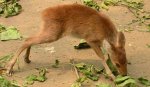
Chinese water deer The Water Deer (Hydropotes inermis) is a usually solitary animal, besides the rutting months, and a good swimmer. There exist two subspecies: the Chinese Water Deer (Hydropotes inermis inermis) and the Korean Water Deer (Hydropotes inermis argyropus). Wild populations of escaped water deer live in the United Kingdom and in France. The water deer is considered a primitive member of the Cervidae family (Deer), because buck has large canine teeth and has no antlers, both evolved by other deer.

Picture of the waterdeer licensed under Attribution ShareAlike 2.0 License

You can help spreading the word about this animal by stumbling it by pressing this link StumbleUpon or discuss things in our Animal Forum

Add your thoughts about this animal - Permanent Link

Sunday 25 March 2007 Nine banded armadillo - can have between 7 to 11 bands

Armadillo The most widespread of the armadillo's, the nine-banded armadillo (Dasypus novemcinctus), can be found in North America, Central America and South America. Despite its name, NINE-banded armadillo, it can have between 7 to 11 bands. They become active during the night and at twilight or before sunrise. Contrary to popular belief, nine-banded armadillos do not curl up into a ball when threatened, but outrun their predators. It as an omnivorous creature, but basically eats ants, beetles, other artropods, small reptiles and amphibians. Armadillos have proven valuable for use in medical research on multiple births, organ transplants, birth defects and diseases.
You can help spreading the word about this animal by stumbling it by pressing this link StumbleUpon or discuss things in our Animal Forum

Add your thoughts about this animal - Permanent Link

Friday 23 March 2007 Kobus kob

Kobus kob height: 70-100 cm
weight: 80-100 kg

The antelope Kobus Kob (Kobus kob) moves around south of the Sahara desert in groups of up to 40 members in the moist savannas. Only males have the S-shaped horns of about 50 cm long that curve sharply backwards and then up again. They are active during the day, except during the heat of the day. Males are reported to be in herds, have single territories, or defend lek territories.

Lek mating system

"A lek (from Swedish lek, a noun which typically denotes pleasurable and less rule-bound games and activities) is a tournament (the males of certain species of animals for the purposes of competitive mating display), held before and during the breeding season, day after day, when the same group of males meet at a traditional place and take up the same individual positions on an arena, each occupying and defending a small territory or court. Intermittently or continuously they spar with their neighbours one at a time, or display magnificent plumage, or vocal powers, or bizarre gymnastics..." ( From wikipedia )

Within a lek, 20 to 200 male kobs defend territories 15 to 200 meters in diameter. The center of the lek is the most favored spot. This is where most of the mating occurs. In areas of lower population density, males are spaced farther apart and hold their territories for longer periods of time.Each lek is associated with a female herd of about 100 individuals. Females can mate after 13 months and males after 18. Sadly, Kob are commonly hunted for sport and food. A survey of bushmeat preferences in Cameroon ranked kob as the third most favored species, second only to North African porcupine and guinea fow.

Predators

Their main predators are the leopard, cheetah, hyena, hunting dog and lion.

Image

  • Description: Uganda-Kob
  • Source: photographed 2002 in the Queen Elisabeth National Park in Uganda
  • Photographer: Frank Dickert
Permission is granted to copy, distribute and/or modify this document under the terms of the GNU Free Documentation License, Version 1.2 or any later version published by the Free Software Foundation; with no Invariant Sections, no Front-Cover Texts, and no Back-Cover Texts. A copy of the license is included in the section entitled "Text of the GNU Free Documentation License

References

Animal Diversity Web

Wikipedia

Ultimate Ungulate

You can help spreading the word about this animal by stumbling it by pressing this link StumbleUpon or discuss things in our Animal Forum

Add your thoughts about this animal - Permanent Link

Monday 19 March 2007 Guanaco
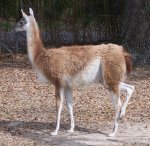
guanaco The guanaco (Lama guanicoe) is a member of the Camelidae family, the Camelids. They are found in Bolivia, Peru, Ecuador, Chile, Argentina and Paraguay. They have double coats like llamas, one outer coat, the guard hair, and one inner coat, which is soft. Guanacos have been hunted for their meat and fur. It is believed that guanacos are the ancestors of the llama and alpaca.

Interesting fact: Guanacos can run as fast as 56 kilometers per hour!

Image by Geoffrey J. King, licensed under GFDL

You can help spreading the word about this animal by stumbling it by pressing this link StumbleUpon or discuss things in our Animal Forum

one comment - Permanent Link

Friday 16 March 2007 Golden Jackal
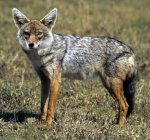
Golden jackalThe Golden Jackal (Canis aureus) is also called Common or Asiatic Jackal. They live from North and East Africa, Southeastern Europe and South Asia to Burma and prefer dry open lands. They are strictly monogamous and live in mating pairs and forage and hunt together, because this is much more successful. Golden Jackals scavenge by following lions for the leftovers of a kill. They are sometimes hunted for their fur, but are not threatened.
You can help spreading the word about this animal by stumbling it by pressing this link StumbleUpon or discuss things in our Animal Forum

Add your thoughts about this animal - Permanent Link

Wednesday 14 March 2007 Wildcat
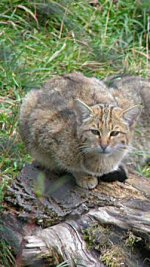
wild cat Wildcats (Felis silvestris) are found throughout Europe, Southwestern Asia and in the savannahs of Africa. Domestic cats are thought to be descended from a subspecies of the Wildcat, the African wild cat (Felis silvestris lybica). Wildcats have camouflaged, grey-brown striped fur with bushy tails. Their fur is sof and short. They have five toes on their forefeet and four on their hind feed and their nails are retractable.

Interesting fact: In contrast to the domestic cat, wild cats will breed only once a year, the period depending on the local climate. The domestic cat, unhindered by local climate or nutrition can breed as much as 3 times a year.

Image of the wildcat by Martin Steiger, licensed under GFDL

You can help spreading the word about this animal by stumbling it by pressing this link StumbleUpon or discuss things in our Animal Forum

Add your thoughts about this animal - Permanent Link

Sunday 11 March 2007 Cape Hyrax - "rock rabbit"

Cape hyrax The Cape Hyrax (Procavia capensis), like all hyraxes, slightly resembles a rabbit superficially. They live between the rocks and can often be found in burrows of other animals, like meerkats and aardvarks. People from South Africa call them "dassies" or "rock rabbits". "Dassie" means badger in German as well as in Afrikaans, which gives reason to believe the early colonist mistook the Cape Hyrax for a badger in the 17th century. Cape Hyraxes produce large amounts of dung and urine that has been used by locals in the treatment ofepilepsy and convulsions.

Image: Dassie (Cape Hyrax) photographed on Table Mountain by Andreas Tusche, Cape Town. The photo was taken on the rocks near the upper cable car station. Licensed under GFDL

You can help spreading the word about this animal by stumbling it by pressing this link StumbleUpon or discuss things in our Animal Forum

one comment - Permanent Link

Thursday 08 March 2007 Northern right whale dolphin

Northern right whale dolphinThe Northern Right Whale Dolphin (Lissodelphis borealis) are coloured black and white with no dorsal fin. Norhtern right whale dolphins look very much like Southern right whale dolphins, but can be distinguished (besides the difference in location) by the amount of white on their bellies. Souther right whale dolphins have much more white than Northern right whale dolphins. The Northern right whales live in the north pacific ocean, between Kamchatka and the United States, where they can travel in groups of an average size of 200 individuals, but can go up to 2000 individuals. They mostly feed on squid and lanternfish.
You can help spreading the word about this animal by stumbling it by pressing this link StumbleUpon or discuss things in our Animal Forum

two comments - Permanent Link

Wednesday 07 March 2007 Capybara - the world's largest living rodent

Capybara The capybara (Hydrochaeris hydrochaeris) is a semi-aquatic herbivorous animal and lives in South America, east of the Andes. It is the world's largest living rodent. Adults reach 105 and 135 cm (40-55 in) in length, and weigh as much as 35 to 65 kg (75-140 lbs). They are good swimmers, and have partially webbed feet. They do a lot of things in the water: mating, hiding from predators, and they can stay submerged for several minutes. Capybaras can even sleep underwater, by leaving their noses just above the water to breathe.
You can help spreading the word about this animal by stumbling it by pressing this link StumbleUpon or discuss things in our Animal Forum

three comments - Permanent Link

Friday 02 March 2007 Golden lion tamarin - one of the rarest animals in the world
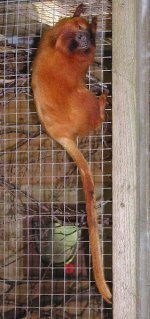
Golden lion tamarin The Golden Lion Tamarin (Leontopithecus rosalia) is endemic to Brazil. Golden lion tamarins live in the closed canopy, where they live 10 to 30 meters off the ground. They sleep in tree holes for protection. Golden lion tamarins are one of the rarest animals in the world, according to some environmentalists. Estimates are that there are only 1000 left in the wild. Its habitat has been destroyed and broken up by logging and agriculture. Because of this populations became isolated, which resulted in inbreeding, likely to result in extinction. To make things worse, there is only one breeding pair per group. The golden lion tamarin certainly is one of the most endangered primates on the planet. Reintroduction programs are successful, but the continuing destruction of its habitat gives less hope. It is hunted by birds of prey, large cats and snakes. The golden lion tamarin can become 15 years of age. Their diet consists of snails, spiders, eggs, birds, fruits, vegetables and small lizards.

Links

Range of the golden lion tamarin from Natureserve

You can help spreading the word about this animal by stumbling it by pressing this link StumbleUpon or discuss things in our Animal Forum

five comments - Permanent Link

Thursday 01 March 2007 Beech marten - ruiner of cars

Beech martenThe Beech Marten (Martes foina) or Stone marten is thin, long and short-legged, and its brown covering has a white (forked) mark at the throat's area, and this sets them apart from the Pine marten (marking is cream-colored).

The Beech Marten often lives in places that are occupied by humans, and they can also be seen in the countryside areas, but they stay away from territories that are bare. A Beech Marten can be found in mainland Europe and West/Central Asian territories. At daytime, this marten sleeps and they hunt for preys during the twilight hours. They are omnivorous creatures and the diet mainly consists of small mammals, eggs and earthworms.

Beech Martens have their mating period from June all the way to August, and a male would attempt to mate with a female from within his ground (home) area. A male's first approach might be faced with aggressiveness by the female. The male Beech Marten would keep at it, via a cooing verbalization. The mating would ordinarily happen during dark and would just last up to an hour, on the average.

Litter size is three to four newborns, all of them blind and bald. The weaning would be at two months, however, the mother and newborns would stay together during the tutor sessions. The parent would be teaching these young on hunting methods. The sexual maturity would be attained at fifteen to twenty-seven months.

Basically, this marten is nocturnal, and apart from the breeding periods lives solitary. How it moves is anchored on the speed of its motion, if it is slow, back feet are a bit off-center vis-a-vis the front feet. If one is running, the back feet land at the same area where the front legs do.

Interesting fact: They are known for an inclination of ruining cars, they bite ignition leads and even braking hoses.
You can help spreading the word about this animal by stumbling it by pressing this link StumbleUpon or discuss things in our Animal Forum

Add your thoughts about this animal - Permanent Link


Animal of the Day
Subscribe to the
animal of the day
Enter your Email


Powered by FeedBlitz