Tuesday 30 October 2007
Clouded leopard
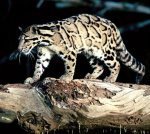
The
clouded leopard (
Neofelis nebulosa) is found in the south-eastern part of Asia (see below for the range map of the clouded leopard). It weighs between 20 and 30 kilograms. The clouded leopard is sometimes given the nickname 'the modern day saber-tooth', because it has the largest canines compared to its body size of all cats. Another distinctive feature from other cat is its elongated skull. They are expert tree climbers and live large parts of their lives in the trees (in the Malay language the clouded leopard is called 'rimaudahan', which means 'tree tiger'). Their diet consists of goats, deer, domesticated livestock, wild pigs, reptiles, monkeys and birds. Clouded leopards are listed as an endangered species. Because of their secretive nature, their behavior is largely unknown.They are threatened by hunting (for Chinese medicine and its fur) and deforestation. Did you know it takes 20 to 30 cats to make on full-length fur coat?
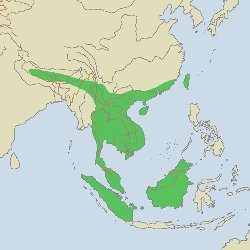
Update:Thanks to Ian T. for pointing out that the 'Clouded leopard' is actually two species, take a look at his
blogpost.
Range map by
Jniemenmaa licensed under the
GNU Free Documentation License, Version 1.2
You can help spreading the word about this animal by liking it on facebook
Permanent Link
Sunday 28 October 2007
Animal with the name "Fisher" not a fish-eater
The
fisher (
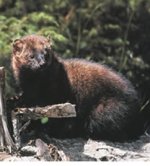
Martes pennanti) is a marten, living in North America. Despite its name, it seldom eats fish. Its name is believed to be derived from the French "fichet", which is the name for a pelt of the European polecat. They are solitary hunters. Interesting is that they are the only known predator to constently hunt porcupines and were reintroduced in some parts of North America to control the population of porcupines in the area. As a result, cats and dogs were also killed in the area by Fishers. They have a remarkable call, that sounds like a child screaming.
You can help spreading the word about this animal by liking it on facebook
Permanent Link
Wednesday 24 October 2007
African Clawless Otter
An
African Clawless Otter (
Aonyx capensis) is also called by the name "Groot otter" and has partly webbed and clawless feet (hence its name), and it is in fact the second biggest freshwater kind of otter. The Brazilian, or Giant, otter, is the largest freshwater otter and the sea otter is the largest otter of all (fresh and salt water). The African Clawless Otter could be found adjacent to bodies of water amidst forested areas, and that includes savannahs.
African Clawless Otters are members of the Mustelidae family, and they possess smooth, thick fur. Fur color is chestnut and they have white facial spots that go down to the throat and chest. The African Clawless Otter's paws are partially webbed, five digits.
In the way of shelter, logs and even foliage would entice this otter, and that includes rolling. They are clumsy on the ground and maybe recognizing their own limitations, they build their burrow near the water, as this would permit them an escape route when being pursued.
The newborns are raised only by the female, and gestation would go up to 2 months. The weaning occurs from 45 up to 60 days. Full maturity is said to come at 1 year. Their diet consists of fish, frogs, crabs. Whenever they see a prey, they dive, they catch it, then they return to ground to eat whatever it is they catch. The paws of an African Clawless Otter act as searching tools, for digging on the unclear bottom of rivers, and even when looking underneath a log. It is an aquatic creature, and uses its tail as a propeller.
Basically a solitary animal, they could live with a set of up to 5 members. These otters do not have so many predators. Their number one nemesis so to speak is the python. The other predators are the fish eagles and crocodiles. Whenever it feels threatened, an individual would scream to give warning to its brethren, or to disorient the predator in front of it.
Interesting fact: Very sensitive whiskers serve as sensors when in water, getting signals of a possible prey/animal.
You can help spreading the word about this animal by liking it on facebook
Permanent Link
Monday 22 October 2007
Pygmy hog
The
Pygmy hog (
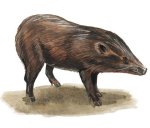
Sus salvanius) is an endangered species of wild pig, and can only be found in the North-east of India in the state Assam. Once they were found throughout Bhutan, Northern India, and Nepal. Estimates of the world population are between 100 and a few hundred individuals. Although they are one of the most threatened species of all mammals, thanks to conservation measures and breeding programs their numbers improve. The reason for their decline is a combination of habitat destruction, overgrazing by domestic livestock, commercial forestry and flood control projects. In the wild they live in tall and dense grassland. Their diet consists of roots, tubers and sometimes insects, invertebrates, eggs and young birds. Pygmy hogs build nests by diggin a trough with their snout and covering it with grasses. This helps them to keep themselves warm in cold weather.
Interesting fact: The pygmy hog is the smallest pig in the world.
Links National Geographic article on pygmy hogs conservation
Image of the pygmy hog by Alessio Marrucci, licensed under GFDL
You can help spreading the word about this animal by liking it on facebook
Permanent Link
Wednesday 17 October 2007
Cape fox
The
Cape Fox (
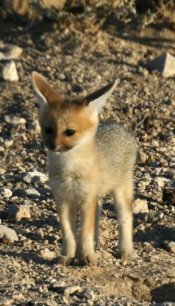
vulpes chama)is the only breed of the genus Vulpes in Africa that can be found under the equator. This fox opts for open habitat like savannas and also semi-desert territories and do not like forests. A typical Cape Fox weighs 2.6kg on average. Their covering is silver-gray, with red head and fore limbs.
Normally, the number of newborns ranges from one to four and the gestation time frame goes from 51 to 52 days. The pups usually are born September to November, and both parents take care of the newborns.
The Cape Fox is basically nocturnal, but the newborns play during daytime hours. Cape Foxes hunt for food independently and are not territorial.
The diet of the Cape Fox consists of rodents, insects, rabbits, larvae and in dire circumstances...it has been speculated that they go for livestock. The Cape Fox probably aids to control numbers of some small mammals, which in turn would have effects on the plant groups.
For some areas, the numbers of these foxes are increasing, while in others, it is decreasing. One major reason for the decline is that farmers strongly believe that they kill livestock, but is it true? Top experts say that foxes scavenge on carcasses and would not hurt healthy animals. The concerned farmers do not think so...
Picture of the cape fox by Susann Eurich, licensed under
GFDL
You can help spreading the word about this animal by liking it on facebook
Permanent Link
Monday 15 October 2007
Dwarf Mongoose
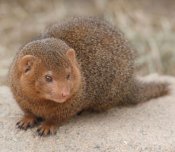
The
Dwarf Mongoose (
Helogale parvula) is the smallest of all African carnivores. It is about the size of a squirrel, has a short head, sharp nose, rounded ears, and a pelage that is both red-brown and glossy. They are found in the South Savanna, Somali Masai and also in Ethiopia and Namibia.
They live around termite mounds, woodlands and wooded vegetations and their diet consists of grasshoppers, crickets, beetles, scorpions, spiders, lizards, snakes, some vegetables, fruits... The Dwarf Mongoose is diurnal, but sometimes their habits change, influenced by the weather. The Dwarf Mongoose lives with packs, and these packs "own" territories that are about 85 acres in size.
There is a breeding pair, and this is made up of the older female and male, and they monopolize breeding. The monopoly is theirs only for as long as they are dominant, which would last up to many years. Females would lead the group, it is the male's job to lookout and be aware of external threats and attacks from rival groups. The other members are the ones to care for the newborns, liberating the mother from the obligations of feeding her young. Thus, instead of feeding the young, the mother has all the time to feed and take care of herself. The newborns would leave the den after 3 weeks, and would start foraging (not alone) after a month.
Interesting fact: Somewhere in East Kenya a long time ago, a fascinating association was documented between a mongoose and 2 Bush Hornbills. The hornbills would get the rodents/insects acquired by the pack, and as a "counter-favor", they would be "guards". They would emit alarm calls when they see flying predators approaching.
Original picture by
Miika Silfverberg from Vantaa, Finland, posted on Flickr, licensed under
Attribution ShareAlike 2.0
You can help spreading the word about this animal by liking it on facebook
Permanent Link
Friday 05 October 2007
Amazonian manatee
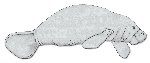
The
Amazonian manatee (
Trichechus inunguis) is the smallest of the manatees and lives, as its name suggests in the Amazon river and its river branches and the Amazon River Basin, they never go out into the sea, or salt water. It is one of three species of manatee, 'lamantine' or 'sea cows', they are part of the order of
Sirenia. They are both diurnal as nocturnal, feeding on aquatic vegetation, as much as 8 percent of their body weight. Amazonian manatee numbers have greatly declined because of hunting and habitat degradation.
Interesting fact: Like all manatees, the Amazonian manatee molar teeth grow constantly, and old teeth are replaced with new ones, which enter at the back of the jaw.
Other manatees are: West Indian manatee, African manatee
Image created by Sharon Mooney, for Sirenian Evolution and based on Manatees of the World, image may be redistributed on condition original credits remain intact. Licensed under Attribution ShareAlike 2.5
You can help spreading the word about this animal by liking it on facebook
Permanent Link
Monday 01 October 2007
Golden Bamboo Lemur
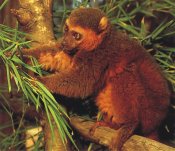
The
Golden Bamboo Lemur (Hapalemur aureus) can only be found in the rainforests of the island of Madagascar where they live in small family groups with one male and one to two females. It has an average weight of 1.2 to 1.6 kgs. More or less, it is the size of a cat. The typical Golden Bamboo Lemur has short ears, full of hair. Their faces are black, eyebrows are bright yellow, and what about yellow underparts with pale orange underfur.
Arboreal in nature, they are also comfortable on the ground. Wherever they may be (up in the tree or down on the ground), they survive on bamboo: pith, shoots, viny parts and leaf bases, giant bamboo parts, bamboo grass.
Interesting fact: Golden bamboo lemurs eat about halve a kilo of bamboo every day, which contains 12 times the amount of cyanide lethal to most other animals.
You can help spreading the word about this animal by liking it on facebook
Permanent Link