Tuesday 29 January 2008
Long-nosed cusimanse
The
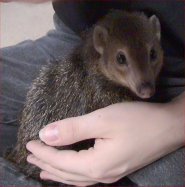
Long-nosed cusimanse (
Crossarchus obscurus) can be found in forests and swamps of Africa, particularly Central and Western, also in Liberia, Ivory Coast and Ghana. A Long-nosed cusimanse is a mongoose, its body is thin, with short tail tapers. Long-nosed cusimanses heads are long, with short ears. Just like the other kinds of mongoose, their pupils are oval-shaped, horizontally. Their curved claws are used to catch insects, and the front claws are longer than those at the back. The feet's soles are hairless, the covering (of the body) is brown-grey and they have 36 teeth.
A Long-nosed cusimanse's diet is made up of larvae, small reptiles, berries, fruits and crabs. Foraging, they can come together in sets of up to 20 members. The Long-nosed cusimanse digs in leaves and using the snout, they can move wood. In a way, they are intelligent, for they can crack crab shells against stones.
The long-nosed cusimanse is a sociable creature, they can be found grouped together with up to 24 individuals. One to three families make up their group, each family is made up of a couple plus the newborns. They are in constant movement, not staying at a single place for long periods.
When domesticated, if a female is not mated, she could go into heat up to 9 times annually. In the wild, though, they can produce only two to three litters annually.
Image of the Long nosed cusimanse by
LA Dawson, licensed under
Creative Commons Attribution 2.5
You can help spreading the word about this animal by liking it on facebook
Permanent Link
Wednesday 23 January 2008
Springhare
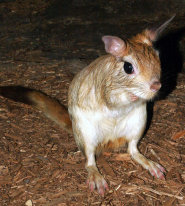
A
Springhare (
Pedetes capensis) looks like a kangaroo, because of the long tail, long hind legs and shorter front legs. As its name implies, it is an enthusiastic jumper, and can jump up to 2 meters in a single jump. Technically though, Springhares are rodents, not hares. The head is short and rounded, they have big eyes, with ears that are both upright and narrow.
A Springhare grazes and its diet mainly consists of grass. Every so often, one would eat some roots and leaves, they could also consume wheat and oats. Their natural predators are owls, snakes and jackals. The typical Springhare could give birth all throughout the year, and the female would have 3.6 liters annually on the average. Young are born with hair all over their bodies and it would take at least 3 days before the eyes would open.
Springhares are principally nocturnal but they could be up and about in the daytime too. At day times, they stay in tunnels which they themselves make. Experts have studied that two individuals could reside in many burrows at different times. Actually, they usually form 3 burrows close together forming a circle. A burrow is ordinarily set near the biggest tree.
These rodents are hunted in South Africa, being thought of as a significant food source. In the wild, they could be said to be solitary, but if captured, they could co-exist peacefully.
Interesting fact: They do not drink water, they just get moisture from dew and the rain.
You can help spreading the word about this animal by liking it on facebook
Permanent Link
Tuesday 15 January 2008
Cuban Solenodon
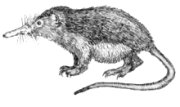
The shrewlike
Cuban Solenodon (
Solenodon cubanus) has short legs and it possesses skin glands that produce a goat-like smell. Its elongated head has tiny eyes coupled with a flexible snout. Their fur could be any of the following: black, red-brown or dark brown. They could be found in both forests and scrublands, and in the main, they are terrestrial. However, the Cuban Solenodons have the ability to climb. At the ground level, they move with an unsteady gait, but for short lengths, a Cuban Solenodon could run quickly.
At night when they are foraging for food, they use that snout to tear tree trunks. Their diet also consists of snakes, frogs, and crabs. A Cuban Solenodon is basically social, with many members residing in a single hole (burrow that is). A Cuban Solenodon communicates with others via squeaks, squeals and twitters. They comprise the family Solenodontidae, and this in turn belongs to a set of mammals termed as insectivores by the scientific community.
Wilhelm Peters discovered this breed of solenodons in 1861. By 1970, everybody thought they had gone extinct. Wrong, three individual solenodons were caught in the mid-70s. Still, they are rare in any part of the globe they exist in. Before 2003, the last sighting came in '99 and no wonder- they are night burrowers and they live in the basement, so to speak.
In 2003, one of them was captured and it raised the number of captured to 37 (they named it Alejandrito). It was released later on, after experts studied it for just a couple of days.
Interesting fact: The solenodon adults approach one another with their mouths open, probably giving out high-frequency sounds.
Another interesting fact: The solenodon is one of the species of mammals that has venomous saliva.
You can help spreading the word about this animal by liking it on facebook
Permanent Link
Sunday 13 January 2008
Golden Snub-nosed Monkey
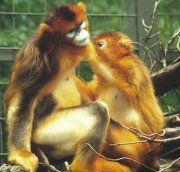
They have black shoulders, back, arms, head and tail, but the back of the
Golden Snub-nosed Monkey (
Pygathrix roxellana) is adorned with a long covering of silver hairs, and for the male, the side of the head, the forehead, neck parts are bright golden, hence the name of these monkeys. The female Golden Snub-nosed Monkey looks like the males, but the upper parts and head are more of the black side. Noses of Golden Snub-nosed Monkeys are flat and established back from their muzzles. They are capable of giving out a set of sounds, often with the absence of facial expressions. In the wild, chorus-like vocalizations often happen.
They live in high forests, going to elevations of more or less 3,000m, but the Golden Snub-nosed Monkey goes down to lower territories during the winter season.
Studies done over the years (just recent) have educated the world on the behavioral and ecological aspects, but more research still needs to be accomplished. The Golden Snub-nosed Monkey is a social creature, forming groups of 20 to 30 during the harsh days of winter, and up to two hundred during summer. These groups would congregate further, forming bands reaching a number of 600. The family unit is made up of one male and on the average, 4 females. Of course, the newborns are included in there. During a moment of danger, they climb very fast up into the refuge of their trees...that is, assuming the predator is not a snake. (A snake could of course catch up with them, no matter how high the tree is).
The Golden Snub-nosed Monkey is capable of exhibiting mating inclination all throughout a year. A young comes out after a gestation of about seven months, and there had been occasions where 2 newborns were given life. Just like so many other kinds, the mother is the one tasked to the infant's rearing, but it is not impossible to find a male actually grooming the newborn.
The diet of these monkeys consists of firs, pine needles, but they could also survive on buds, bamboo shoots and even fruits, among others. One area which needs to be conclusively studied is the life expectancy, as of now, it is for all intents and purposed, unknown.
Interesting fact: A long time ago, the coat of these monkeys was thought of to defeat rheumatism, and only Manchurian officials were allowed to wear it.
Picture of the Golden Snub-nosed Monkey by Eva Hejda, Source:
http://fotos.naturspot.de/bilder/11-79.html, licensed under
Creative Commons Attribution ShareAlike 2.0 Germany License
You can help spreading the word about this animal by liking it on facebook
Permanent Link
Saturday 12 January 2008
Common Treeshrew
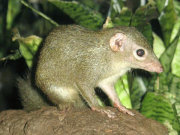
The
Common Treeshrew (
Tupaia glis) has a long nose, and unlike squirrels, no long black whiskers. The Common Treeshrews differ from their relatives, as their tails are layered with long hair, they have an area of naked skin just above the nose, and an earlobe that is tinier than the ear's top area. The colors of the upper body could be any of a multitude of hues, such as red, ochre, brownish, olive and dark- but not exaxctly black, just dark.
They are diurnal creatures, but they use the bulk of the time at the ground and bush areas. Hungry or not, they are on search for food, constantly. Their diet comprises of insects, leaves and fruits. If a Common Treeshrew is eating, it would settle on its haunches, then manage the food via its front paws- very much like a squirrel. The social group is usually made up of a male, and he is accompanied by one to three females, but that's only a norm. A territory is well-set with both sexes interacting.
Their breeding occurs all throughout the year, and the litter size is can range from 1 to 3. The young are kept in an isolated place, and the parents just visits them to do feeding. Typically, sexual maturity of this shrew is attained at three months of age, for both genders.
Interesting fact: A long time ago, they had been categorized as insectivores, that or "primitive primates", but that was then. At present, they are under the order of "Scandentia".
Picture of the common treeshrew by
User:Stavenn, licensed under
GFDL
You can help spreading the word about this animal by liking it on facebook
Permanent Link
Friday 11 January 2008
Mandrill - Mysterious primate from the West African jungle

There's quite a good chance to encounter
Mandrills (
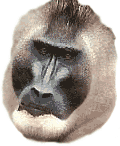
Mandrillus sphinx) in zoos, but in their natural habitat, the West African forests, these baboons are hardly studied and little is known about their behaviour. It's very hard to follow Mandrills through the undergrowth and moreover they are very shy and try to escape human observation immediately. A fact is, that adult, dominant males are among the most colourful mammals. Very impressive is the blue and red "warpaint" of their faces.
(more)
You can help spreading the word about this animal by liking it on facebook
Permanent Link
Tuesday 08 January 2008
Przewalski Horse - the national symbol of Mongolia
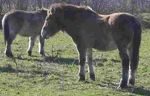
Also called the Mongolian Wild Horse, or Takhi, the Przewalski
horses (
Equus caballus przewalskii) became extinct in the wild in 1969. The worlds population of these horses all descend from 15 wild Przewalski horses captured in 1900. Read more about the re-introduction program
here. The Przewalski horse has much shorter legs than a "normal"
horse and are often striped. Some suggest that that reflects a common heritage with the zebra. The mane of the przewalski stands erect. "Fillies leave their natal groups around age two, and look for a herd to join, after which they will begin to breed. Colts are driven out when they are about three years old, and spend a year or two in small bachelor herds, practicing fighting. At around age 5, a stallion will try to pass on his genes by attempting to take over an existing herd, stealing one or more mares from another stallion's harem, or gathering unattached fillies." (
source )
Permission is granted to copy, distribute and/or modify the image under the terms of the GNU Free Documentation License
You can help spreading the word about this animal by liking it on facebook
Permanent Link
Sunday 06 January 2008
African wild dog
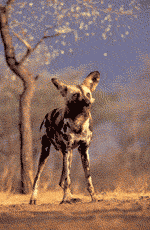
Reaching a length of up to 100 cm and a weight of 35 kg, the
African hunting dog (
Lycaon pictus), which is also simply called Wild dog, is about the size of a small Wolf. Its fur is of dark colour, which is softened by yellowish, brownish and white spots. Its ears are etraordinarily large. At first glance there is a certain resemblance between African hunting dogs and Hyenas concerning the appearance. But they are not closely related to Hyenas except the fact that both are carnivores; African hunting dogs are "real" dogs, whereas the closest relatives of Hyenas are Viverrids.
(more)
You can help spreading the word about this animal by liking it on facebook
Permanent Link
Friday 04 January 2008
Maned wolf - Walking on stilts through the South American savannas
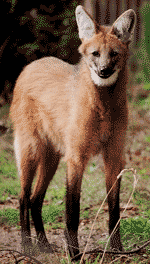
Somehow the name of this South American canid is a little confusing; the attractive inhabitants of grasslands are not closely related to wolves. More convincing is the first part of their name;
Maned wolves (
Chrysocyon brachyurus) wear a characteristic black mane, which can be erected, along their backs. The "aguara guazú", as the Maned wolf is called in South America, is one of the most beautiful canids because of its size, its reddish brown fur, its long dark legs, its white throat and tip of the tail and its conspicuous way of moving. As many other conspicuous animals, the Maned wolf plays a role in human myths and rituals. The native South American inhabitants use parts of the fur as amulets or during their religious ceremonies.
(more)
You can help spreading the word about this animal by liking it on facebook
Permanent Link
Thursday 03 January 2008
Grey squirrel - facing "humane and targeted pest control"
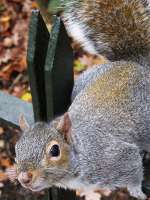
Remember when the Eurasian Red Squirrel was the animal of the day? Here is a quick reminder with an excerpt of that entry:
"On the European mainland and in the UK and Ireland, populations decline through the competition with the Grey Squirrels (Sciurus carolinensis) which were introduced from North America." (full entry here)
The native red squirrels are outnumbered by 66 to 1 by the grey squirrels in the UK. The population of reds is declining, because they are 'squeezed out' by the greys. Now, the UK biodiversity minister Jim Knight proposed "humane and targeted pest control". "Many people love grey squirrels, but the reality is that they are a real problem for some of our most threatened native species," he said.
Read more in this article on the BBC.
Image © Andrew Dunn, Licensed under ShareAlike License v. 2.0
You can help spreading the word about this animal by liking it on facebook
Permanent Link
Tuesday 01 January 2008
Broad-striped Mongoose
A Broad-striped Mongoose (
Galidictis fasciata) can be found in the rain forests of Madagascar, and specifically, they stay on range from 400 plus meters to around 1500 meters (elevation), from low ground to montane jungles. It has a small (to medium) physique, if we put it side by side with the other martens of the animal world. Here are its characteristics: short legs, bushy tail, and a long head.
At present, the data on reproduction of the Broad-striped Mongooses are not abundant, experts hypothesize that the Broad-striped Mongoose is in all likelihood, pair-bonded. Ergo, they are probably monogamous, but that has not been proved beyond a shadow of a doubt.
Not too long ago, a female Broad-striped Mongoose was caught, but it failed to exhibit reproductive behavior. Reports of those in captivity exist, but still, little has been determined regarding longevity. Its cousins (captured) exhibited a great variation in longevity. One of the Malagasy ring-tailed mongooses was reported to reach past 24 years, again, this was a captured individual. But a Malagasy brown-tailed just lived up to 4 years and 9 months, a big difference indeed.
Why the scant data on the Broad-striped Mongoose, you may be asking? It could be primarily due to the nocturnal nature of these mongooses. Speculations are persistent that these creatures are social, that means, they exist in cliques.
What do they eat: they most likely feed on lemurs, rodents, amphibians and reptiles. However, some experts assert that lemurs are not part of their diet, well...everything would just be speculations, until a captured mongoose of this breed is captured, and a lemur on a plate put in front of it.
interesting fact: Did you know this- that these mongooses leave behind scented paths/trails via glands of the anus/cheeks?
You can help spreading the word about this animal by liking it on facebook
Permanent Link
Tuesday 01 January 2008
Small Indian Civet
They are scattered all over most of India, but the Small Indian civet (
Viverricula indica) and can also be found in Pakistan, south China, Thailand, Myanmar, Indonesia, Malaysia and Sri Lanka. Small Indian civets are like cats in appearance. For one, they have pronounced round ears, the body pelage's color differs. It could be from sand-color to gray-white. Spots are small at the spine area, all its legs are dark but spotted with white patches, its throat/breast areas possess gray-white coloring, and it weighs on the average around 3.4kgs.
The Small Indian civet is nocturnal and solitary. It is arboreal, that is to say, it climbs trees and stay there. However, when hunting, it opts for ground level. The Small Indian civet is basically omnivorous. Its diet consists of lizards, rodents, birds, insects and even eggs. They are polyestrous, and the newborns could be sighted at any time of the year, litter size would range from three to five. Longevity is about 22 years (in captivity).
Let us talk about the trapping of these civets (and its cousins), the trapping success is actually low, in one expert study/experiment done, only 3 of 400 trappings succeeded, for a pitiful rate of 0.75%, and as far as the rate with this civet is concerned, just about .25% turned out OK, and even the Indian Grey Mongoose dished out a .5% profile. (That may be bad news for humans, but that is good for them, I suppose).
To be more specific, a mature male was caught sometime in 1998, weighing at 2.5kgs. It was radio-collared (that means it was set free), and tracked by the experts for months. All of a sudden, the radio stopped working, and they assumed it was a battery failure, we can safely assume that this animal was never found again.
Interesting fact: The sexual maturity is often known in so many animals, but for the Small Indian civet, it is still unknown up to this day...
You can help spreading the word about this animal by liking it on facebook
Permanent Link