Wednesday 14 May 2008
Geoffroy's Cat
Length (avg): 60 cm (24 in)
Weight (avg): 2–4 kg (4–9 lb)
Geoffroy's Cat (
Oncifelis geoffroyi) is the most common cat of South America. It resides on the Andes mountains, in grasslands and woodland areas. The Geoffroy's Cat is the size of an ordinary domesticated cat. Colors can vary however, they can be brown or gray, sometimes yellow. They can become up to 15 years of age in the wild.
The Geoffroy's Cats living more south have a more grayish coat, while the ones living more north have a brownish yellow coat. The Geoffroy's Cat has a circular head, short fur (in summer), and the male is ordinarily bigger than the female side. They have big ears, and this permits it to be aware of sounds coming from an approaching predator or prey, for that matter.
The claws are deadly-sharp, and this is for two reasons. First, to be able to climb, and second, to be used for stabbing its prey. It cannot be denied that these cats are good swimmers, as they can easily cross rivers.
A female Geoffroy's Cat produces one litter annually, where the litter size is at most 3 kittens. The male does not do anything as far as rearing the young is concerned. The gestation period for a mother would be 72 up to 78 days, and when it is time to give birth, they give birth at a rocky terrain. After 6 weeks the kittens are fully mobile.
The male reaches sexual maturity after two years, while the female reaches sexual maturity at eighteen months. Whatever predator in the wild would attempt to turn this cat into lunch, that predator might be disappointed, or more than disappointed if it is the one who gets killed. In other words: it is at the top of the food chain. The Geoffroy's Cat is a match to almost any kind of adversary, of course with one exception, humans. They are often killed for the value of the fur.
Their diet consists of small lizards, rodents, insects, and sometimes a frog or fish.
Interesting fact: This cat actually shares its home (at grasslands) with the
Kodkod, another kind of cat.
Picture of the Geoffrey's cat by Daf-de, licensed under
GFDL
You can help spreading the word about this animal by stumbling it by pressing
this link 
or discuss things in our
Animal Forum
- Permanent Link
Tuesday 13 May 2008
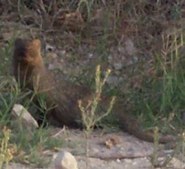
Striped-necked mongoose
Body length: 43-53 cm (17 - 21 inch)
Tail length: 40 cm (16 inch)
Weight: 1.36-2.73 kg (3-6 lbs)
The
Striped-necked mongoose (
Herpestes vitticollis) is the biggest Asian mongoose and is confined to Sri Lanka and India. On Sri Lanka, they can be sighted at the well-wooded habitats, particularly in the dry and moist deciduous forests where they prefer streams and rivers. Striped-necked mongooses have short limbs, with long fore-claws and the color of their fur can be dark brown, gray-yellow, or orange-yellow. The male weighs at around 3.1kgs and the females would weight much less.
A litter of the Striped-necked mongoose ranges from 2 to 3, and the newborns hunt with the parent until they are independent. This mongoose is frequently sighted in daytime at the open sea, and more often than not, it is solitary. Their diet consists mainly on crabs, as well as birds, small mammals (such as mouse deer), fish, frogs, grubs, insects and certain kinds of roots.
There are types of mongoose that are comfortable living near human settlements, but this specific mongoose is not one of them. They prefer to stay within a forest, and near a body of water.
Actually, two subspecies are recognized in India, these are:
Herpestes vitticollis vitticollis, which can be distinguished by the chestnut-red color of the coat. The second is the
Herpestes vitticollis inornatus, which has no red marking/color.
Interesting fact The Striped-necked mongoose could also prey on something bigger than himself, for example the Indian hare.
You can help spreading the word about this animal by stumbling it by pressing
this link 
or discuss things in our
Animal Forum
- Permanent Link
Friday 09 May 2008
Neotropical River Otter
Mass: 5 to 15 kg (11 to 33 lbs)
Length: 36 to 66 cm (14.17 to 25.98 in)
The
Neotropical River Otter (
Lontra longicaudis) resides in swamps, streams, lagoons and lakes in Mexico and parts of South America (especially Brazil, Bolivia, Paraguay and Uruguay). It is the most widespread of the Lontra genus.
If you have seen a North American river otter, then you could easily imagine a Neotropical River Otter, for they are quite alike in appearance. However, the Neotropical River Otter is shorter, around the mouth, the areas are white, its body is long and circular. Neotropical River Otters possess a soft wool-like undercoat that is layered with guard hairs, the latter maintains dryness to the undercoat when it is wet. Unlike seals, the Neotropical River Otter does not have an insulating layer of fats, but instead they depend on this fur for dryness and warmth.
Its head is both round and flat, ears placed low, the muzzle is just short and whisker-filled. The neck is also short, it has eyes which are widely-spaced. The best description for the nose of a Neotropical River Otter would be trapezoid-like.
The back legs are longer than the front ones, allowing them to swim adequately. If an otter is relaxed and swimming slowly, it could be seen paddling using all 4 paws, but if it is engaged in fast swimming (for example, being pursued, or chasing a prey), short paws are maintained close to its sides, the tail acts as a propeller. Its nostrils/ears could be closed when one is submerged.
Their diet mainly consists of mollusks and fish, but they are what we call opportunistic eaters, they can also eat birds, small reptiles or mammals.
This otter has no set breeding period, and just like its relative otters, a delayed implantation prior to breeding might occur. A newborn is born fully furred, but the eyes are shut, and these would open after approximately 44 days.
Interesting fact: One marks by scent via the leaving of feces on places like bridges or logs, and you know why? Experts believe this is an advertisement of one's gender.
Picture of the Neotropical River Otter © 2006 Carla Antonini, licensed under
Attribution-ShareAlike 2.5
You can help spreading the word about this animal by stumbling it by pressing
this link 
or discuss things in our
Animal Forum
- Permanent Link
Monday 05 May 2008
Ribbon seal

The scientific name of the
Ribbon seal (
Phoca fasciata) sounds like something straight from a "Lord of the Rings" genre, but the truth is, Phoca is 'seal, while "fasciata" is a band or ribbon, hence the name of this seal. The Ribbon Seal inhabits the periodically ice-covered waters in North Pacific. The Ribbon Seal actually has other names, such as: Qaqruliq or Kukupak in
Yupik.
They are of medium size, if we would compare them to other ice seals. Usually they would weigh around 70kgs, while a newborn would weigh about 10.5kgs. Newborn Ribbon Seals possess a pelage of white, soft hair, and this gives them protection from the elements. First year pelage would not exhibit the usual coloration of the adults, but by the time they reach their fourth year, color would be any of 4 particular, light-hued ribbons set on dark. They can be found on the following areas: encircling head/neck, encircling trunk or at the navel areas, one at each side of its body. The measurements of the ribbons vary, and fact is, in some individuals, they merge.
They have big eyes, a bit-flat whiskers and weak teeth. A female Ribbon Seal is sexually mature from 2 to 4 years, while the males are at ages 3 to 6. The young Ribbon Seals are born on an ice setting (floes), and the nursing time frame would go from three weeks to a month. Majority of the adult females get pregnant each year.
These seals consume a wide repertoire of foods, but in general, their diet consists of fish, and walleye pollocks, in territories where this kind of prey abounds. Besides fish, they survive on shrimps, crabs and squids.
Interesting fact: One's air sac overlies its ribs at the right side, and the purpose of this structure (it is absent from its relatives' bodies) is basically a mystery. Scientists speculate that it is most probably related to vocalization when underwater.
You can help spreading the word about this animal by stumbling it by pressing
this link 
or discuss things in our
Animal Forum
- Permanent Link