Tuesday 28 August 2007
Giant otter

As its name indicates, the
giant otter (
Pteronura brasiliensis) is the largest otter in the world. Its body length can reach up to 1.4 m while its tail alone can grow to be 30 cm to 100 cm. The average weight of an adult giant otter can reach up to 34 kgs. The males are larger than the females.
The giant otter's feet have been adapted for their amphibious life. They have strong claws and big webbed feet, and its under-fur is water-repellent. The giant otter is extremely dark brown, almost black in color, except for a distinctive white spot at the throat's area. The giant otter lives in the larger rivers of the tropical rainforests in South America, preferring the slower rivers where vegetation is thick at the banks. To avoid their predators, the puma and jaguar, giant otters avoid bare ground, when possible, and prefer to live in areas with a large amount of vegetation.
In the past, the giant otter’s range was from Venezuela to northern Argentina; however, currently they are found only in Guyana and Brazil. Giant otters are social and live in groups, called holts. The holts are territorial. A giant otter holt consists of family members, typically siblings. The entire holt will help to rear the young and defend their territory.
Giant otters subsist primarily on fish, particularly catfish and perch. However, on occasions when fish is scarce, they will eat crustaceans, caiman and even snakes.
Interesting fact: This otter is able to eat six to nine pounds of food in a single day.
Picture of the Giant otter by Renaud d'Avout d'Auerstaedt (
http://renaud.davout.org/), licensed under
Attribution ShareAlike 2.5
You can help spreading the word about this animal by liking it on facebook
Permanent Link
Sunday 26 August 2007
Short-beaked Echidna - The Spiny Anteater
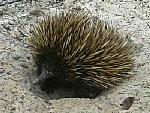
The
short-beaked Echidna (
Tachyglossus aculeatus) is one of four living species of Echidna (The Cyclops Long-beaked Echidna was recently discovered). It regularly eats ants and termites, therefore its nickname, the spiny anteater. It inhabits most of Australia and many nearby islands including Tasmania and New Guinea. They generally use their smell to locate food. Some scientists believe they can receive electric impulses using sensors around their nose to help them in locating prey animals.
You can help spreading the word about this animal by liking it on facebook
Permanent Link
Sunday 19 August 2007
Meerkat
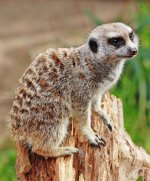
The
Meerkat (
Suricata suricatta) is a member of the mongoose family. It can be found in the Kalahari desert in the South of Africa in Botswana, Zimbabwe and Mozambique, where it lives in so-called 'mobs' or 'gangs'. Their tails are, unlike other mongoose species, long and thin instead of bushy and has a black / red tip. They use their tail for balance and use it to look larger than they really are when threatened or when mobbing, in additon they arch their backs. They are very social animals, and can live together with 3 families, and as much as 30 individuals. Among packs heavy competition and fights can arise. Packs work with sentinels, which sound the alarm with their distinctive bark. Male meerkats tend to take over or emigrate to another pack when they become adults. Their main diet consists of insects, but they will also eat small invertebrates, eggs, reptiles and birds. They are not endangered or threatened.
Interesting fact: The color of the coat of the Meerkat differs per region, following Gloger's rule, which, in short, is that animals living in more humid areas have darker coloured coats than their relatives from more arid regions.
Image by Fir0002, licensed under GFDL
You can help spreading the word about this animal by liking it on facebook
Permanent Link
Thursday 16 August 2007
Flat-headed cat
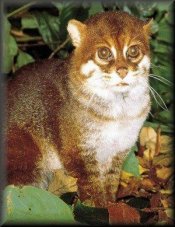
The
flat-headed cat (
Prionailurus planiceps) is about the size of a domestic cat, but possesses a flat but long head and round ears. The flat-headed cat looks similar to a civet and it is adapted to partially-aquatic living. Flat-headed cats have partial webbing on their toes, and this aids them in navigating through water. Also, their teeth face backwards to help the cat hold on to slippery prey, like frogs.
Around the year 1985, the flat-headed cat was classified as extinct, but luckily, they were not. In 1995 they were removed from the extinct list when they were spotted in Malaysia, Indonesia, and Thailand. The flat-headed cat's habitats are forests near rivers and river banks.
In the wild, the flat-headed cat is believed to be nocturnal, but in captivity they exhibit crepuscular (active at dusk and dawn) behavior. Their diet includes crustaceans, frogs, fish and, as a last resort, rodents.
Like most other cats, this cat is solitary, using scent to mark its territory. The size of a typical litter is between one and four kittens. In captivity, these cats have lived up to 14 years of age.
Because of their dependence on rivers and the fact that pollution is a growing problem in their habitats, it is assumed that the population of these cats is not thriving.
Interesting fact: In the 19th century, this cat was known as the "fire cat". Also, they will ignore a live sparrow even if this is within reach.
Image of the flat-headed cat by Alessio Marrucci, licensed under
GFDL
You can help spreading the word about this animal by liking it on facebook
Permanent Link
Monday 13 August 2007
Palla's cat
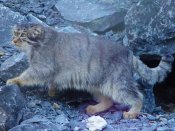 Palla's cats
 (
Otocolobus manul) are small cats which range in the rocky areas and deserts from Iran to China and Mongolia. The Palla's cat's appearance a bit unusual with a broad head, tiny ears, big eyes, and stocky limbs. The Palla's cat's coat is longer than any of its relatives, and it is not of uniform color. It can be light-gray or a combination of yellow and brown.
It can be extremely silent when stalking. Its ability to move stealthily makes it a good predator. It is known to sneak up on its prey even with very few plants to hide in.
This cat is both solitary and a bit mysterious, Scientists do not know much about the Palla's cat, but from all indications, they appear to be night creatures. They hunt during the night relying mostly on excellent night vision. They hunt marmots, but mice are also a significant part of their diet.
Mating happens at the early part of the year, starting with many mating calls from both the males and females. The young are born blind, with a wooly covering. These kittens become autonomous at around eight weeks, and become sexually mature at 18 months of age.
The two largest threats to Palla's cats are humans, who hunt them, and an illness, called toxomoplasmosi, which is transmitted to younger cats from eating rodents.
Interesting fact: A Palla's cat's eyes have a nictitating (blinking) membrane found at its corner. It acts as another eyelid.
You can help spreading the word about this animal by liking it on facebook
Permanent Link
Saturday 11 August 2007
Sika deer
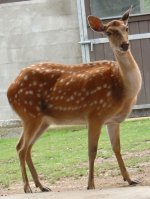
The
Sika deer (
Cervus nippon) lives in East Asia, but they have also been introduced in countries like Australia, Austria, Denmark, England, France, Ireland, Jolo Island (south of the Philippines), New Zealand, Poland, Scotland, Maryland, Morocco, Oklahoma, Texas, Wisconsin, and Virginia (
source). The Sika deer is primarily nocturnal and do not form groups that often. Males are mostly solitary, and only sometimes form groups. Females form groups with their young only during the calving season. They are excellent swimmers. The word 'sikha' in Japanese is the general word for deer. Two subspecies, Dybowski's sika deer and Formosan sika deer are very endangered and possibly extinct in the wild, but are still found in zoos.
Picture by en:User:Tempshill, licensed under GFDL
You can help spreading the word about this animal by liking it on facebook
Permanent Link
Thursday 09 August 2007
Dorcas gazelle
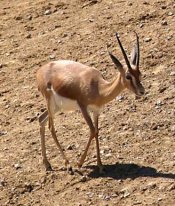
The
Dorcas gazelle (
Gazella dorcas) is closely related to the mountain gazelle, but is different on a few points. They have longer ears and they have curvier horns. The Dorcas gazelles live in northern Africa, and the Sahara and Negev deserts in Morocco, Rio de Oro, Algeria, Tunisia, Libya, Chad, Somalia and Ethiopia. In the Middle East they live in parts of Israel and Sinai. The coloring in subspecies is different, in the Northern Sahara, they are an ocher color and they have darker flanking stripes. But the population near the Red Sea, has a more reddish-brown and lighter flanking stripes.
Their diet consists of leaves, flowers and pods of Acacian trees and various bushes.
When they feel threatened they sound their alarm call which sounds like barking. When chased, these gazelles use "stotting" (leaping straight up during pursuit by a predator) as a method to signal their fitness to the predator and warn other gazelles a predator is present. Dorcas gazelles can reach speeds of up to 80 km/hr. Their natural predators are the lion, cheetah and the leopard, but their main threats are habitat destruction, hunting, and the introduction of domestic sheep and goats.
Picture by Dorcas Gazelle by Frithjof Spangenberg, licensed under
Attribution ShareAlike 2.5
You can help spreading the word about this animal by liking it on facebook
Permanent Link
Saturday 04 August 2007
Rusty Spotted Cat
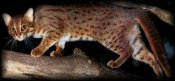
The
Rusty-spotted Cat (
Prionailurus rubiginosus) is indigenous to the following places: South of India- Jammu, Gujarat, Kashmir and Sri Lanka, but as of late, Central India joined the list. There are two kinds of populations, the first kind in Southern India while the second kind is the Sri Lankan type. The latter moves in the thick tropical forests at high altitudes, while at Central India, they could be seen on dry grass grounds and forests (open).
Rusty-spotted Cats are among the smallest wild cats. The tail itself is around 50% of the overall body length. Its name is derived from its appearance of course, rust colored spots traversing the upper parts of the body. The underside are light though, and a couple of dark lines run along the head of this cat. Some people say that the Rusty-spotted Cat is a "washed out" variant of its cousin, the Leopard cat, but that I suppose, this is just a matter of opinion.
A Rusty-spotted Cat's gestation season is close to 70 days, pups are born in April, usually one to two.
Most of the time, the Rusty-spotted Cat is nocturnal, contented to rest in hollow logs during the day hours. Experts strongly believe that they are above-average climbers, and they leave urine elements within their established "turf'.
Their diet consists mammals, birds, reptiles and insects. They could also go after frogs, right after a rainfall.
Picture of the Rusty Spotted Cat by Alessio Marruccik, licensed under
GFDL
You can help spreading the word about this animal by liking it on facebook
Permanent Link
Thursday 02 August 2007
Ross Seal
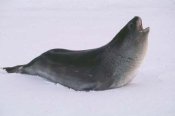
The
Ross seal (
Ommatophoca rossii) is one of a kind, it is the only seal whose geographic range is confined to the Antarctic. They are found at areas of average to densely-packed ice, and the places they inhabit are quite isolated, and difficult to navigate through. It is one principal reason why there is just scant data on the habitats, other than the ones I mentioned.
The average Ross seal weighs from 150 to 215kgs, but do not get so impressed with it. Fact is, Ross seals are the most humble of all seals in the Antarctic, size-wise. One has short hair, a dark dorsal surface, a silver ventral surface and on its head/neck, streaks are present. How do we differentiate by sight a Ross seal from its cousins? One is that they have big eyes, which are not in proportion.
The breeding happens in December, while the newborns (the pups) materialize sometime in November, and on the average...just one offspring. A female's reproductive maturity happens on the average, at about 3 years, and the same could be said for the males.
The Ross seal male has been recorded to go to 21 years of age, and the oldest from the distaff side was 19, but of course, it is not impossible that one of these days, we might just see another seal "break the record", so to speak.
This seal is believed to be solitary in nature. According to expert studies, just about 3 to 9 percent had been sighted in pairs, but these figures could actually be quite far from the truth, as other biologists believe.
What do they survive on: fish and squid beaks are among them. Experts have come up with these figures as far as breaking down their "diet" is concerned: cephalopods (64%), fish (22%) while other forms of invertebrates would go down as 14%.
Did you know you can distinguish seals from sea lions by looking at their ears? Visible ear flaps are absent with seals.
You can help spreading the word about this animal by liking it on facebook
Permanent Link