new - Animal forum

Subscribe to
"Animal of the day"

AddThis Feed Button
Or subscribe by e-mail

Enter your Email


Powered by FeedBlitz

We hope that reader will gain an increased appreciation of the need for more conservation measure in order to protect the beautiful creatures that inhabit the earth. Our philosophy is that the more we learn about animals, the more we respect them and take better care of them. That is why we update this blog with new animals, We encourage you to syndicate our content by adding "animal of the day" to your own blog! (read more)

About us

Our mission is to get people excited about animals and their welfare by writing articles on these animals. We encourage people to comment on posts and share with others. Don't forget to subscribe to our feed.

Contact us
Copyright notice

Funny animal videos and pictures

Swimming with manatees - harmful or helpful

Last Comments

janicka (Ribbon seal): i love the ribbon seal i …
bob (Fattest cat in th…): DUUUUUUUUUUUUUUUUUUUUUUUU…
P.L. Frederick (Ribbon seal): This seal is new to me — …
kenneth maldonado… (Ribbon seal): unbelievably cute.Why hav…
jenny (Impala - don't sh…): i totally luv imppalas th…
coco (Impala - don't sh…): i luv impalas they are my…
cicimici (Ribbon seal): me also did`t heard about…
Doriesmom (Ribbon seal): What an interesting seal.…
mry (Pudu - smallest d…): Tasty, with Fries and Béa…
lane (Bush dog): does the bushdog have any…

Calendar

« May 2008
S M T W T F S
        1 2 3
4 5 6 7 8 9 10
11 12 13 14 15 16 17
18 19 20 21 22 23 24
25 26 27 28 29 30 31

Archives

Next Archive Previous Archive

01 May - 31 May 2008
01 Apr - 30 Apr 2008
01 Mar - 31 Mar 2008
01 Feb - 28 Feb 2008
01 Jan - 31 Jan 2008
01 Dec - 31 Dec 2007
01 Nov - 30 Nov 2007
01 Oct - 31 Oct 2007
01 Sep - 30 Sep 2007
01 Aug - 31 Aug 2007
01 Jul - 31 Jul 2007
01 Jun - 30 Jun 2007
01 May - 31 May 2007
01 Apr - 30 Apr 2007
01 Mar - 31 Mar 2007
01 Feb - 28 Feb 2007
01 Jan - 31 Jan 2007
01 Dec - 31 Dec 2006
01 Nov - 30 Nov 2006
01 Oct - 31 Oct 2006
01 Sep - 30 Sep 2006
01 Aug - 31 Aug 2006
01 Jul - 31 Jul 2006
01 Jun - 30 Jun 2006
01 May - 31 May 2006
01 Apr - 30 Apr 2006
01 Mar - 31 Mar 2006
01 Feb - 28 Feb 2006
01 Jan - 31 Jan 2006
01 Dec - 31 Dec 2005
01 Nov - 30 Nov 2005
01 Oct - 31 Oct 2005
01 Sep - 30 Sep 2005
01 Aug - 31 Aug 2005
01 Jul - 31 Jul 2005

Animal posters
Animal pictures
Mammals.start4all.com
Animal diversity web
Recently extinct animals forum
PetLvr.com
Another chance to see
Happiness is a warm puppy

Miscellany

AddThis Feed Button

Saturday 30 June 2007 Madagascan Dwarf Hippopotamus

The Madagascan Dwarf Hippopotamus (Hippopotamus lemerlei) is extinct now. They bear a thin skin (just like their mainland counterparts) and the speed of water loss via the skin (dry air) is much, much greater than that of the rest of the mammals in the world. The Madagascan Dwarf Hippopotamuses have to be in water most of the time if the location is humid. Otherwise, they would simply get dehydrated.

A Madagascan Dwarf Hippopotamus had stubby legs, and as it ages, these legs would be less and less capable of supporting its great weight. So, when these hippopotamuses reach a very advanced age, the water's buoyancy is crucial in lifting themselves up.

Actually, fossils were unearthed until about 1000 AD, but verbal traditions in Madagascar persist. These talks describe a creature very much like a hippo, insinuating that this animal lived on in more recent times, or that there may still be one or two who is still alive. (Who can actually say with certainty, one way or the other?)

If you are very curious about the Madagascan Dwarf Hippopotamus of Madagascar, they have a display (skeleton, lest you think it is the last of the "Mohicans") of it in Oslo (Paleontologisk Museum)

INTERESTING FACT: did you know: that the word "Hippopotamus" means river horse in Greek?
You can help spreading the word about this animal by stumbling it by pressing this link StumbleUpon or discuss things in our Animal Forum

Add your thoughts about this animal - Permanent Link

Thursday 28 June 2007 Bowhead Whale

BowheadsThe Bowhead Whale (Balaena mysticetus) is also named the Arctic Whale or Greenland Right Whale. Unlike other whales, the bowhead spends all its life in the Arctic waters. In history they were an ideal target for whale hunters, they are slow swimming and float after death. Their predators are orcas and humans. Depending on the location of the whales, they are classified as 'critically endangered' (Spitsbergen) to 'Lower risk - conservation dependent' (Bering-Chukchi-Beaufort).

Some facts:

  • With their gigantic bony skulls they can break through 60 centimeter thick ice to breathe.
  • The layer of blubber fat on their body can be as thick as 50 centimeters.
  • Bowhead whales can stay as long as 40 minutes.
  • Bowhead whales do not have dorsal fins and have the longest baleen plates of more then three meters.
You can help spreading the word about this animal by stumbling it by pressing this link StumbleUpon or discuss things in our Animal Forum

Add your thoughts about this animal - Permanent Link

Tuesday 26 June 2007 Onager

OnagerAmong the world of equids, the Onager is one of the bigger breeds in Asia. Onagers (Equus Onager) is the fastest, and they are known to be capable of speeds reaching 70km per hour. They could usually be found on semi-desert areas where it is hot (day), cool (nighttime) and only some occurrences of rain.

Body/Head length of an Onager is usually two meters and its weight is in the range of 250 kgs. It has a light sandy-red coat that has a pronounced brown line running through the backbone area. Legs are quite short (thin too). The male is just a bit bigger than the female counterparts. An Onager would eat grass if it's the nearest thing/food to it, but they are known to survive on trees and herbs. They get most of the water they need from the foods itself, but chances are, they would always be within thirty kilometers from water.

The female and their young form a very temporary, small set from 2 to 5 members. The can be found in China, India, Iran, Mongolia and Turkmenistan. Their main threats are the direct competition with grazing livestock, loss of habitat, and poaching for meat and hides.

Picture of the Onager by Alessio Marrucci, licensed under GFDL.
You can help spreading the word about this animal by stumbling it by pressing this link StumbleUpon or discuss things in our Animal Forum

Add your thoughts about this animal - Permanent Link

Monday 25 June 2007 Indian Giant Squirrel

Indian giant squirrelIndian Giant Squirrels (Ratufa indica) most often stay in trees, and they find refuge within holes of the trees, but here is one amusing bit of truth: they could leap from tree to tree, jumping a span of 6 meters or longer. The Indian Giant Squirrel is found in tropical forests, that includes the rainforests.

An Indian Giant Squirrel has dorsal colors that go from red to brown, but generally, they have a white fur in the belly area. Ears of an Indian Giant Squirrel are round, a pronounced hand with an inner paw that is of course used for gripping. A typical Indian Giant Squirrel weighs about 1.5 to 2 kilograms.

The number of young average to two, and on the average, Indian Giant Squirrels have a gestation period of 31 days. The reproductive particulars for these squirrels are not exactly known, but indications point to the fact that breeding happens all throughout the year. Longevity of these squirrels as far as the wild habitat is concerned, is unknown, but according to records, one in captivity reached two decades. Basically, they are solitary creatures, and they are cautious (with all the predators out there, for good reason).

They are omnivorous, surviving on flowers, fruits, eggs, insects and even bark. It is safe to assume that they escape being killed by their predators by simply going to the trees, plus exercising their agility. These squirrels could do harm to crops by eating the seeds, and they could also harm poultry when they eat their (poultry's) food.

Interesting fact: The Giant Squirrel's large tailis used as a counterweight, to help them keep their balance.

Picture of Indian giant squirrel by Vijay Cavale, Muthodi, Karnataka. India November, 2005 Author: Vijay AT indiabirds.com, licensed under Creative Commons Attribution 2.5
You can help spreading the word about this animal by stumbling it by pressing this link StumbleUpon or discuss things in our Animal Forum

Add your thoughts about this animal - Permanent Link

Saturday 23 June 2007 Hispaniolan solenodon

Hispaniolan solenodons (Solenodon paradoxus) were unknown to the world until 1833. They look like a shrew, but it is bigger. A Hispaniolan solenodon weighs from 600 grams to 1 full kg. Fur is brown-red, underside is of a paler hue. Legs, tail, eartips and the snout are all bald, and its claws have been given by Mother Nature for digging purposes. The female Hispaniolan solenodon can have (average-wise) 2 litters, where one set would have 1 to 3 newborns. Ordinarily, only a pair would survive, since the female just has two nipples. These nipples are located in a very unusual part: near its buttocks. There is a reason why these solenodons remained unknown for a long time: their nocturnal movements. Another is that it cannot be said that their numbers are big, thus, their bearing on the ecosystem is practically little. In day hours, they hide in the trees/burrows but if and when one comes out, a Hispaniolan solenodon goes with an ugly waddle, on a zigzag fashion. According to the local folks, they have never seen one that moved in a straight course. That is not to say that they move fast, relatively, they are clumsy when they run. It follows then that, if dogs or cats are loose, the odds that a solenodon would stay alive for long become scary (scary for them). What are their choice of foods: snails, worms, even small reptiles, but they also subsist on foliage and fruits. What these animals do is, they poke on the ground with the snout, then they go about digging. Those in captivity were observed to bathe frequently, and they would only drink during baths. Interesting fact: A poisonous saliva produced by one of its glands is part of this solenodon's personality. It is just one of the very few mammals who are venom-producing.
You can help spreading the word about this animal by stumbling it by pressing this link StumbleUpon or discuss things in our Animal Forum

Add your thoughts about this animal - Permanent Link

Friday 22 June 2007 Saiga

SaigaThe Saiga (Saiga tatarica) communities are found in 3 places, all within the Asian continent: Kalmykia, Kazakhstan and Mongolia. They stay in semi-desert areas and dry steppes, but herds could be found in those grassy territories that have no hills or rugged areas.

Mass of a typical Saiga is thirty to forty-five kilograms. Its weight is nothing spectacular though, what is spectacular is its head, possessing a mobile nose hanging over the mouth area. Male Saigas have two long colored horns, and save for the horns/snout, it actually just resembles a sheep, a small one at that. These antelopes have long legs, supporting a body which could be considered as robust. In summer time, a Saiga's coat would be yellow-red (back) while the belly side is of pale color. When winter comes though, their covering turns thicker.

When we speak of reproduction and weaning, here are what you should know: number of offsprings at a given birth are from one to three. The Saiga's gestation time frame can go all the way to 152 days. The females attain sexual maturity in just seven months, whereas the males would reach the same point in 2 years' time. Pregnancy period is five months, while lactation goes much shorter than that, 4 months. Under captivity status, it has been noted that young Saigas would even nurse from adults that are actually unrelated to them.

In breeding period, they join to form sets of 5 to 10 females, along with a single male, and the latter is not going to let any harm fall onto his group, as much as he could help it. Bloody fights occur between 2 opposing males, and when I say 'bloody, one of the two usually gets killed at the end. Migration-wise, it is not often, but it happens if snowstorms for example are in progress.

Interesting fact: Saiga's horns are considered as precious commodities, these are crushed and often used in some forms of medicine (Chinese kind).
You can help spreading the word about this animal by stumbling it by pressing this link StumbleUpon or discuss things in our Animal Forum

one comment - Permanent Link

Sunday 17 June 2007 Gelada
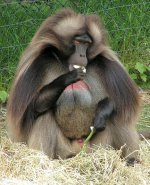
GeladaThe Gelada (Theropithecus gelada) can be found in the highlands of Ethiopia and Eritrea, the especially Semien Mountains National Park in Ethiopia. They are eaily recognizable for their hourglass-shaped patch on their chest. On males, the patch is surrounded by white hair. They live in small harems, consisting of one male, several females and the young Geladas. The small harems join together to feed and the numbers of the total number of Geladas can go as high as 670! The Gelada prefers to sleep on rocky cliffs. They are exclusively herbivorous and feed on grass, seeds, fruit, and flowers. Geladas are not listed as endangered, but it is estimated that around 50,000 to 60,000 exist today. Through habitat destruction and hunting they are forced to live more close to the Olive Baboon and hybiridsation has been observed.

Picture of the Gelada by sannse, licensed under GFDL

You can help spreading the word about this animal by stumbling it by pressing this link StumbleUpon or discuss things in our Animal Forum

Add your thoughts about this animal - Permanent Link

Saturday 16 June 2007 Mountain zebra

The Mountain Zebra (Equus zebra) has a body length of 2.2m, and the shoulder length goes at approximately 1.3m and the tail, that never-forgotten tail (never forgotten by the kids), it is .5m. Equus Zebras' coats are marked by white and black stripes, and the stripes are quite close at the torso and neck areas. Legs of a typical zebra has stripes that are made up of horizontal bands. Spine of the Equus Zebra and its upper tail are decorated with a grid-iron pattern, and this I am sure you would agree, remains to be one of its most known physical attributes.

Undersides are white, but it could be mixed with a dark line that goes all the length of this animal's belly, and what's more, they have a hanging flap (skin) which would remind us of our own Adam's apple (er, if you are a woman, I am speaking of "us" in reference to humanity). An Equus Zebra's head is quite short, its muzzle is dark, long ears which hold black and white spots.

These zebras could mate at age 2 and expected lifespan is approximately 25 years. Their breeding is not confined to a single part of the year, it could go on for the whole year. They are diurnal, and they do eat a lot. The feeding eats up more than half of their day hours, but next to eating, an Equus Zebra baths too, once or two times in a day. Their foods: leaves, bark and grass...and on the other side of the coin, the hyenas and lions consider them as food.

They are referred to as 'mountain zebras', and that is apt, for they are very good rock climbers, as opposed to the "plains" counterparts.

Interesting fact: Within a breeding group, they have their own hierarchy, the dominant male is responsible for its own group. When adult stallions of two herds meet, a combat may ensue, but sometimes the two herds may just integrate into a bigger herd.

You can help spreading the word about this animal by stumbling it by pressing this link StumbleUpon or discuss things in our Animal Forum

Add your thoughts about this animal - Permanent Link

Friday 15 June 2007 American Mink
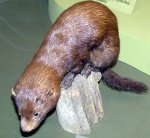
American minkThe American Minks (Mustela vison) are considered as part of the Weasel Family, they are scattered over North America, but do not expect to find one at the tundra areas or Southwest US...unless of course, if somebody took it for a pet and brought it there. I am speaking about the American Mink, and akin to many other weasels, they have a similar physique. Usually, one weighs 2.07 kg, and the males are usually bigger than the female side. The color of the American Minks' hair range from brown to something very close to black, but the underside has a lighter shade. An American Mink's soft, thick fur gives warmth and protection when in they are in aquatic places. They are nocturnal, active the whole year long, and are outstanding swimmers. In the treacherous world of animals, they are fair game for coyotes, foxes, bobcats and even owls (yes, owls, believe it or not).

Creatures usually at the shorelines serve as the American Mink's basic food requirements, such as muskrats, shrews, various fish, frogs, salamanders, earthworms and insects. They ordinarily live in burrow (roots of trees) or shelters created by beavers. The males journey more than the distaff side, and they utilize many of the said places. According to records, at the UK mainland, these Minks survive on rats and rabbits. When winter comes, the fish would serve as their staple food, as many kinds of fish become torpid. Minks would kill a greater number of birds than what they actually need to eat, and they would conserve the surplus. Regarding mating, the males are known to be promiscuous, and the later the period of mating, the shorter implantation period is. Newborns are all of the following: wrinkled, pink, blind and deaf. An American Mink would be able to take care of itself at 2 months old.

Interesting fact: It has been known that they have the capability to kill snakes, but... they do not seem to eat them.

You can help spreading the word about this animal by stumbling it by pressing this link StumbleUpon or discuss things in our Animal Forum

Add your thoughts about this animal - Permanent Link

Thursday 14 June 2007 Bushpig

The Bushpig (Potamochoerus larvatus) typically has a body length of 1 to 1.5 meters, a tail length of 30 to 40 centimeters, weighing from 50 kg up to 115. Its coat could be a pale red or brown up to a near-black shade. Its pale head often has white spots, but from birth, the young have yellow or brown stripes. Bushpigs have long tails, whose ends are tufted. Basically, its body is round, with quite short legs. The male ones have a ridge at the mouth area and speaking of their tusks, a Bushpig's upper tusk can barely be seen by the human eye, but the lower tusks are very sharp.

Sexual maturity of these Bushpigs occur starting at 18 months, and the life expectancy is two decades. Prior to birth, a female Bushpig would stay at a secluded nest. They are predominantly nocturnal, and their resting areas are usually those with thick vegetation. They are a lot of times found taking the footsteps of fruit-eating monkeys, taking in the leftovers from these animals. Prevailing sounds are grunts and squeals. Besides the said discarded fruits, other items of their "diet" are roots, small animals and grass.

In case you are wondering, they are located in grasslands, woodlands (of the moist kind) and the swamp areas of Madagascar and Africa. A Bushpig is very rare if we talked of captivity outside the nation of origin, but a few have been recorded from some American and European collections. Breeding while in captivity has been very rare, for differing causes.

In Guinea and Sierra Leone, they are still unshielded by law, as opposed to the other nations where they could only be gunned hunted if it's open season for the hunters.

Interesting fact: In Burundi, the Bushpigs are protected by the law at all times, it is one of the very few places on earth that shows total commitment to the preservation of these animals.

You can help spreading the word about this animal by stumbling it by pressing this link StumbleUpon or discuss things in our Animal Forum

Add your thoughts about this animal - Permanent Link

Wednesday 13 June 2007 Allen's Swamp Monkey

Allens swam monkeyExpert studies focused on Zaire assert that the Allen's Swamp Monkey (Allenopithecus nigroviridis) can only be found in swamp forests/jungles. Arborary is one apt description for the Allen's Swamp Monkeys. On the average, their number of offsprings is just one, but the important word is "average".

They are actually strongly-built, they have a gray-green skin but the face is red-shaded with hairy cheeks, plus, the body measurements range from 45 to 60 meters. Expectedly (like in so many kinds of animals), the males are bigger than the females.

The newborn Allen's Swamp Monkeys are weaned at two and a half months, but the breeding length of time is generally unknown. Its lifespan is capable of reaching up to 20 years. An Allen's Swamp Monkey is diurnal and they survive in packs consisting of at least forty members. (It is to be expected that many adult males are in a typical group.) It is quite amusing (and frustrating too, for the researchers) that notwithstanding the presence of literature expounding on Old World Monkeys, little could be proven about the Allen's Swamp Monkey's system. However, studies have been done on captured monkeys, and from all indications, these monkeys are quite social.

Regarding food, they forage both on soil and on water...and what exactly do they consume? Leaves, fruit and invertebrates, in other words...they are omnivore (insects like beetles are fair game for these monkeys). Fact is, the webbing found on their toes/fingers concretize their aquatic capabilities.

According to studies still, their life is far from easy, they really have to survive. They are subjected to constant threat from predators such as snakes, eagles, etc. Snakes and raptors are counted as among the mortal enemies of this type of monkeys.

Interesting fact: These monkeys are capable of several facial expressions, like snarling, grinning and even grimacing.

Picture by Grendelkhan, licensed under GFDL, original can be found here

You can help spreading the word about this animal by stumbling it by pressing this link StumbleUpon or discuss things in our Animal Forum

Add your thoughts about this animal - Permanent Link

Tuesday 12 June 2007 Hispid Cotton Rat

Hispid cotton ratThe Hispid Cotton Rats (Sigmodon Hispidus), are a kind of rodent considered to be prevalent in North America, South America and Central America. Still, from recent DNA sequence information, experts in the field are asserting that they could be subdivided further into three subspecies.

A Hispid Cotton Rat has a gray-enhanced coat of deep-brown hair. It has a dark tail, 5 sets of nipples but it has been known that it could have 6 sets. A typical Hispid Cotton Rat resides in grasslands and of course it is to be expected, as grass is its typical food for survival. They move about in both nighttime and daytime, and you may not believe this, but these Hispid Cotton Rats could swim (a fascinating datum). Its underparts go in colors of gray or white. It has small ears and ordinarily, covered by the fur...and...going back to the tail, it is thinly covered.

As far as breeding is concerned, these rats go on all throughout the year, and gestation time frame is close to a month. Size of the litter can go from 1 up to 15, with the Northern-living rats capable of still bigger sets. A young Hispid Cotton Rat is already well-formed right at birth, and its eyes would be functional within 36 hours (upon birth), the weaning period is approximately 2 weeks (in terms of days, that's 10 to 15).

Interesting fact: Right now, they are not yet endangered, but two of the subspecies have been labelled as Near Threatened, which means it is just a matter of time.

You can help spreading the word about this animal by stumbling it by pressing this link StumbleUpon or discuss things in our Animal Forum

Add your thoughts about this animal - Permanent Link

Monday 11 June 2007 Lemurine night monkey

The Lemurine night monkey (Aotus lemurinus) can be found in Central and South America, from Panama to Norht-east Argentina and from Peru to Brazil. They prefer the dense forest with many vines and live in several canopy levels, moving around quadrupedally (with both legs and arms) and only occasionaly touch the ground. Lemurine night monkeys are nocturnal animals and live in groups of 2 to 5 members (one mating, monogamous, pair and their offspring). Female and males look alike and even both take care of their young.
You can help spreading the word about this animal by stumbling it by pressing this link StumbleUpon or discuss things in our Animal Forum

Add your thoughts about this animal - Permanent Link

Sunday 10 June 2007 Western Quoll

western quollA long time ago, the habitat of the Western Quoll (Dasyurus geoffroii) was huge, it covered desert areas of Central Australia, but that was then. At present, their turf had been significantly cut down to what is known as the Jarrah forests (see picture below). How do the Western Quolls look like: an average of 1.3 kg, they ordinarily have a black/brown coat featured with white areas. The Western Quoll has a short-legged structure, a pale face, big eyes and ears which we could only think of as rounded.

Their breeding (reproduction) comes from May to July, where June could be considered as the "heaviest" period. They have a gestation time frame of sixteen to twenty-three days, and a newborn would stay at the mother's pouch for 7-15 weeks, until the time that the newborn Western Quoll could manage to stay out of the said container. These Quolls (both sexes) are considered as sexually capable at just 1 year old.

They are nocturnal creatures. The abode of male Western Quolls are big and cross the areas of females, still, they actually only meet when they need to mate. A Western Quoll can climb tress, and they stay in dens which were built by other creatures.

What exactly does a Western Quoll eat? Well, it encompasses a lot: big insects, vertebrates, carrion even. If we speak of human-settled places, they are capable of raiding chicken cages. When it is in a forested locus, they eat reptiles, parrot-sized birds and crustaceans.

A great fraction of their habitat has been eradicated by constant burning and pesticide-application by the farmers, but that is just one reason. Foxes and deadly cats have cut down their population to what it is right now.

Interesting fact: A Western Quoll is capable of killing bigger prey by a bite to the back of its head.

jarrah forest

Map of Australia, highlighted is the Jarrah forest, by Hesperian, licensed under GFDL

Picture of the Western Quoll by Nezumi Dumousseau, licensed under Attribution 2.5 License

You can help spreading the word about this animal by stumbling it by pressing this link StumbleUpon or discuss things in our Animal Forum

Add your thoughts about this animal - Permanent Link

Saturday 09 June 2007 Cozumel Island Raccoon

The Cozumel Island Raccoon (Procyon pygmaeus) lives only on the island of Cozumel, off the coast of Mexico. The Cozumel Island Raccoon is much smaller than the common raccoon from the mainland and only weighs 3 - 4 kilograms. Other distinctive features are a large black throat band with a light yellow or bronze colored tail and smaller teeth. They live in the mangrove smaps of the island. They are thought to have also lived on the mainland of Mexico, but through habitat destruction and hunting, the only place they live now is on the island of Cozumel. Also on the island of Cozumel, their numbers are declining, through habitat destruction and tourism might also have an impact.

Interesting fact: the Cozumel Island Raccoon is the smallest species of raccoon in the world.

You can help spreading the word about this animal by stumbling it by pressing this link StumbleUpon or discuss things in our Animal Forum

Add your thoughts about this animal - Permanent Link

Wednesday 06 June 2007 Leopard - one of the four big cats

Leopard As part of the big cats, the leopard's size ranges from one to almost two meters! The leopard (Panthera pardus) thanks its name to people who considered it a hybrid between a lion (leo) and a panther (pard)... There is a lot of misconception and mistakes when keeping jaguars, panthers and leopards apart. This is because in different parts of the world they mean different things... In fact, a "panther" can be any of several species of large felid. In North America panther means puma and in South America a panther is a jaguar. Elsewhere in the world a panther is a leopard. There are about 30 subspecies of leopards (one, the Zanzibar leopard is extinct) and some of them are endangered: the Anatolian (maybe even extinct), Barbary, Amur, North Chinese, and South Arabian leopards are all critically endangered.
You can help spreading the word about this animal by stumbling it by pressing this link StumbleUpon or discuss things in our Animal Forum

Add your thoughts about this animal - Permanent Link

Monday 04 June 2007 Whiskered bat
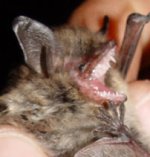
whiskered batThe Whiskered bat (Myotis mystacinus) lives mostly in central Europe and is small, has a pointy face and short pointed ears and has shaggy fur. It is darker than the Brandt's bat, which looks very similair and could easily be confused with. They can become 4 to 8 grams in weight and reach 24 years of age, but the average is 4 years old. Their diet consists of gnats, mayfly, moths, flies and mosquitoes.

Links

World Deer
Animal Diversity Web
Photo of the whiskered bat

Picture by Mnolf, licensed under GFDL.

You can help spreading the word about this animal by stumbling it by pressing this link StumbleUpon or discuss things in our Animal Forum

Add your thoughts about this animal - Permanent Link


Animal of the Day
Subscribe to the
animal of the day
Enter your Email


Powered by FeedBlitz