Thursday 29 November 2007
North African Gundi

The
North African gundi (
Ctenodactylus gundi) can be found in deserts with rocks in Northern Algeria, Southeastern Morocco, Tunisia and Libya. These rodents can become 16 - 20 centimeters in head body length and have short legs, flat ears, big eyes, long whiskers and compact bodies.
Gundis live in colonies, with a size depending on the amount of food in the neighborhood. They live in shelters which regulates temperature, keeping them warm during cold nights and also can offer a cool retreat during the hot day. In the winter Gundis also pile on top of each other to stay warm. Gundis also have other ways to regulate their temperature which can be compared to the way lizards regulate their body heat. They sunbathe during the early morning, until the temperature reaches 20°C (68°F) and then begin to forage. After a quick bite, they flatten themselves against the rocks to help speed digestion and keeping them warm. When the temperature reaches 32°C (90°F) they hide in the shade of the rocks and stay there until the temperature drops in the afternoon.
They do not store foods and, due to the scarcity of food in the desert, they may forage up to 1 kilometer per morning... Their diet consists of stalks, leaves, flowers, and seeds, but they do not drink water. All the water they get comes from the plants they eat.
Interesting fact Gundis can flatten their ribs in order to squeeze into a crack in a rock when in danger.
You can help spreading the word about this animal by stumbling it by pressing
this link 
or discuss things in our
Animal Forum
- Permanent Link
Monday 26 November 2007
Senegal bushbaby

The
Senegal Bushbaby (Galago senegalensis) or Senegal Galago is a primate, member of the Galagidae family. They are on average 16cm long, with a 23cm long tail and weighing around 250g. They can be found in the forested and bushed areas south of the Sahara of Africa. They are nocturnal primates, running along branches. They have large eyes, which gives them excellent night vision and they have strong hind limbs and a long tail to keep them balanced.
Their diet consists of insects, fruit, gum or plant fluids. They can hunt insects by sound alone and snatch them from the air as they fly by.
Interesting fact the name 'bushbaby' can either refer to their appearance or their cries.
Picture of the Senegal Bushbaby by Hans Hillewaert (
Lycaon), licensed under
Attribution ShareAlike 2.5
You can help spreading the word about this animal by stumbling it by pressing
this link 
or discuss things in our
Animal Forum
- Permanent Link
Thursday 22 November 2007
Paca
The
Paca (
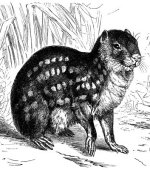
Agouti paca) is a solitary, nocturnal animal which can be found from Mexico to Paraguay. It lives in the rainforests near water and can dig burrows that can be two meters in length, with usually one exit, and Pacas have usually more than one burrow. To escape danger, Pacas usually flee to the water, they are good swimmers. Pacas have three to five spots on the sides of their bodies and can weigh between 6 and 12 kilos. They use their urine and anal glands to mark their territories. The Paca is considered a pest by the formers as they eat their food crops like yams, cassavas, sugar canes and corns. While they are not endangered, their numbers decline due to habitat destruction and hunting.
You can help spreading the word about this animal by stumbling it by pressing
this link 
or discuss things in our
Animal Forum
- Permanent Link
Sunday 18 November 2007
Grey-headed flying fox

The
Grey-headed flying fox (
Pteropus poliocephalus) can be found on the south-eastern part of Australia. In 2001 a
study shows that their range has shifted 750 kilometers southwards, possibly due to climate change. Their habitat consists of woodlands, rainforests, and swamps. Their diet consists of pollen, nectar and fruit and they are an important pollinator and seed-disperser of the native trees.
Adult males have a maximum wingspan of over 1 meter and they can weigh up to 1 kg. During the day the Grey headed flying fox can be found together with small groups to tens of thousands of bats at large 'roosts' (camps or colonies).
The total population is about 300,000 and it has been suggested that they have declined in numbers as much as 30% in the last decade alone. Recent research has shown that since 1994, more than 24,500 grey-headed flying foxes have died from extreme heat events alone.
The main threats of the Grey headed flying fox are
- habitat destruction due to the building of houses and the clearing for agriculture.
- disturbance of roosting sites
- Unregulated shooting
- Electrocution on power lines
- Competition and hybridisation with the Black Flying-fox (Pteropus alecto)
- Extreme heat events
Interesting fact The Grey-headed flying fox can become very old for a mammal of its size. Reports show individuals surviving in captivity for up to 23 years, and a maximum age of up to 15 years in the wild.
Picture of the grey-headed flying fox by
benjamint444 licensed under
GFDL
You can help spreading the word about this animal by stumbling it by pressing
this link 
or discuss things in our
Animal Forum
- Permanent Link
Tuesday 13 November 2007
Asian Golden Cat
The
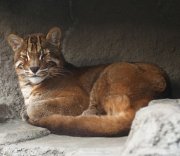
Asian Golden Cat (
Catopuma temminckii) can be found scattered all over Southeast Asia, particularly, in deciduous forests, rain forests, and open terrain with rocky areas.
A typical Asian Golden Cat weighs about 8 to 15 kg. Its fur is coarse and thick, and the markings on their fur are not uniform. It changes from one location to the next, the fur's colors could be bright brown, red or gray-brown. Tail's ventral surface is principally white, and experts think that these could be used for signaling purposes.
Mating/breeding of the Asian Golden Cats occurs in hollow trees, hollows in the ground or among rocks. An Asian Golden Cat's gestation lasts up to around 95 days, and a set of 1 to 2 kittens is expected. The newborns' weight would be doubled after three weeks and tripled after six weeks. The male helps in raising the newborns.
They are mostly active during the night and they hunt hares, deer, lizards, birds and other kinds of smaller animals.
The total population of this species in the wild is unknown but it is thought to be uncommon. It has been rarely seen in the wild, although over the 1990s a few camera trap photos have been collected and two golden cats were radio-collared in Thailand’s Phu Khieu National Park
(source IUCN).
Their main threat is the loss of their natural habitat through deforestation. They are also hunted for their pelt, and the bones are used in certain medicinal mixes.
Interesting fact: Local Thai people strongly believe that when a tiger is near, burning the fur of this cat would surely help. It would cause the tiger to flee.
You can help spreading the word about this animal by stumbling it by pressing
this link 
or discuss things in our
Animal Forum
- Permanent Link
Monday 12 November 2007
Malayan pangolin

The
Malayan Pangolin (
Manis javanica), also known as the Sunda Pangolin, is found in Malaysia, the Philippines, Thailand, Vietnam, Laos and Cambodia, Indonesia, and Singapore. The
IUCN entry on the Malayan Pangolin has it listed as 'possibly extinct regionally' in Singapore and 'Uncertain presence and origin' in Bangladesh and China. The Chinese and Malayan Pangolin are closely related, the Malayan Pangolin is larger, has shorter foreclaws and is lighter in colour.
Malayan Pangolins inhabit burrows, which they dig out themselves, or occupy burrows from previous residents. They use their strong foreclaws, which also come in handy when digging out termite mounds and ant nests.They are remarkable creatures, nicknamed the "living pine cones", with their dragon like armor with sharp scales.
The Malayan Pangolin's natural predators are the Tiger and the Clouded Leopard.
Interesting fact Although they resemble tanks, a mother Pangolin is extremely protective. When threatened, the mother will curl into a ball with the young inside.
Picture of the Malayan pangolin by
de:User:Piekfrosch, licensed under
GFDL
You can help spreading the word about this animal by stumbling it by pressing
this link 
or discuss things in our
Animal Forum
- Permanent Link
Saturday 10 November 2007
Malayan Flying Lemur

Despite its name, the
Malayan flying lemur (
Cynocephalus variegatus) cannot actually fly, and is not related to the lemurs of Madagascar. Instead it is a glider, which uses its gliding membrane (
patagium) to glide between trees. The
patagium is as large as possible, stretching from its shoulder blade to their fore-paws, from their fore-paws to their to their toes and from their toes to their tail.
Malayan flying lemurs live in Thailand, Malaysia, Singapore and Indonesia. They are resting during the day, but active at night and their diet consists of young leaves, shoots, fruit and flowers. The loss of rain forest to the timber industry and agriculture results in loss of habitat for the Malayan flying lemurs. People hunt them for their fur and meat.
Interesting fact Flying lemurs are also known as '
Colugos' or '
Cobegos', which leads to less confusion since they cannot fly and are not directly related to the lemurs in Madagascar.
Picture of the Malayan Flying Lemur: original by Nina Holopainen, licensed under
Creative Commons Attribution 2.5
You can help spreading the word about this animal by stumbling it by pressing
this link 
or discuss things in our
Animal Forum
- Permanent Link
Friday 09 November 2007
Agile gibbon
The
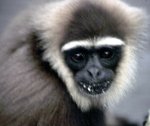
Agile Gibbon (
Hylobates agilis) is a largely arboreal gibbon living in South-east Asia, in Indonesia, Thailand and Malaysia. With their long arms they can swing from branch to branch very fast and hardly every come to the ground (they can cover a distance of 10 meters from branch to branch !). Gibbon pairs are monogamous, mated pairs stick together until one mate dies. Agile gibbons defend their territory by 'singing'. In the morning, loud songs can be heard throughout the forest. Their diet consists mainly of fruit and is supplemented by insects, leaves and flowers. Their natural predators are snakes and raptors. Because the agile gibbons prefer the upper canopy, they are difficult for other predators to catch. Their main threats are habitat destruction and poaching for meat and the pet trade.
Interesting fact: Gibbons have no tails.
Picture of the Agile Gibbon by Alessio Marrucci, licensed under GFDL
You can help spreading the word about this animal by stumbling it by pressing
this link 
or discuss things in our
Animal Forum
- Permanent Link
Tuesday 06 November 2007
Brazilian three-banded armadillo

The
Brazilian Three-banded Armadillo (
Tolypeutes tricinctus) lives in the tropical forests of Brazil. Three-banded Armadillos are the
only species of armadillo that can roll itself into a ball (the other species of three-banded armadillo is the Southern three-banded armadillo).
Just like the
Nine banded armadillo, its name does not actually say that much about how many bands the armadillo has, it can be either two, three or four. They have a short, thick tail.
When they feel threatened they roll into a ball, leaving only a very small opening between shell edges, and they even shut that small opening too when an intruder tries to get through.
Interesting fact They walk on the tips of their foreclaws, even when they are running.
Picture of the Brazilian three-banded armadillo in Edmonton Zoo in Canada, by ChrisStubbs, licensed under
GFDL
You can help spreading the word about this animal by stumbling it by pressing
this link 
or discuss things in our
Animal Forum
- Permanent Link
Friday 02 November 2007
Lesser Hedgehog Tenrec

The
Lesser Hedgehog Tenrec (
Echinops telfairi) can be found in Southern and Southwestern Madagascar in the semidesert, coastal regions and dry forest. Their diet mainly consists of insect, but they eat fruit on the side. They are solitary, nocturnal animals who hibernate during the cold season. Tenrecs are widely diverse creatures, resembling hedgehogs, shrews, opossums, mice and even otters.
Interesting fact: The Lesser Hedgehog Tenrec (Echinops telfairi) is one of 16 mammalian species that will have its genome sequenced as part of the Mammalian
Genome Project. During a studies of the genome, the analysis joined the tenrec, the African elephant (order Proboscidea) and the aardvark (order Tubulidentata) on a common branch (
source).
Picture of the Lesser Hedgehog Tenrec by
Pinky sl, licensed under
GFDL
You can help spreading the word about this animal by stumbling it by pressing
this link 
or discuss things in our
Animal Forum
- Permanent Link