Tuesday 31 July 2007
Andean Mountain Cat

As early as 1865, the
Andean Mountain Cat (
Leopardus jacobitus) had been described to the scientific world, but it was only sometime in the 1980s that a real sighting happened. A couple of experts photographed it for a mere 2 hours, and these observations formed the bulk (if not the totality at that time) of data regarding their habits. Way back in '99, another set of photos were acquired by a biologist.
The Andean Mountain Cats have a very confined distribution, they are in arid grounds at Northern Chile and parts of Argentina. They could also be found in South Peru and Southwest Bolivia, but that's about it. Let me be more specific, in terms of their habitat, they only stay in rocky, arid territories, shrubberies and grass areas where rock piles abound. Harsh climate would not necessarily kill them, and as such, we could call them survivors in their own right. Freezing weather, intense heat, thermal condition changes, low precipitation...all these they could survive on...
No specific food of the Andean Mountain Cat is known, or rather, proved. As such, the experts have just been speculating, and what have they come up with? They said that the Andean Mountain cat most likely eats viscachas and chinchillas. Other food for them could be small birds and even lizards. Logic dictates that they would also consume insects and the never-absent rodents.
All told, the overall numbers of these cats are low, their range is so confined that it would stretch credulity to say that they are "overflowing". Fact is, they have been labelled as "endangered".
It is a small but strongly-built animal, it has long fur mixed with red marks. It has a long tail, with seven dark rings on it.
Due to the status of these cats, the Andean Cat Alliance, Alianza Gato Andino (AGA) came into being. They work for the protection of these animals in ALL range nations.
You can help spreading the word about this animal by stumbling it by pressing
this link 
or discuss things in our
Animal Forum
- Permanent Link
Sunday 29 July 2007
Lesser Grison
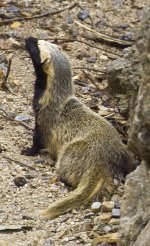
The body of the
Lesser Grison (
Galictis cuja) and the neck are long, and it has a narrow chest, short tail, short legs and the head is small too. Furthermore, its ears are rounded and also small. Salt and pepper would be the best description for the head's top and the tail. Its belly, throat and legs are pure black but every once in a while, grizzled. A Lesser Grison's fur is basically coarse, but the undercoat is short and soft. The toes are webbed in character, claws look menacing enough, being sharp and curved. Lesser Grisons have heels that are hairy, but the soles are bare.
The Lesser Grison is found in Bolivia, Peru, central Chile, Uruguay, Paraguay, Argentina and Brazil. At Peru, the Lesser Grison stays in high altitudes while in Paraguay, they could be seen in moisture-deprived grounds. Still, these grisons are able to live in a wide number of habitats, and some of these are: brushy territories below timberline, semideciduous montane forests, evergreen lands, steppes, open woodlands, chaco desert, arid srub areas, and even seashore grounds.
The Lesser grison is categorized as monogamous, pairs hunt during times where the young are being reared. The litter size ranges from 2 to 5, and the young are capable of leaving the birth place just after a few days. The Lesser Grison is recognized for its aggressiveness, fact is, there is a Chilean expression which says: "estar como quique", translated as: be like a grison. According to one recorded event, a grison met three dogs (this was in Uruguay) and it was able to hold its own, meaning to say, it must have survived, maybe even killing all three. Here is another amusing incident, a guinea pig was traversing uphill, hidden by tall grass, a grison was moving too (uphill) in a random fashion. Its movement carried it to meet the pig's direction head-on, and it was obvious that neither had been aware of the other's presence. They collided, and the shocked pig fled, while the grison was left behind.
They are active in daytime, but they also go for prey during dusk hours.
Female grison would play with a living prey (ie. grasshoppers) after the capture. It would play with it for 4 to 45 minutes.
Image of the Lesser Grison by Ken Erickson, licensed under
GFDL
You can help spreading the word about this animal by stumbling it by pressing
this link 
or discuss things in our
Animal Forum
- Permanent Link
Thursday 26 July 2007
Visayan warty pig

The Philippines may just be slightly more than a dot when you view it from a giant world map, but it is home to some of the most unusual animals in existence. According to the history books, these forest-living pigs have only been acknowledged as a separate breed in the early nineties. I am referring to the
Visayan Warty pigs (
Sus cebifrons). The Visayan Warty pig may have been discovered just recently, but from all indications, they have been around for a very long time. At present, they are already being labelled as 'critically endangered'. (if estimations are indeed correct, these pigs are the most critically endangered among all wild pigs on the face of the globe.)
When mating season comes, a Visayan Warty pig would grow manes, giving it a Mohawk facade. The Visayan Warty pig has 3 sets of bumps found on the face. The world's biologists contend that these bumps serve a crucial role: protection against tusks when facing off another Visayan Warty pig, or maybe any tusked animal for that matter.
The Visayan Warty pig holds notoriety in the Philippines for raiding crops, and they are ordinarily seen in sets of 4 or 5, but a group of 12 is not impossible. The piglets are seen on dry season, and speaking of piglets, the litter usually holds 3 to 4.
In the wild, very little is actually learned about these pigs, but those captured have been described as playful. It is capable of eating any of the following: fruits, roots and cultivated vegetables.
Let us go back to their 'endangered' state, why is this so? They are native to 6 islands of the country, and they are already threatened on 4 of those 6. Not only due to the loss of habitat, but other causes include the farming system of slash/burn and also interbreeding with the other kinds of pigs. Lastly, the damage done by these pigs to the crops of citizens has given rise to irritation/anger from the farmers/planters, which in turn results to hunting.
Picture by B Gratwicke, Oregon Zoo, licensed under
Creative Commons Attribution 2.5 License.
You can help spreading the word about this animal by stumbling it by pressing
this link 
or discuss things in our
Animal Forum
- Permanent Link
Tuesday 24 July 2007
Jungle cat
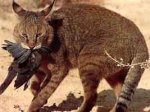
The population of
Jungle cats (
Felis chaus) is significant in India (and adjacent nations), but is recognized by just a singular historical specimen from Vietnam or Cambodia. At Indochina, all the other small/medium cats are noted more often than the Jungle Cats. Habitat survival (read: adapting) in other areas would allow a better conservation status if man's hunting could be cut down considerably. Sadly, they are frequently killed by man, and maybe we could not blame them (the humans)...these cats have been known to kill livestock too.
The Jungle Cat is active during the day, and they have a shelter to take refuge in if a rest is needed. Breeding season for the Jungle Cat depends on the range actually. At the north parts, they mate during the winter da
ys, but if they are in the south areas, they could mate at any time within the year. When gestating is through (2 months), one to six kittens come out. When the newborn reaches 8 weeks old, they are weaned, and at about
6 months old, they could be segregated from the female parent. These cats are solitary by nature, and when resting, one would twist the forefeet and put them under its body.
Let us go to the Jungle Cat's food habits, they eat small mammals, hares, snakes, birds, frogs and lizards. Eating or not, they are often located near water, and the moist territories give them the best habitat cover of
grasslands and reeds. (These are useful to them in the way of camouflage.) It may fascinate you to know that present-day scientists think and hypothesize that domestic cats hold similar genetic links to this kind of cat, but that could not be proven yet beyond a shadow of a doubt.
In the mating season, a male would bark, in a dog-like fashion.
You can help spreading the word about this animal by stumbling it by pressing
this link 
or discuss things in our
Animal Forum
- Permanent Link
Sunday 22 July 2007
Banded mongoose
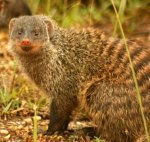
A
Banded Mongoose (
Mungos mungo) lives in parts of Africa, and its main distribution is at the Sahara's south parts. Outside this main distribution, it could be located from Gambia to Ethiopia. Banded mongooses could survive on many habitats, such as rocky ground, woods and grasslands. One habitat they could not survive on however, are the deserts.
It is basically considered as small, in the breeds of mongoose. A Banded Mongoose could be recognized apart from its relatives by the set of black marks along the back, midback and tail's area. Their cheek teeth have rounded cusps, and a Banded Mongoose's muzzle is quite pointed. Just like us, it has 5 digits on the foot (front) but at the hind foot, it has four (unlike us). These hind feet have claws.
The litter size varies, anything from 2 to 6, and these young come into the world via grassy chambers, which are holes on the soil, or even termite homes. A young would be fed by a lactating female, not necessarily the m
other. If the pack leaves for preying adventures, on the average, a female for 8 newborns would be left behind. The newborns would start leaving the nesting ground at around a month old.
A Banded Mongoose is diurnal, and definitely not a solitary creature. They exist in packs that number from ten to twenty. However, when hunting, there are times when an individual would be a loner. As per past observations, it has been shown that they help each other when the prey is a dangerous one, like a sand snake. What about aggression within the males within the same pack? Very little actually, any quarrel over food is conceded to the dominant male. If the pack is under threat, they would all scatter in any and all directions, if escape is going to be an easy one for them. Now it gets interesting, if escape is NOT easy for them, they would get close to each other, encircling the young ones.
The reproduction within a group is usually synchronized, and as a result, many females would give birth WITHIN the same week, just few days apart.
* Author: TKnoxB]
*
Source
* Licensed under
Creative Commons Attribution 2.0 License
You can help spreading the word about this animal by stumbling it by pressing
this link 
or discuss things in our
Animal Forum
- Permanent Link
Friday 20 July 2007
American Black Bear
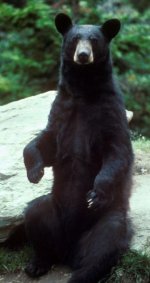
The
American Black Bear (
Ursus americanus) exists in various places: Canada, from Atlantic to Pacific, and 40 states of the US. There were probably around 2 million of these bears prior to European colonization, but their numbers drastically went down to 200,000, coming from the destruction of their habitat.
The female American Black Bear weighs from 40 to 180 kg, while the males from 114 all the way to 274 kgs. Those are the norm, but it has been known that a male could go up to 365kgs, but that would be a very rare occurrence. Adult American Black Bears have round ears, small eyes and a long snout. Usually, they would have shaggy covering, but the color would differ: there are brown, black and even blonde. They could stand/walk using the hind legs, but usually, they move on all fours. The shuffling walk we are so familiar with comes from the fact that the hind legs are a bit longer than the front ones.
The typical American Black Bear of Canada opts to stay in forested areas, wet hardwood and forests (conifer kind). They sometimes go through hibernation in winter and to take refuge, would build their homes in tree holes, banks, and even under logs. For the mountain areas, they would opt for lower elevations in the search for food, and they would relocate to northerly slopes (higher ground) when summer sets in. These bears actually climb the trees if under threat, and they use the forest as travel paths.
The mating is usually done in summer, June to middle of August, with some variations in some cases. Cubs are tiny, born hairless and blind. The average is 2-3 cubs for a birth, but a number of five is not impossible. In times where a parent (female) senses any kind of threat, she would grunt as a warning to the cubs, and they would then climb up (a tree)...actually, the survival of the young depends on the parent's skills in teaching. Teaching in terms of eating, where to take refuge, and when to anticipate dangers.
The concept that these bears are inclined to kill/harm humans without provocation is probably a gross exaggeration. Estimate-wise, there have been ONLY fifty-six cases of humans (being killed) in North America, for the past century.
You can help spreading the word about this animal by stumbling it by pressing
this link 
or discuss things in our
Animal Forum
- Permanent Link
Wednesday 18 July 2007
Fallow Deer

A
Fallow Deer (
Dama dama) is slender, medium-sized, and its appearance is not exactly ordinary. They are not as stocky as their brethren kind, the legs are quite long, head is thin, and the neck is long, but no...not as long as a giraffe's. A Fallow Deer presents a graceful facade, and it is in fact a parkland creature enjoying popularity. Its coat is quite a sight with its patterns and color. Many Fallow Deers have pale flanks of chestnut brown, while lower areas are white, the same goes for the inside of legs.
Its tail is long, holds a black end, making it stand out against the rump's white. The male, and they are known as bucks, are bigger and heavier than females. The male Fallow Deer has antlers, which are absent from the distaff side. Indeed, to say that a Fallow Deer's antlers are impressive is not an understatement. Not like other kinds of deer, the Fallow Deer's are flat and broad. Fact is, the antler is dependent on the age of the individual, with of course the old ones holding the largest antlers, fascinating datum huh?
Right after the Ice age (last), these deers were discovered in North Africa, and parts of the Balkans, but due to the heavy hunting of mankind, the numbers quickly went down. Until it came to the point that Asia Minor was the only place where they could be found. That was then, nowadays, they could be found at a lot of European states. Outside of Europe, they could also be found in the United States. They live a maximum of 11 to 15 years, but those are the ones in captivity, the ones at the wild do not last that long, and it is of course due to predation and the elements. Did you know the deer's antlers grow afresh every year?
Picture by
de:User:APPER, licensed under
GFDL
You can help spreading the word about this animal by stumbling it by pressing
this link 
or discuss things in our
Animal Forum
- Permanent Link
Saturday 14 July 2007
Douglas Squirrel

A
Douglas Squirrel (Tamiasciurus douglasii) is a kind of sentinel, it acts as one for the other forest animals by letting out a harsh sound when predators (that includes us, mankind) come into proximity. These squirrels take refuge in tree holes, which were built by the woodpeckers, and their nests are made up with moss and bark. Since they are in fact squirrels, it is no surprise that they have as their diet: seeds from Shore Pine, Douglas Fir, and the other kinds of cones. Douglas Squirrels would slice off a scale, throw this off, then get the seed within. Those discarded scales would then in time, go up like a tower from being accumulated, and this is called midden (if you see one, chances are, a squirrel is just within sight).
A Douglas Squirrel would also harvest nuts and green cones, then hide these to serve as their "buffer" for winter season. A lot of cones in fact are forgotten over time, and germination by the seeds would occur. Mushrooms could also be taken in by a Douglas Squirrel, but not only that, flowers, mice, invertebrates are also eaten at one time or another. They are active all throughout the year, save for the very cold season. In the latter, a Douglas Squirrel would just stay inside a tree (the holes) and sleep, just like the other kinds of squirrels. As soon as the climate heats up again, they would resume their running ways.
One lone squirrel would inhabit an area of around 1 hectare, and is very possessive of this. It would chase the other squirrels if they violate its sanctity, but in this chasing, the fun continues. When the trespassing squirrel reaches its own "sanctuary", he would then turn around, face the pursuer...and the pursuer would then become pursued. It would be fun to watch this in action.
Picture of the Douglas squirrel by Franco Folini, licensed under
GFDL
You can help spreading the word about this animal by stumbling it by pressing
this link 
or discuss things in our
Animal Forum
- Permanent Link
Thursday 12 July 2007
Mongolian gazelle

Measuring around 1m to 1.5m, with a weight of 20 to 40kgs, the
Mongolian gazelle (Procapra gutturosa) could be recognized from its buff covering, which is paler during the winter season. The males are the only ones who hold the lyre-formed horns, and these horns curl backward and go parallel to its back, and these horns grow about .40cm.
Longevity is expected to be seven years, and talking about their mating, it occur
s from November all the way to January. Newborns lie quite hidden from the world,
that is, for the initial days. After about four days to a week, they would joini
ng the parents.
During winter/autumn days, a Mongolian gazelle is active in the daytime, they gra
ze during mornings and even afternoons. Mongolian gazelles are very fast, they co
uld run all the way to 39 kilometers/hour, they could hold this clip at 12,000 meters...impressive isn't it? That is not all, they could jumpo up to two meters into air. Still, not only that, a Mongolian gazelle is a strong swimmer and could traverse big rivers...and as such, these gazelles are capable of doing big-scale migrations. A herd of 6,000 to 8,000 (both genders) congregate during the spring, and they could cover at least 200km in one day, and even while not migrating, a Mongolian gazelle could move above 20 kilometers in a day's time.
What do they eat: herbs and grasses principally. Who eats them: principally, the
wolves. At the moment, they do not fall under the endangered kind, but they are g
oing there, from all indications. Time will only tell if in the immediate future,
they would be endangered, or if they would prevail (I can make a good guess, and
it would coincide with yours).
Picture of the Monoglian gazelle by Alessio Marrucci, licensed under
GFDL
You can help spreading the word about this animal by stumbling it by pressing
this link 
or discuss things in our
Animal Forum
- Permanent Link
Tuesday 10 July 2007
Argentine gray fox

The
Argentine gray fox (Pseudalopex griseus) goes by a couple of other names, namely Chilla or the Grey Zorro. Argentine gray fox can be located in the south part of South America, especially Chile or Argentina. At Argentina, the Argentine gray fox lives at the semi-arid parts. Most specifically, they live in the sandy soil, shrubs and grasslands too. Numbers-wise, they hold the largest in Chile, the smallest numbers are in Peru. They could also be seen on both ends of Andes Mountain range.
Argentine gray foxes are small, weighing at around 2.5 to 4 kilograms, and lengthwise, they could go from 43 centimeters up to 70 centimeters. Diet of these foxes is made up of: rabbits, birds and rodents. Technically though, these foxes fall under the omnivores.
Breeding occurs in March, and when a gestation of two months has passed, 2-4 newborns would form the litter. In the way of caring for the newborns, both genders participate.
The Argentine gray fox holds long canines, its tail is very obvious, ventrally, dark brown while it is black at the other areas. The snout of the Argentine gray fox is sharp, and its ears are triangle-shaped.
They are social creatures and live in burrows or even dens found in rocks. It is not a safe place for these foxes, and I mean "absolutely safe", they are hunted. A lot of people call them "lamb killers", and that is one great misconception. These foxes very seldom kill these animals, although during a drought, they may kill a sick lamb just to survive.
Interesting fact: You may find it weird, but this particular fox is capable of eating geese.
Picture of the Argentine gray fox © 2006 Carla Antonini , licensed under
Creative Commons Attribution-ShareAlike 2.5 Argentina
You can help spreading the word about this animal by stumbling it by pressing
this link 
or discuss things in our
Animal Forum
- Permanent Link
Monday 09 July 2007
African Manatee

The
African Manatee (Trichechus senegalensis) is a big, roundly-shaped mammal, whose forelimbs could serve as flippers...and whose rear is horizontal and flat. Its flexible flippers are for touching, embracing (other manatees of course) and in moving their food. The upper lip has a bristly layer, and it is segregated. It may interest you to know that they do not have canine teeth/incisors, so what do they have? Only molars, and these are for crushing their vegetation intake. Older ones (molars, not the Manatee) fall out, and a new set materializes.
Another name for it is the 'West African Manatee'. It weighs below five hundred kg. African Manatees are known to reside in lagoons, coastal territories and big rivers- from brackish all the way to freshwater. An African Manatee is dependent on hanging vegetation, as opposed to those submerged. A typical member of this breed is capable of journeying from 30 to 40 km per day through various waters.
The African Manatee's population runs from Mauritania up to Angola, but their num
bers are on the way down. This has been caused by hunting, captures, among lesser
reasons. There has been legal mandates set to protect the African Manatee, but i
t is still targetted by humans. Every so often, they are killed in control gates
(dams) and turbines. If the locus is significantly damaged, a breed that thrives
in it is also affected. In this case, coastal wetlands have been ruined due to ma
nkind's activities. Cutting of wood has been causing the disintegration of mangro
ve areas. The clearing of mangroves greatly affect lagoons and other bodies of wa
ter.
Although the occasional shark or croccodile kills a manatee, the main threat for these animals are human related, habitat loss, poaching and other environmental influences.
Interesting fact: The Manatee has the unusual capability of moving each side of i
ts lips independently.
Picture of the West african manatee by Sharon Mooney, licensed under
GFDL
You can help spreading the word about this animal by stumbling it by pressing
this link 
or discuss things in our
Animal Forum
- Permanent Link
Sunday 08 July 2007
Tayra

The
Tayra (Eira barbara) lives in the evergreen forests of America, Central and Southern parts. Tayras have also been known to exist in Trinidad. A Tayra is a long weasel, with a bushy tail, a long neck, with low-hanging and rounded ears. The color differs from one place to another, but in the main, a Tayra has a brown body with lighter-shaded head, and on its chest, a patch is present. They have dark muzzles, long claws that are used when they go on their climbing adventures.
What does a Tayra consume to live: it is omnivorous, they choose smaller mammals
(like the rat) but they have been known to eat reptiles, vegetables and fruits.
It produces its litter (2 to 3) after gestating for seventy days, approximately.
Newborns would open the eyes when they are 35 to 58 days old, and nursing occurs
for 2 to 3 months, again, on the average. Captivity-wise, longevity is up to 18 y
ears. They are diurnal, living in family sets. One impressive thing about them is
that they are both be terrestrial and arboreal, which helps them escaping from chasing predators.
These weasels had been used by different peoples for rodent-hunting. It has been
known that they also feed on sugar fields and poultry, it cannot be said that the
y do drastic harm to the economic side of human's life.
Interesting fact: When startled, it would produce a barking noise, then it would rush to the refuge of the nearest tree or tall plant.
Picture of the Tayra, by
Dirk van der Made, licensed under
GFDL.
You can help spreading the word about this animal by stumbling it by pressing
this link 
or discuss things in our
Animal Forum
- Permanent Link
Friday 06 July 2007
Kodkod
Kodkods (Oncifelis guigna) live in the forests of South Andean/ranges of Argentina and Chile. A Kodkod is also capable of staying at disturbed environments, records have been made of captures in cultivated lands and secondary forest areas. A Kodkod is a small felid (feline) measuring from .58 to .68 m, that includes the tail of this animal. Color-wise, they can go from gray brown to (sometimes) black. Usually though, a Kodkod's ears are black with light spots. According to some experts, these cats could be the subspecies of the Geoffroy's Cat. One very unusual trait of these cats is the fact that they could nest in bamboo thickets found under trees (whatever it is they do there...your guess is as good as mine). Allegedly, it is the smallest cat existing in the Americas.
This is one rare creature, and due to its rarity, almost nothing could be said about their reproduction, either captured or out in the wild. However, this much is known: a litter size could be from 2 to 3 young. A Kodkod is nocturnal, very arboreal, that is, they go to the trees when chased by the wild's predators, whichever it may be.
Food habits: they have been known to survive on birds and tiny mammals. Their favorite foods are birds and rodents. They may actually survive in eucalyptus plantations, as some findings assert. One solitary male exists (existed, if it is dead by now) in a zoo somewhere in Chile. Life expectancy is about eleven years, but that is an average.
The gestation lasts from 72 days all the way to 78. Litter could be from 1 to 3.
interesting fact: "Kodkod" could have initially referred to the Pampas cat (O colocolo). The latter was also referred to as Guigna by the Chile people.
You can help spreading the word about this animal by stumbling it by pressing
this link 
or discuss things in our
Animal Forum
- Permanent Link
Wednesday 04 July 2007
Hirola

The average mass of a
Hirola (Damaliscus hunteri) ranges from 80 to 120 kg, with an average shoulder dimension of 1 meter. As of the moment, experts contend that there are less than four hundred individuals on the face of the planet.
Competing with domestic cattle is believed to be the fundamental reason for the Hirola's dwindling numbers, but there are still other causes. Poaching is one, which is the reason for so many species going under the "near-extinction" roster. As far as the US is concerned, only a single Hirola exists in capture, that is, a female at Texas' Gladys Porter Zoo.
For those that are remaining, the Hirola is confined to territories in Somalia and parts of Kenya, but it has been introduced too at the Tsavo National Park. Not to put too fine a print on it, but this antelope is now Africa's most endangered antelope, and their numbers have both shockingly and sadly gone down to a very small number, a process mankind has witnessed for the past three decades.
These antelopes could be found on grassy, arid areas. They are diurnal (active on daytime), and during nighttime, they graze. Typical herds would have anything from 2 to 40 females, under the control (and we can safely guess, defense) of a male. During fights, a male would go down on its knees, but when it is wrestling with another, they are up on all legs.
Picture of the hirola licensed under
GFDL
You can help spreading the word about this animal by stumbling it by pressing
this link 
or discuss things in our
Animal Forum
- Permanent Link
Monday 02 July 2007
Honey Possum

Scientifically, it is called (Tarsipes rostratus) but in layman's terms, it goes by the sweet name of
Honey Possum or Noolbenger. Physically, they would range from 6 up to 9 centimeters, and lifespan of the typical possum (this kind) is from 1 to 3 years. Their habitat is in the southwest territories of Western Australia, and their 'residence' may be confined, but they are nowhere near our list of "threatened" animals.
A Honey Possum has a pronounced snout, a long tongue that is capable of taking in nectar and pollen. One thing crucial to these possums is floral presence, meaning a huge diversity of it, it would die if deprived of the necessary amounts of nectar. Its feet (both back and front) are build for climbing trees, and also for going through the undergrowth at noteworthy quickness. These possums are among the smallest known but their overall appearance is not exactly ordinary. Their toes hold sharp claws, and this makes it possible for them to hold on to both leaves and bark.
A Honey Possum is mainly nocturnal, but it does not mean it sleeps all the time during the day. It feeds in daytime if the weather is on the cooler side.
Their breeding is on the summer period, and they could start mating at the age of a half-year. A young Honey Possum would take shelter in the parent's pouch, feeding on the milk for about 8 weeks. After that length of time, they would have a fur coating that would allow them to survive on their own.
They could be found in shrub-filled lands, low woodlands and it goes without saying (as you can deduce from what I said earlier), their biology is connected to the presence and distribution of nectar-giving flowers. These possums travel in groups, feeding not only on pollen, but on insects as well.
Interesting fact: Some experts think that the Honey Possum is the one and only survivor of a long-extinct marsupial kind.
You can help spreading the word about this animal by stumbling it by pressing
this link 
or discuss things in our
Animal Forum
- Permanent Link
Sunday 01 July 2007
Weddell Seal
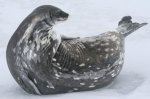
The
Weddell Seal (Leptonychotes weddellii) could be found scattered all over the Antartic but also on (at least) 15 islands nearby. They are arctic region dwellers, both on fast ice and on sea, migrating is something they do not do, and being shifted from one place to another are caused by ice conditions/movements. Swimming underwater happens when the ice areas are thin so that the Weddell Seal could punch holes (by their teeth that is). From November up to the Yuletide season, the females become pregnant.
They give birth on sea ice. Weddell Seal newborns weigh around 30 kg upon birth, but that is on the average. Six weeks of age is the time for weaning, and here is one trivia for you. The male Weddell Seal do not usually mate until six to seven years old. This particular seal navigates in slow motion (humping motion that is) both on ground and on ice. This you do not (chances are): the Weddell Seal could swim at a clip of 5 to 7 knots. The depths they can reach could go up to 600 meters, and it could remain submerged for 60 minutes. They also eat underwater.
Weddell Seals are are killed for dog-food purposes that have seal as an ingredient. One last thing, in case you are wondering about the name, they were named after James Weddell, the top man of a sealing expedition.
Interesting fact: Studies done by scholars/experts on the vocal ability of these seal have helped in mankind's attempts in the field of communications with animals.
You can help spreading the word about this animal by stumbling it by pressing
this link 
or discuss things in our
Animal Forum
- Permanent Link