Wednesday 27 September 2006
Markhor - official animal of pakistan
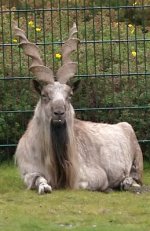
The
Markhor (Capra falconeri) is a goat-antilope from the himalayas where they graze at altitudes of 500 to 3500 meters high. Males are usually solitary and females gather in herds of about 9 individuals. Males can weigh from 80 to 110 kilograms, while the females only weigh around 32 to 50. Predators of the Markhor are wolves, the Himalayan lynx, snow leopards, panthers and golden eagles prey upon young markhors. They are prized among trophy hunters and used for the Asian medicine market. Markhors are declared an endangered species and the survival of the species is dependent upon conservation programs. The Markhor is the official animal of pakistan and means 'snake eater', although it is a strict herbivore.
Picture by F. Spangenberg, licensed under GFDL.
You can help spreading the word about this animal by liking it on facebook
Permanent Link
Monday 25 September 2006
Order Diprotodontia
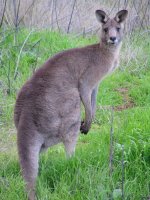 Diprodontia
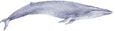
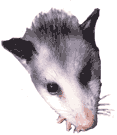
 is a very diverse order of marsupials including the koala, kangaroos, possum, wallaby, and their relatives, about 130 species in total. They all live in Australasia and they are recognized by their second and third digits of the hind feet fully fused except for the claws. They have soft fur and a single pair of developed incisor teeth in the lower jaw (hence the name:di is two; proto is front; odontia is teeth), and sometimes an additional pair. When around 50,000 years ago the first humans arrived in Australia, some members of this order became extinct, with human activities such as hunting and setting fire to forests. In the order of Diprodontia several new mammal species have been discovered in the last 25 years, a rare occasion.
Some characteristic species in the order Diprodontia
You can help spreading the word about this animal by liking it on facebook
Permanent Link
Sunday 24 September 2006
Greater Bilby
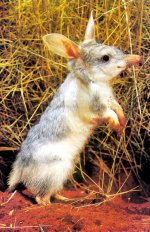
The
Greater Bilby (Macrotis lagotis) is a marsupial, wearing its pouch backward to prevent any dirt coming in while digging. The other species in the genus Macrotis, the Lesser Bilby is extinct since the 1950s, because of fur trapping and the introduction of foxes and competition with introduced rabbits. The Greater Bilby is a nocturnal animal which live under the ground in burrows. Its diet consists of insects and their larvae which they search by digging small holes about 10 centimeters deep. They do not need to drink water as they get that from their food. Their numbers greatly declined because of the same reasons as the extinction of the Lesser Bilby. Bilbies have a long muzzle, characteristic to bandicoots and very long ears. There have been succesful
reintroduction programs of the Bilby in Western and Southern Australia once rabbits, cats, and foxes are removed.
Links
Queensland government Environmental Protection Agency - Bilby
You can help spreading the word about this animal by liking it on facebook
Permanent Link
Thursday 21 September 2006
Ring-tailed mongoose
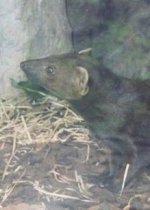
The
Ring-tailed mongoose (
Galidia elegans) is actually more related to the
Fossa than it is related to a mongoose. As its name implies it has a tail colored with red and black rings. It lives in Madagascar, where it hunts on small mammals, fish, eggs,
reptiles and invertebrates, and occasionally fruit and insects. It is very agile and a proficient climber. Over the past 10 years the ring-tailed mongoose population in Madagascar decreased by 20 %, mostly because of habitat destruction and competition with the Indian Civet and feral dogs and cats. It is listed as vulnerable on the IUCN Red List.
You can help spreading the word about this animal by liking it on facebook
Permanent Link
Tuesday 19 September 2006
Sugar glider
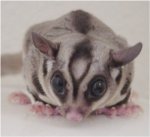
The
Sugar Glider (Petaurus breviceps) is a gliding possum and has about the size of a squirrel, living in Australia, New Guinea and Tasmania. They can glide up to 45 meters and they can bark as a squirrel also do. Sugar gliders are omnivorous and they are very fond of eucalyptus tree sap. They can fall into hybernation for a short period of time, when the weather in a particular area becomes too cold or there are long periods of food scarcity. Sugar gliders make excellent pets and there has been a recent boom in the American pet population of sugar gliders. Currently, the USDA's guidelines for owning and breeding sugar gliders in the United States varies from state to state. In captivity, sugar gliders can become 14 years of age.
Links
International sugar glider association
Image
Photograph by User:Dawson, licensed under Attribution ShareAlike License v. 2.5
You can help spreading the word about this animal by liking it on facebook
Permanent Link
Thursday 14 September 2006
Meadow vole
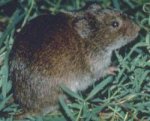
The
Meadow Vole (Microtus pennsylvanicus) is also called Field Mouse or Meadow Mouse. It is a member of the order Rodentia (rodents) and resembles a mouse, but with a stouter body, a shorter hairy tail, and smaller ears and eyes. The Meadow vole is the most widespread vole in the United States. They are hunted on by snakes, owls, hawks, falcons and various
carnivores. Its size ranges from 12,8 to 19,5 centimeters. They are active all day, but most active during the night. They dig burrows to store food and give birth (litter size ranges from 2 to 9, with 6 / 7 on average). Meadow voles can be kept as pets.
You can help spreading the word about this animal by liking it on facebook
Permanent Link
Wednesday 13 September 2006
Giant panda
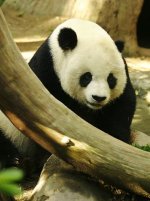
The
giant panda bear (Ailuropoda melanoleuca) is classified as a member of the family Ursidae (bears) and is native in Southern and Central China. Its diet consists almost completely on bamboo, although eggs, insects and fish act as necessary supplement of protein. Although it is a bear, it does not hybernate, just like other subtropical mammals. Because of habitat loss and low birthrate, the Giant Panda is an endangered species. They spend, on average, 12 hours a day eating bamboo. The problem with bamboo is that when the plants reach maturity, they give seeds and die all at once, forcing the panda to move to another area. When areas are disturbed by humans or cut off, the Giant Panda is in danger. Only about 1600 live in the wild, and estimates around 300 are living in zoos around the world. Until 1997, killing a Giant panda in China resulted in the death penalty (in 1997, the sentence was changed to 20 years of prison). Pandas can become 34 years of age in captivity. In the wild they usually become 14 to 20 years of age.
Photo by Aaron Logan, licensed under Creative Commons Attribution 1.0.
You can help spreading the word about this animal by liking it on facebook
Permanent Link
Friday 08 September 2006
Bumblee bat or hog-nosed bat
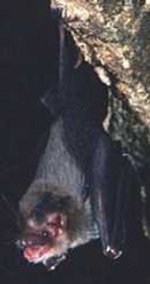
The
Bumblebee Bat, or Kitti's Hog-nosed Bat, (Craseonycteris thonglongyai) is the worlds smallest mammal. This is when you define smallest as 'the smallest mammal by length' as opposed to 'the smallest mammal by weight'. Its length ranges from 2.9 to 3.3 centimeters and it weighs between 1.7 and 2 grams. It lives in Thailand in small holes or in crevices formed by stalactites in caves and is most active at dusk, where it flies above the bamboo and teak trees to feed on insects, either in flight or on the trees. Bumblebee bats were first discovered in 1973 by Kitti Thonglongya. Their major threat is deforestation by the teak logging industry.
Picture by Tim Menzies, licensed under GPL
You can help spreading the word about this animal by liking it on facebook
Permanent Link
Sunday 03 September 2006
Steller's sea cow
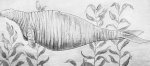 Steller's Sea Cow
 (
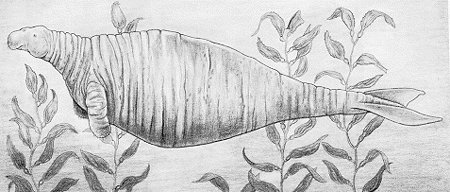
Hydrodamalis gigas) is an extinct mammal from the order Sirenia in the animal kingdom, which also includes the manatee and dugong. It got its name from the man who discovered it, Georg Steller. The Steller's Sea Cow was hunted to extinction in the 18th century, only 30 years after its discovery. It was slaughtered for its meat and leather. It could way up to 11,000 kilograms. The Steller's sea cow did not have any teeth and did not need to, as it ate algae and sea grass. Herds included juveniles, as well as adult males and females. Juveniles were kept in the center of the herd to protect them. Steller (its discoverer) noted that the animal was monogamous and the pair bond was quite strong. He also noted that the sea cow could only be submerged for about four to five minutes. This makes the sea cow an easy target for hunters.
From wikipedia on the Steller's sea cow: "There are still sporadic reports of sea cow-like animals from the Bering area, the Arctic, and Greenland, so it has been suggested that small populations of the animal may have survived to the present day. This remains so far unproven."
The thumbnail of the Steller's sea cow is not quite clear, Click here for a larger version of the drawing of a Stellar's Sea Cow circa mid 18th century.
You can help spreading the word about this animal by liking it on facebook
Permanent Link