

Tiger - Largest cat killed by Chinese medicine?
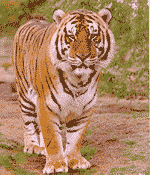 The largest of all cats killed by traditional Chinese medicine? There are different opinions among scientists, whether to call the Tiger Panthera tigris (Panthera tigris) and leave it in the genus Panthera together with the Lion and the other so-called Great cats or to call it Neofelis tigris and have it in the genus Neofelis together with the much smaller Clouded leopard (Neofelis nebulosa). But the following is not disputed: Tigers are the largest living cats. They reach a length up to 280 cm and a weight of almost 300 kg. Remarkable are the dark stripes on orange- or ochre- coloured ground. There are various subspecies, which partly differ widely in size. The largest subspecies is the Siberian tiger.
Tigers inhabit forests. They prefer regions, where they find stretches of water. Their habitats are located in the Eastern Asian region. Their northernmost distribution frontier is the Russian Amur-area, a region of extremely cold winters. On the other hand South-East Asian subspecies live continuously in tropical climate. The westernmost distribution frontier of Tigers is the eastern coast of the Black Sea.
Tigers are mostly solitary animals, living in huge home ranges. They hunt above all hoofed animals up to the size of cattle. In times of neediness they content themselves with much smaller prey like frogs and grasshoppers. Tigers give birth to 2 up to 4 young. Their mother takes care of them and teaches them to hunt when they grow up.
Tigers are very endangered. Several subspecies seem to be already extinct. There are several reasons: The destruction of their habitat but above all the hunting of Tigers. In former times trophy hunting was fashionable in some groups of people. There have been lots of battues at those times, especially on the Bengal tiger, living in India. Nowadays Tigers are protected and hunting is illegal. But nevertheless they are even more threatened by poachers at the moment than in former years. Most effected is the Siberian tiger. Some parts of the bodies of these largest cats are said to be wonder cures of the traditional Chinese medicine, for which high amounts are paid. Several years ago 500 Siberian tigers were estimated to live in the wild. This figure was alarming. But an estimate, made at the end of the nineties, revealed an even more dramatic development: Just a little more then 10 (!!!) animals seem to be alive. It's just a question of time that these last Siberian tigers in the wild are killed by poachers. Zoos try to keep a self-preserving population in captivity. Breeding Tigers is quite easy. So reproduction has to be controlled by contraceptives. There are about 5000 Siberian tigers living in zoos. The long-term goal has to be the reestablishment of conditions in their natural distribution range that allow the Tigers to survive. But this seems to be far-off at the moment. Their distribution range is too broken to take effective measures against poachers. Moreover there seems to be little political will to act at all. And as long as the traditional Chinese medicine is demanding for Tiger products, trading with killed Tigers is still lucrative - and the return of the Siberian tiger to it's natural distribution range is more than uncertain.
This article was originally published at magazine.naturspot.de. Link to the original article
two comments:
I love yur blog. what work this must be to keep up with…
Actually the vast majority of all endangered species products, especially tiger, end up in Japan. They pay HUGE money for Rhino, Whale, Tiger…
They are obsessed with with virility issues…
lonnie b hodge (Email) (URL) - 11 09 05 - 11:59
Um cool blog? I guess..
Unknown - 26 01 11 - 22:21